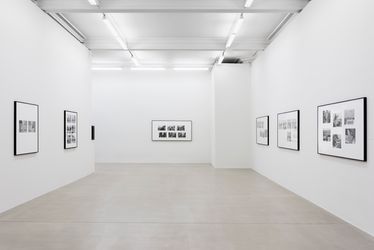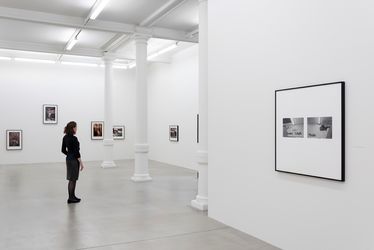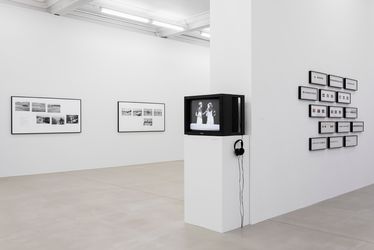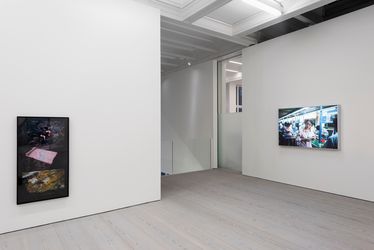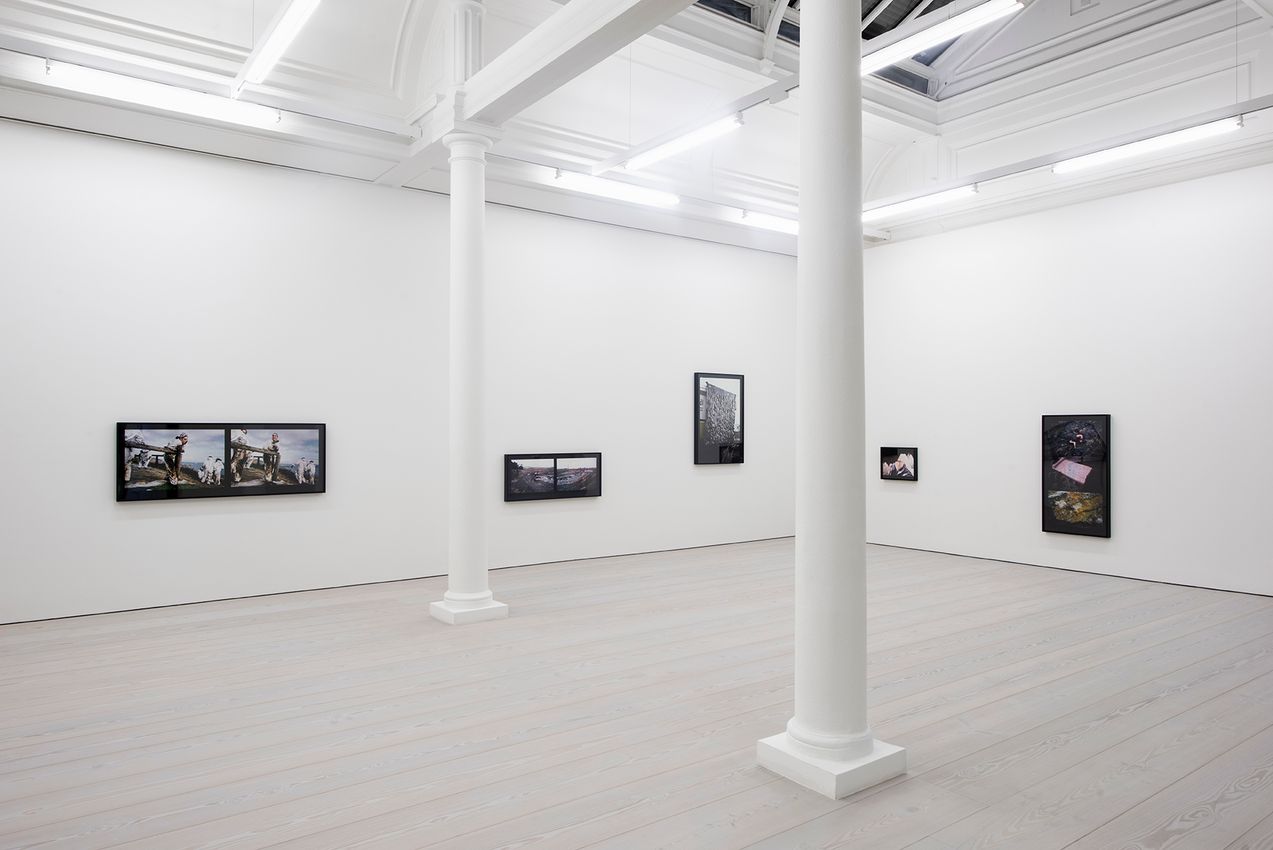
Marian Goodman Gallery London is delighted to present an exhibition of works by the late American artist Allan Sekula (1951–2013), curated by Marie Muracciole. The presentation will bring together a selection of significant works, highlighting the formal and conceptual links between different periods of the artist’s practice, including photography, film and criticism.
This exhibition focuses on the photography of artist Allan Sekula (1951–2013), who was also a writer, a filmmaker, a theoretician, and a teacher. From his student days in the 1970s at the University of California, San Diego, he witnessed the economic and social changes that eventually ended up tightly restructuring the global economic situation. Inspired very early on by critical Marxist theory, his work was consistently engaged without becoming dogmatic; he remained constantly involved in recording the evolution of the world of labour in the face of globalised capitalism, through series of photographs relating strongly to facts but also to his critical writings.
Introducing this exhibition are the photographic narratives of California Stories (1973–1975), in which Sekula documents his surroundings and everyday life, and This Ain’t China: A Photonovel (1974), in which Sekula portrays the struggles of a group of workers with the conditions of the job. The latter is shown here together with its maquette and a video piece about the same topic, Performance under Working Conditions (1973).
Sekula built his photography practice from the prolongation of some of his early performances, and against the preference developed by conceptual photography for erasing any human presence; he took charge of the medium’s social roots, vernacular uses, and the dependency of the image on a range of facts and political issues. His first writings, along with photographic essays, were published by Benjamin Buchloh in 1984 under the title Photography Against the Grain, and have stayed seminal to the critical history of the medium ever since.
Sekula constantly experimented with diverse ways of intertwining the visual and the written, arguing that the photograph, especially the single photographic image, is radically insufficient as a mode of social and artistic communication. He was in fact interested by this insufficiency, the dependency of the photograph on its context and to all that provides it some meaning, the words and texts that interfere with visual perception: ‘Here was a visual art for which, unlike cinema, discontinuity and incompletion seemed fundamental, despite attempts to construct reassuring notions of organic unity and coherence at the level of the single image.’ By creating montages of images and texts–against the myth of the adequacy and sufficiency of the medium–Sekula formed the concept of the ‘disassembled movie’.
In his work, images are always fragments in a wider series, and often in diptychs or triptychs. He would produce a slideshow or a sequence and relate it to specific writings, which in return related to images, but also to art and literature with references that shed light on his photographs. One example is Sekula’s major photographic essay and book, Fish Story (1995), with its nine chapters comprising prints, slideshows, captions, and texts. In Fish Story, like other series such as Black Tide/Marea negra (2002–2003) or films such as The Lottery of the Sea (2006), Sekula developed his exploration of the maritime world–where he would travel for months–as a significantly ‘forgotten space’. Having grown up in a harbour, Sekula was aware of the sea world as a material, social, and economic space for the problems raised by capitalism and through this, by globalisation.
The works shown here attest to Sekula’s strong political approach, in the way he looked at the world he was living in, but also in the way he experimented with photography against the idea of the medium as a universal language, or of any art ‘based on the coherence of a system or on the homogeneity of a style’.
Marie Muracciole, 2019Marian Goodman Gallery would like to thank Allan Sekula Studio for its support of the exhibition.


For over forty years, Marian Goodman Gallery has played an important role in helping to establish a vital dialogue among artists and institutions working internationally. Marian Goodman Gallery was founded in New York City in late 1977. In 1995 the Gallery expanded to include an exhibition space in Paris – with an additional exhibition space and bookshop added in 2016 - and in 2014 an exhibition space in London. The London space transitioned to Marian Goodman Projects in 2021, a new initiative to present exhibitions and artist projects in London and other select cities around the world.

A respected voice in contemporary art discourse.
Focusing on ambitious storytelling and insightful art-world commentary. Ocula Magazine publishes in-depth interviews, critical essays and timely analysis on the artists, exhibitions and ideas driving the global art world.
Learn more about Ocula Magazine
Showcasing the best of the art world.
Ocula partners with galleries from around the world to highlight their artists, artworks and exhibitions. Gallery membership is by application and invitation, with each member vetted by an independent panel.
Learn more about Ocula Membership

Specialises in the sale of major artworks.
Led by a team with deep ties to the world’s leading auction houses, galleries and collectors. Ocula’s advisory team offers bespoke services to high-net-worth clients from around the world who are looking to acquire the best of contemporary and modern art.
Learn more about our team and services