




EDWARD HOPPER
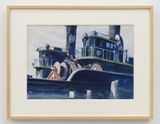
1882-1967, United StatesEdward Hopper (1882–1967) was an American realist painter and printmaker, whose enigmatic depictions of modern American life often portray solitary figures in urban settings, capturing the isolation and introspection of 20th-century existence.
Early years
Hopper was raised in a middle-class family on 22 July 1882 in Nyack, New York. He displayed artistic talent from a young age, creating detailed sketches and models of boats—a reflection of his hometown’s shipbuilding industry. After high school, Hopper studied illustration at the Correspondence School of Illustrating in New York City before enrolling at the New York School of Art in 1900, where he was taught by William Merritt Chase and Robert Henri.
Artistic development and influences
Between 1906 and 1910, Hopper made three trips to Europe, spending the majority of his time in Paris. Unlike many contemporaries, he bypassed the emerging modernist trends of the early 20th century, instead captivated by the the light and architecture of Europe. This experience would continue to feature prominently in his art for years to come, profoundly shaped his artistic sensibility.
Breakthrough and signature style
Hopper’s career gained momentum in the early 1920s. A 1924 watercolour exhibition at the Frank K. Rehn Gallery in New York was a critical and commercial success, allowing him to transition from illustration to painting full-time. That same year, he married fellow artist Josephine Nivison, who would often model for Hopper and manage his career.
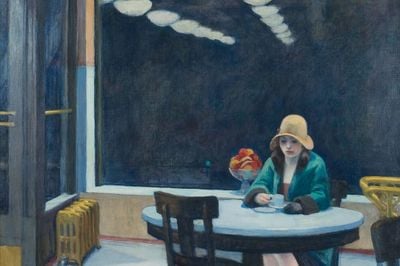
His paintings are characterised by urban isolation, stark lighting, and architectural elements, where everyday scenes are imbued with a psychological depth. Works like Automat (1927) and Nighthawks 1942) showcase solitary figures in public spaces, reflecting themes of loneliness and contemplation.
Key artworks
Morning Sun (1952) depicts a solitary woman seated on a bed, gazing out of a sunlit window, her body bathed in stark light and shadow. The composition exemplifies Hopper’s characteristic exploration of interiority and psychological stillness, evoking themes of contemplation and emotional distance within the modern domestic space.
Perhaps Hopper’s most iconic and well-known painting, Nighthawks (1942), portrays late-night diners in a brightly lit urban café. Despite depicting multiple figures sharing a space, the work evokes a modern isolation heightened by the separation of the painting’s viewer looking in from the dark street.
House by the Railroad (1925) features no figures, only a Victorian house isolated against a softly clouded sky. A railroad track crops the bottom of the composition and walls of the view of the bottom of the house, suggesting an encroachment of modernity on traditional life.
Notable Exhibitions
Hopper’s works have been the focus of many exhibitions during his lifetime and posthumously. Significant exhibitions include:
- Edward Hopper: Retrospective Exhibition, Museum of Modern Art, New York (30 October–8 December 1933).
- Edward Hopper, Tate Modern, London (7 May–5 September 2004).
- Edward Hopper, Museum of Fine Arts, Boston (6 May–19 August 2007).
- Hopper, Museo Nacional Thyssen-Bornemisza, Madrid (12 June–16 September)
- Edward Hopper’s New York, Whitney Museum of American Art, New York (19 October–5 March 2023)
Edward Hopper FAQs
What is Edward Hopper’s most famous work?
Hopper’s most well known painting is Nighthawks (1942), which portrays individuals in a late-night diner, symbolising urban isolation. The iconic scene is often referenced and parodied in pop-culture.
What influenced Edward Hopper’s art?
Hopper was influenced by his early experiences in Nyack, his studies under Robert Henri, and his time in Paris, where he developed an appreciation for light and architecture.
Where can I see Edward Hopper’s paintings?
His works are housed in major museums such as the Museum of Modern Art in New York and the Art Institute of Chicago. However, the largest collection of work by Edward Hopper is found at the Whitney Museum of American Art in New York.
Did Edward Hopper only paint urban scenes?
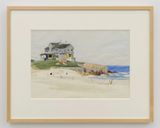
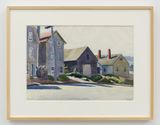
While Hopper is famous for urban scenes, he also painted rural landscapes and seascapes, particularly inspired by summers spent in New England.
Hazel Ellis | Ocula | 2025








Explore and Follow Artists Shaping Contemporary Art
A respected voice in contemporary art discourse.
Focusing on ambitious storytelling and insightful art-world commentary. Ocula Magazine publishes in-depth interviews, critical essays and timely analysis on the artists, exhibitions and ideas driving the global art world.
Learn more about Ocula Magazine
Showcasing the best of the art world.
Ocula partners with galleries from around the world to highlight their artists, artworks and exhibitions. Gallery membership is by application and invitation, with each member vetted by an independent panel.
Learn more about Ocula Membership
Specialises in the sale of major artworks.
Led by a team with deep ties to the world’s leading auction houses, galleries and collectors. Ocula’s advisory team offers bespoke services to high-net-worth clients from around the world who are looking to acquire the best of contemporary and modern art.
Learn more about our team and services