





PETER HALLEY
b. 1953, United StatesPeter Halley is a pioneering American contemporary artist known for his vibrant geometric paintings that explore themes of modern isolation, urban architecture, and digital connectivity.
Early Years
Peter Halley was born in New York City in 1953 and raised in the suburban enclave of New Canaan, Connecticut. He studied at Yale University, graduating with a BA in Art History in 1975, and later earned an MFA from the University of New Orleans in 1978. His time in New Orleans, surrounded by stark modernist architecture and the urban grid, profoundly shaped his visual vocabulary.
Returning to New York in the early 1980s, Halley immersed himself in the downtown art scene and quickly emerged as a central figure in the neo-geo movement. Alongside peers like Jeff Koons and Ashley Bickerton, Halley’s work responded critically to the structures of postmodern society.
Artworks
Peter Halley’s distinctive geometric paintings fuse abstract minimalism with bold critiques of modern life, exploring how architecture, digital systems, and social structures shape individual experience. His use of synthetic colour, textured surfaces, and diagrammatic motifs challenges the neutrality of geometry in contemporary art.
Neo-Geo Structures
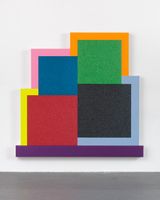
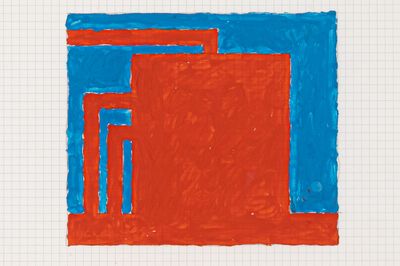
In the 1980s, Peter Halley introduced the concepts of ‘cells’ and ‘conduits’—a visual lexicon that became central to his contemporary art practice. These simplified geometric forms, often presented as glowing rectangular blocks and interconnecting bars, symbolise the confinement and surveillance embedded in urban planning, institutional architecture, and networked communication. Paintings such as Two Cells with Circulating Conduit (1985) juxtapose isolated units with rigid connections, expressing Halley’s commentary on social isolation and control. By reducing space to these charged, symbolic structures, Halley questioned the idealism of modernist abstraction, instead recontextualising it as a visual language of entrapment. His artworks from this period remain key to understanding postmodern critiques in 1980s American painting.
Colour, Texture, and Surface
Halley’s use of Day-Glo paints and textured Roll-a-Tex surfaces is a deliberate strategy that critiques both the aesthetics of suburban design and the artificiality of mediated environments. Rather than adopting the flat polish of minimalism, Halley embraces an industrial, almost synthetic finish. This approach gives his paintings a jarring material presence, accentuating their architectural associations. The texture of Roll-a-Tex, often used to mask imperfections in interior walls, becomes a metaphor for cultural veneers and institutional facades. Meanwhile, fluorescent hues—evocative of highlighters, warning signs, and consumer packaging—saturate his work with a sense of urgency and excess. Halley’s paintings do not merely depict spaces; they evoke the sensory overload of contemporary visual culture, revealing how surface itself has become ideological in art and design.
Digital and Diagrammatic
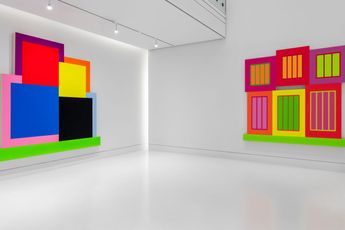
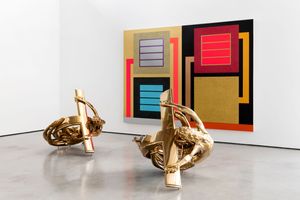
From the 1990s onwards, Peter Halley’s art expanded into immersive wall paintings, digital prints, and large-scale installations that echo the visual logic of computer networks and data systems. These later works retain his cell-and-conduit vocabulary but transpose it into sleek, reflective materials such as vinyl, aluminium, and Plexiglas. Halley’s compositions increasingly resemble circuit boards or architectural diagrams—abstract yet legible in their evocation of order, control, and connectivity. His wall works, often realised in institutional or public spaces, challenge the viewer’s spatial perception and reframe painting as a kind of diagrammatic architecture. These diagrammatic paintings visualise the unseen infrastructures—both technological and psychological—that govern modern life. By bridging digital aesthetics and geometric abstraction, Halley cements his role as a contemporary artist deeply attuned to the structures shaping 21st-century existence.
Public Commissions
- Monumental painting for Terminal D at the Dallas/Fort Worth International Airport, Texas (2005)
Awards and Accolades
- Frank Jewett Mather Award, College Art Association (2001)
Exhibitions
Peter Halley has been the subject of both solo and group exhibitions at important institutions. A selection of important exhibitions is provided below.
Solo Exhibitions
- Peter Halley: The Mirror Stage, NSU Art Museum, Fort Lauderdale, Florida (2024)
- Peter Halley in Spain, Thyssen-Bornemisza National Museum, Madrid (2024)
- Conduits: Paintings from the 1980s, Musée d’art moderne Grand-Duc Jean (MUDAM), Luxembourg (2023)
- PETER HALLEY: CELL GRIDS, Dallas Contemporary, Dallas (2021)
- PETER HALLEY: BLOCKS, The Ranch, Montauk (2021)
Group Exhibitions
- Breaking the Mold: Brooklyn Museum at 200, Brooklyn Museum, New York (2025)
- Everything Gets Lighter, Museo Jumex, Mexico City (2025)
- Somewhere Downtown: Art in 1980s New York, UCCA Center of Contemporary Art, Beijing (2022)
- THE 80S. ART OF THE EIGHTIES, Albertina Museum, Vienna (2021)
- Emerald City, K11 Foundation, Hong Kong (2018)
Website and Instagram
Peter Halley’s website can be found here, and his Instagram here.
Critical Reception
Peter Halley’s practice has been widely discussed in publications such as ArtReview, Ocula Magazine, and The New York Times.
Peter Halley FAQs
What is Peter Halley best known for?
Peter Halley is best known for his Day-Glo geometric paintings featuring ‘cells’ and ‘conduits’, which symbolise the spatial and psychological constraints of contemporary life. These bold, architectonic compositions critique modern social structures—such as urban planning, bureaucratic systems, and digital connectivity—by turning abstraction into a language of confinement and control. His work helped define the Neo-Geo movement of the 1980s and remains influential for its ability to merge visual aesthetics with structural critique in contemporary art.
Who are Peter Halley’s major influences?
Peter Halley’s influences span modernist abstraction, structuralist theory, and contemporary media culture. He draws from artists like Josef Albers and Barnett Newman, but critiques their utopian ideals by recontextualising geometry as a symbol of confinement. Halley is also influenced by French theorists such as Michel Foucault and Jean Baudrillard, whose writings on power, simulation, and space deeply inform his work. Additionally, the visual language of urban grids, mass media, and digital systems shape his distinctive visual and conceptual approach.
What role does writing play in Peter Halley’s practice?
Writing has been integral to Peter Halley’s broader contribution to contemporary art. In the 1980s and 1990s, he published widely read essays that examined the cultural context of postmodern art, addressing themes like simulation, consumerism, and urbanism. Notable texts include ‘The Crisis in Geometry’ (1984) and ‘Notes on the Paintings of Peter Halley’ (1982), which contextualise his work within broader theoretical frameworks. Halley also founded and edited index Magazine (1996–2005), a platform that featured interviews with artists, designers, and musicians, highlighting his intellectual engagement with art beyond painting.
Ocula | 2025








Explore Peter Halley's Exhibitions







Peter Halley in Ocula Magazine




Explore and Follow Artists Shaping Contemporary Art
A respected voice in contemporary art discourse.
Focusing on ambitious storytelling and insightful art-world commentary. Ocula Magazine publishes in-depth interviews, critical essays and timely analysis on the artists, exhibitions and ideas driving the global art world.
Learn more about Ocula Magazine
Showcasing the best of the art world.
Ocula partners with galleries from around the world to highlight their artists, artworks and exhibitions. Gallery membership is by application and invitation, with each member vetted by an independent panel.
Learn more about Ocula Membership
Specialises in the sale of major artworks.
Led by a team with deep ties to the world’s leading auction houses, galleries and collectors. Ocula’s advisory team offers bespoke services to high-net-worth clients from around the world who are looking to acquire the best of contemporary and modern art.
Learn more about our team and services