MASSIMODECARLO Pièce Unique is pleased to present TERRITORIES, the first solo exhibition by Vladislav Markov with the gallery.
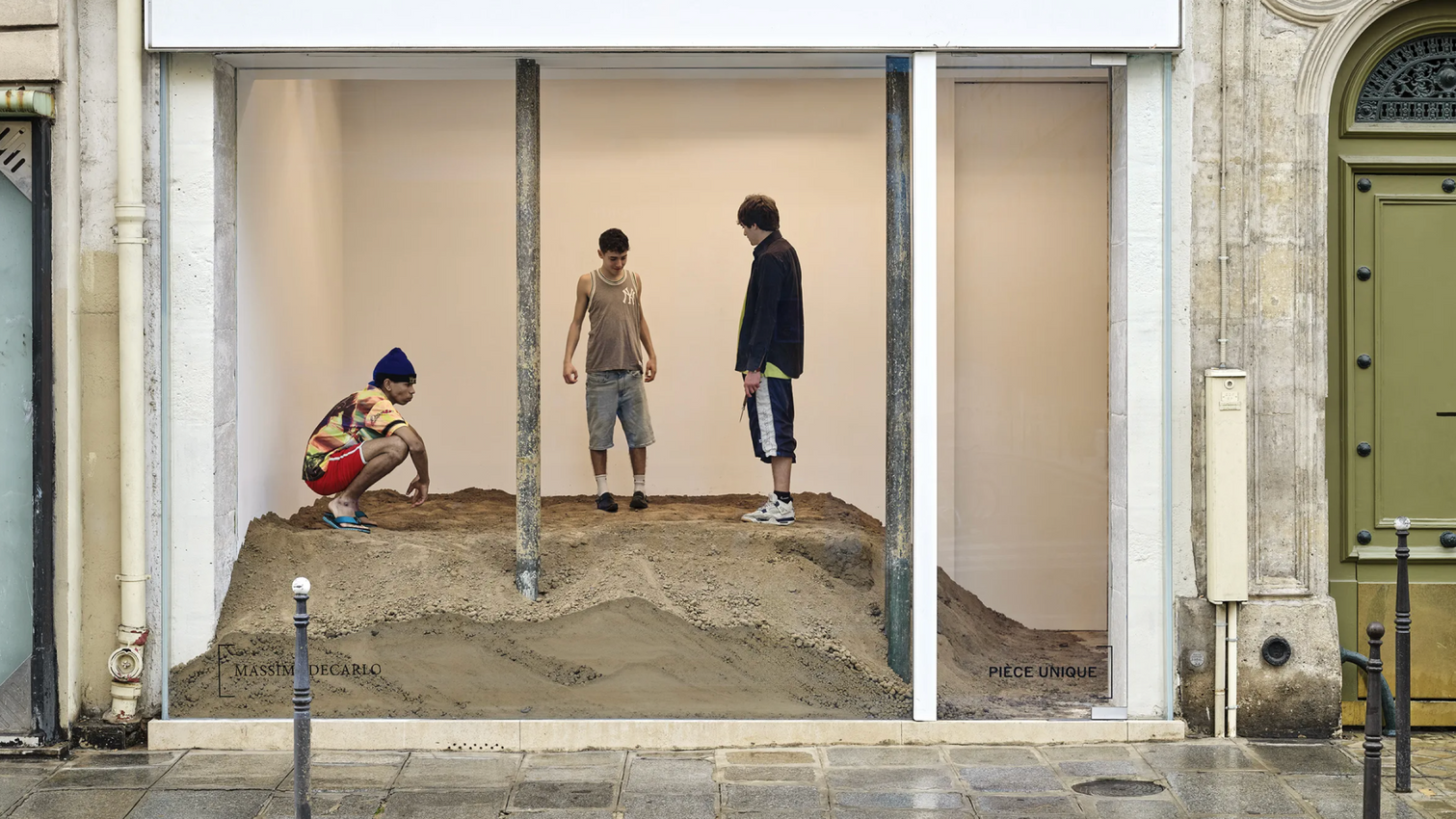
Covering Pièce Unique’s floor, wall to wall, in earth, the New York-based artist stages three teenagers who use it as the ground for nozhichki, a Soviet and post-Soviet children’s game Markov grew up playing in Magadan. A knife thrown into a rival’s territory, if it sticks, redraws the border in the thrower’s favour; a player left without land is out.
The game continues in another material. Five paintings, varying in scale, come from scans of the three players: bodies stretched and smeared, limbs trailing off like something still in motion. Among their titles: Hi sister. I am ok. giovanni vs giovanni. Hi be carefull was hacked. If I ask you something (money or help) in one of our conversations ignore it.
__But TERRITORIES is just one thread in a much wider practice: installations, sculptures, and paintings built from scanned, 3D-printed, staged material, designed to implicate the viewer, not just hold their gaze – rooms organised, again and again, around surveillance, simulation, and the mechanics of attention.
TERRITORIES closes a cycle Markov began in 2025 with Objects in Mirror May Be Closer Than They Appear in New York, a one-way-mirrored strip club worked by two amputee performers in Markov’s own custom prosthetics, and continued in 2026 with Location. Location. Location. in Zurich, a grubby kitchen looping footage of strangers stalled in a car, circling a conversation about someone recently dead. Across all three works, Markov builds a scene the viewer can enter only through a barrier – a one-way mirror, a screen, a shop window – that grants proximity while withholding entry.
TERRITORIES recalls Walter De Maria’s The New York Earth Room (1977), in which a SoHo loft was filled with more than 127,000 kilograms of soil and left untouched for decades, asking visitors to contemplate an enormous quantity of earth without ever entering it. Where De Maria’s earth stayed sealed behind glass, Markov’s gets walked on, knelt in, cut into, its condition changing by the hour.
Once ground stops being something to look at and starts being something to fight over, cruelty is no longer a metaphor. The art historian Guillaume Blanc-Marianne, writing about TERRITORIES in a recent article, returns to Walter Benjamin’s idea of play as a “miniaturisation of the adult world” – a world whose gestures, rules, and violence a child absorbs early, and rarely questions.
What sets Markov’s approach apart is his refusal to leave that zone abstract. Rather than illustrate the idea, he builds it: real earth, a real game. Facing the storefront on a busy street in the Marais, the boundary he draws does not end at the window. Standing outside, watching three minors negotiate a war of attrition through the glass, the viewer finds that attention itself has become difficult to distinguish from complicity. It is, in that sense, something closer to a controlled outbreak than a performance – a visceral, cathartic force that moves through an audience and surfaces what a society would rather keep out of view: its violence, its desire, its cruelty.
Courtesy Massimodecarlo


MASSIMODECARLO Pièce Unique opened in a historical building at 57 Rue de Turenne on February 2021. It has been renovated by acclaimed Japanese architect Kengo Kuma in collaboration with PiM.studio Architects. MASSIMODECARLO Pièce Unique offers a flexible, dynamic, and upbeat program of single-work exhibitions, visible day and night through its glass window. The gallery is born from the purchase of the “Pièce Unique” brand, an adventurous space by iconic gallerist Lucio Amelio that he opened in Paris in 1989 designed with Cy Twombly. MASSIMODECARLO Pièce Unique will respect and recast into the 21st Century the legacy of this historical project, renewing its original idea, infusing a new perspective, and offering an alternative exhibition model for the contemporary art system.
A respected voice in contemporary art discourse.
Focusing on ambitious storytelling and insightful art-world commentary. Ocula Magazine publishes in-depth interviews, critical essays and timely analysis on the artists, exhibitions and ideas driving the global art world.
Learn more about Ocula Magazine
Showcasing the best of the art world.
Ocula partners with galleries from around the world to highlight their artists, artworks and exhibitions. Gallery membership is by application and invitation, with each member vetted by an independent panel.
Learn more about Ocula Membership

Specialises in the sale of major artworks.
Led by a team with deep ties to the world’s leading auction houses, galleries and collectors. Ocula’s advisory team offers bespoke services to high-net-worth clients from around the world who are looking to acquire the best of contemporary and modern art.
Learn more about our team and services