Press Release

ARARIO GALLERY SHANGHAI is pleased to present Quantified Self, a solo exhibition by Hu Yun. The exhibition opens on November 11, 2026 and runs through January 2, 2027.

The expansion of human civilization is also a history of the migration of life. From early expeditionary fleets to today’s spacecraft, vessels have carried seeds, crops, and specimens across land and ocean, and even into outer space. Living things are collected, named, and relocated, put to use for “me.” From Crosby’s “ecological imperialism” to the “Plantationocene” discussed by Haraway and Anna Tsing, this logic has been questioned again and again: when did making nature serve human ends become the self-evident premise of civilization?

On the shores of Lake Ohrid, Hu Yun encountered a plant that can grow in soil with a high metal content and draw nickel into its own body. In today’s world of pervasive contamination, such weeds, recently classified as “hyperaccumulators,” are seen as a two-in-one solution: they “improve” the soil while supplying the raw materials needed to produce batteries. What fascinates the artist most is the logic behind this seemingly perfect solution. Once we redefine a plant long regarded as a weed as a “metal crop,” the soil that was once “barren” becomes a “mine” overnight. Has exploitation in the traditional sense been eliminated? Or has it been transferred onto the plants, these “invisible laborers”?

The exhibition comprises five groups of works. The electroformed copper plant reliefs things in nature merely grow (2026) are based on plant specimens collected during a 2025 research trip to Lake Ohrid. The specimens were molded, then re-formed through electroforming in an electrolytic bath, and cut to the “standard” dimensions of a botanical herbarium collection. The entire surface is nickel-plated, giving a dark silver finish. The installation is lit by indoor grow lights that simulate sunlight, recreating the conditions in which these hyperaccumulators are artificially “tended” in research laboratories.

At the center of the main gallery hangs the wool tapestry Untitled (Atom) (2026), made by a handweaving workshop from the Balkans. Its seemingly abstract pattern derives from synchrotron-scanned images of hyperaccumulator cells, which the artist collected while researching his commissioned work for the 10th Asia Pacific Triennial. The punch-card logic of European looms was a forerunner of binary code, and weaving was among the earliest forms of mass image production, a logic that today’s datafied world continues. Our boundless desire for ever sharper images thus raises questions about the visible and the invisible, the real and the fictional.

The glass sculpture carving water, melting stones (2021) continues the artist’s commissioned work for the Singapore Biennale. Filipino woodcarvers of religious statues, “trained” during the Spanish colonial period, have now been forced out of work and turned to performing ice carving on ocean-going cruise ships. The sculpture uses ultra-clear glass to present a block of ice that never melts. Its model is the right forearm of a wooden statue of Jesus, carved by a Filipino woodcarver in an attempt to restore it to the original state of a tree branch.

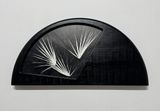
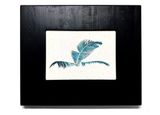
The palm-leaf works on paper scattered throughout the exhibition come from the artist’s palm series, which he has continued for more than ten years. Each palm corresponds to a specific place, mostly chance encounters during research trips for various projects. Drawing these plants one by one is also a way for the artist to ask, repeatedly, of everyone including himself: why are we so endlessly drawn to the “exotic”?

At the end of the exhibition is a black silk embroidery, modeled on a white silk handkerchief that Feng Yuxiang gave to Sun Yat-sen, now in the collection of the Shanghai Sun Yat-sen Memorial Museum. Working with a traditional Suzhou embroiderer, the artist enlarged the handkerchief’s design and embroidered it by hand in black thread on black silk. The image and text can be made out only when light falls on them.

From the metal content within a plant, to the resolution of an image, to each self that is counted and assessed, “quantification” determines what is seen and what is counted as value. In these processes, the many kinds of “light” are both a basic condition for growth and a means of measurement and imaging. The wool yarn dyed with mineral pigments and the pattern worked in black silk thread appear under light, and as we too are illuminated, reading is taking place. Quantified Self swallows plant specimens, traditional weaving and carving, and digital images whole.

Read More

Installation Views

Selected Works

Loading...

Also Exhibiting at Arario Gallery

About the Gallery
ARARIO GALLERY opened its first Chinese branch in 2005 in the Jiu Chang Art District, Beijing. The Beijing space, which operated successfully for over seven years, closed its doors in 2012. In 2014, ARARIO GALLERY SHANGHAI opened in Xujiahui, Shanghai, operating until June 2017. It then relocated to West Bund, Shanghai, from July 2017 to August 2020, and once again within the West Bund from October 2022 to April 2024. The gallery has played a significant role in introducing the works of not only Korean artists but also a diverse range of Asian artists from Japan, India, China, the Philippines, and Indonesia to the Chinese art scene. Building on decades of experience and expertise, ARARIO GALLERY SHANGHAI reopens its new space in Jing’an District, Shanghai, in March 2025. As the oldest Korean gallery in China, ARARIO GALLERY SHANGHAI is firmly established and continues to provide a sustainable foundation for Asian artists through the continuous discovery of emerging talents and the creation of advanced exhibition opportunities.
View Gallery Profile
Address
2F-205
30 Wen'an Road
Jing'an District
Shanghai
China
Opening Hours
Tuesday – Saturday
11am – 6pm
(1)
Shanghai 2F-205, 30 Wen'an Road
Arario Gallery
2F-205, 30 Wen'an Road, Jing'an District, Shanghai, China
+86 21 5424 9220
http://www.arariogallery.com

Opening hours
Tuesday – Saturday
11am – 6pm
The art world in focus