





JOSEPH CORNELL
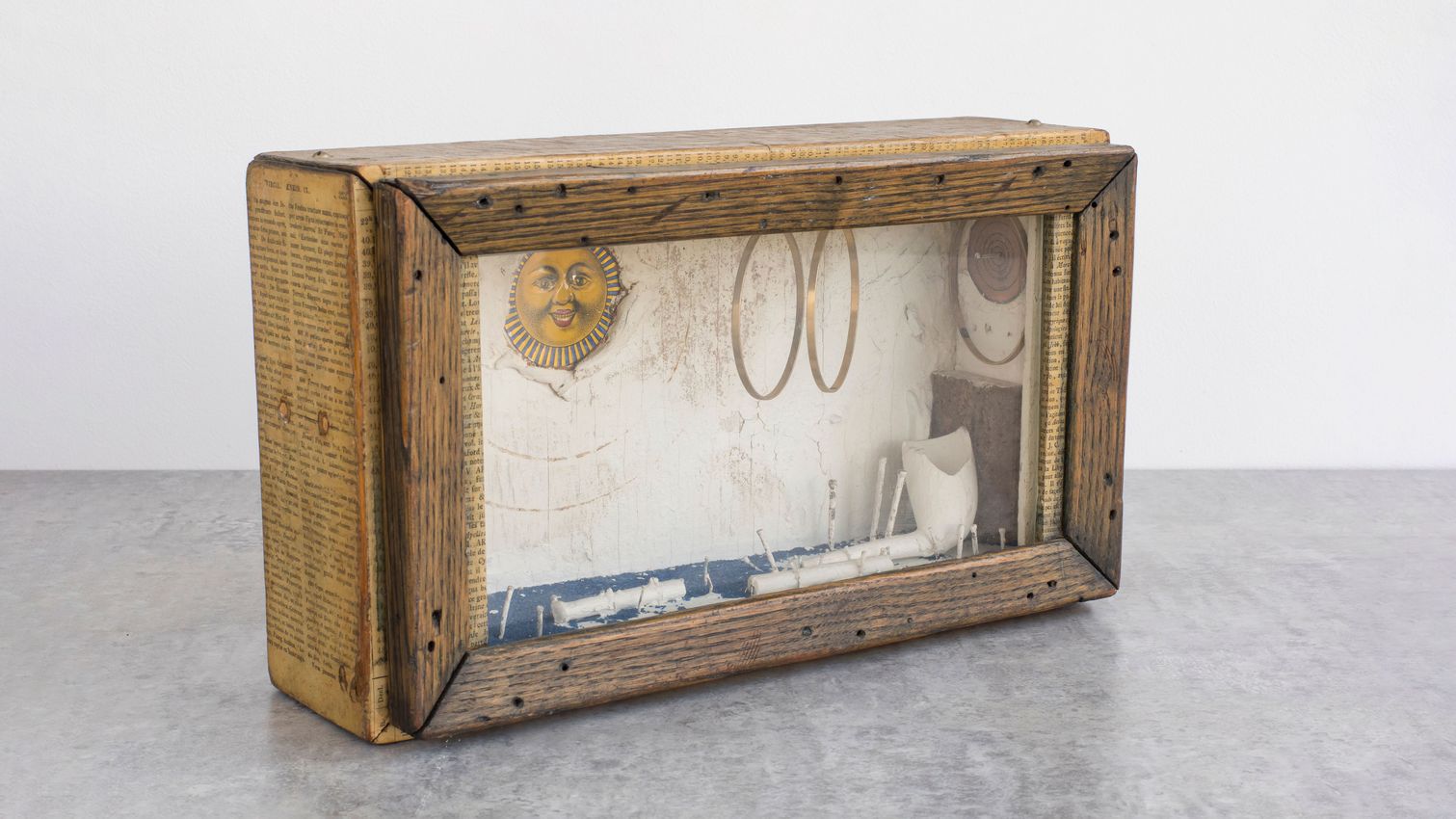
1903-1972, United StatesJoseph Cornell (1903–1972) was an American artist and experimental filmmaker whose poetic box assemblages helped define assemblage in twentieth-century New York art. Working largely from his family home in Flushing, Queens, he transformed found objects and images into intimate, dream-like tableaux that fused Surrealist strategies with a personal language of memory, nostalgia, and wonder.
Life and studio in Queens
Born in Nyack, New York, Cornell spent his childhood in the Hudson River Valley before settling with his family in Queens, where he lived for most of his life. Apart from three and a half years at Phillips Academy in Andover, Massachusetts, he was self-taught, educating himself in Manhattan bookshops, libraries, and museums such as the Museum of Modern Art and midtown galleries. Supporting himself as a textile salesman, he cared for his mother and his younger brother Robert, who had cerebral palsy, while developing his art in a modest frame house on Utopia Parkway whose basement studio became a legendary laboratory of boxes and collages.
In 2025–26, Gagosian Paris restaged this Queens studio in The House on Utopia Parkway: Joseph Cornell’s Studio Re-Created by Wes Anderson, the first solo presentation of his work in Paris in more than four decades.
Surrealism and Exhibitions
Cornell’s early encounters with Surrealism came at Julien Levy’s New York gallery, where he saw collages by Max Ernst and met European émigrés including Ernst, Salvador Dalí, and Marcel Duchamp. In 1932 he designed the catalogue cover for Levy’s Surrealist exhibition and showed his own collages and objects; his first solo exhibition, Objects by Joseph Cornell: Minutiae, Glass Bells, Coups d’Oeil, Jouet Surréalistes, followed later that year. He was included in the Museum of Modern Art’s landmark Fantastic Art, Dada, Surrealism exhibition in 1936 with Untitled (Soap Bubble Set) (1936) which later entered the Wadsworth Atheneum, and he subsequently exhibited widely in New York and across the United States while undertaking freelance design work for magazines such as Vogue and House & Garden. Cornell developed a close friendship with Duchamp, assisting with the Boîte-en-valise “portable museum,” and, although linked to Surrealism, he maintained a more lyrical, contemplative tone than many of his European contemporaries.
Shadow boxes and key series
Beginning as a collagist, Cornell bought and photocopied books largely for their images, which he cut and recombined with Victorian bric-à-brac, old photographs, maps, celestial charts, toys, and other found materials. His glass-fronted shadow boxes, often assembled in boxes first sourced in small Asian shops in Manhattan, stage these fragments in miniature theatres that evoke shrines, cabinets of curiosities, and dioramas. Among his most important series are the ‘Soap Bubble Sets’ of the late 1930s and 1940s, which combine scientific instruments, glass spheres, toys, and astronomical charts; the ‘Medici Slot Machine’ boxes of the early 1940s, which turn Renaissance portraits into quasi-arcade devices; the ‘Hotel’ series, built from printed stationery, keys, and labelled drawers; the ‘Aviary’ works, presenting birds within gridded enclosures; and the ‘Observatory’ and ‘Space Object Boxes’ which transform star charts and navigation tools into compact cosmic stages. These works revolve around recurring archetypes—the ballerina, the hotel guest, the traveller, the celestial navigator, and the caged or liberated bird—through which Cornell explored time, longing, and the desire for escape.
Film and found footage
Cornell’s passion for cinema yielded a small but influential body of experimental films that parallel his box assemblages. Working with existing reels, he pioneered the appropriation and re-editing of found footage to form new narratives and atmospheres governed by chance and association. Rose Hobart (1936), drawn from the Hollywood feature East of Borneo, isolates and reorders scenes featuring the actress Rose Hobart, slows the projection, and tints the film to create an oneiric portrait that famously prompted Dalí to accuse Cornell of stealing an idea from his subconscious. Cornell continued to make montage films and collaborated with figures such as Stan Brakhage, and his approach to found footage has become a touchstone for later generations of experimental and compilation filmmakers.
Motifs, Relationships, and Legacy
Throughout his career, Cornell returned to a constellation of motifs that fused biography, popular culture, and the cosmos. Ballerinas and theatrical interiors appear in boxes that function as miniature stages, while film stars such as Lauren Bacall enter as distant muses, represented through cut-out portraits and film stills set among celestial charts and architectural fragments. Birds, maps, and astronomical diagrams recur across series such as ‘Aviary’, ‘Observatory’, and the ‘Space Object Boxes’, framing everyday objects as if they were stars in a private universe.
Although he worked quietly in Queens, Cornell maintained close ties with artists and writers; beyond Duchamp and the Surrealists, he befriended younger figures including Andy Warhol and Robert Rauschenberg, who admired his use of found imagery and display. In the 1960s he formed an intense, largely platonic relationship with Yayoi Kusama, exchanging letters, drawings, and gifts; he collected her work and gave her boxes of clippings and ephemera that she transformed within her own practice. Cornell’s poetic use of assemblage and vitrines has positioned him as a crucial precursor to Pop art, appropriation, Minimalism, Conceptual art, and contemporary installation, and his influence continues to shape sculpture, moving-image practice, and exhibition-making internationally.
Exhibitions, Recognition, and Legacy
Cornell’s first solo exhibition, Objects by Joseph Cornell: Minutiae, Glass Bells, Coups d’Oeil, Jouet Surréalistes, at Julien Levy Gallery in New York in 1931 marked his emergence as a distinctive voice in American Surrealism. He was subsequently featured in major museum exhibitions in the United States and Europe, and his work is now held in leading collections worldwide.
Notable exhibitions include:
- Objects by Joseph Cornell: Minutiae, Glass Bells, Coups d’Oeil, Jouet Surréalistes, Julien Levy Gallery, New York (1931)
- Fantastic Art, Dada, Surrealism, The Museum of Modern Art (MoMA), New York (1936)
- Subsequent solo and group exhibitions at the Whitney Museum of American Art, New York
- Exhibitions at the Smithsonian American Art Museum, Washington, D.C.
- Presentations of his work at Tate, London, and other major European museums
Today, Cornell is widely regarded as a premier assemblagist whose intimate box constructions have influenced generations of artists working with found objects, vitrines, and installation, and his presence in institutions across New York, Washington, London, and beyond reinforces his status within twentieth century and contemporary art discourse.
Joseph Cornell Art Market
Joseph Cornell’s shadow boxes and collages occupy a strong niche within the international Post-War and Contemporary market, with works regularly appearing in evening sales at Christie’s, Sotheby’s, and Phillips. His auction record was set in the mid-2010s by Untitled (Penny Arcade Portrait of Lauren Bacall) (1946), which realised around 5.3 million USD at Christie’s New York, underscoring the appetite for museum-quality box constructions among blue-chip collectors.
In May 2026, a major work by Joseph Cornell will be offered at Christie’s in New York as part of a high-profile auction of masterpieces from the collection of the late arts patron Agnes Gund, presented alongside important paintings by Mark Rothko and Cy Twombly. The Cornell piece, described as a museum-grade box construction that encapsulates his ability to weave together disparate objects into a suspended world of time, memory, and collective history, carries an estimate in the region of 3–5 million USD and is expected to challenge or surpass his current auction record. Together, the Cornell, Rothko, and Twombly works form the centrepiece of Christie’s Marquee Week, with a combined presale estimate exceeding 120 million USD, underscoring Cornell’s position not only as a key figure in twentieth-century American art but also as a significant presence in today’s global art market.
Joseph Cornell FAQs
Who was Joseph Cornell?
Joseph Cornell (1903–1972) was an American artist and experimental filmmaker best known for his Surrealist-inspired shadow boxes and assemblages made from found objects.
What is Joseph Cornell best known for?
Joseph Cornell is best known for his glass-fronted box constructions, or “shadow boxes,” which combine vintage photographs, maps, toys, and ephemera into poetic, dream-like assemblages.
Was Joseph Cornell a Surrealist?
Although closely associated with Surrealism in New York and exhibited alongside Surrealist artists, Joseph Cornell saw himself as more of a self-taught maker than a strict Surrealist.
Where can I see Joseph Cornell’s work?
Major works by Joseph Cornell are held in museum collections including the Museum of Modern Art and the Whitney Museum of American Art in New York, the Smithsonian American Art Museum in Washington, D.C., and Tate in London.
How much is a Joseph Cornell box worth?
Joseph Cornell’s box assemblages have achieved prices in the millions at auction, with top examples offered at major houses such as Christie’s and Phillips in New York and London.
Has Joseph Cornell been included in major collection sales alongside artists like Mark Rothko and Cy Twombly?
Yes, important Joseph Cornell box constructions have featured in high-profile auctions of blue-chip collections, where they have been offered alongside works by leading post-war artists such as Mark Rothko and Cy Twombly.
Ocula | 2026





Explore and Follow Artists Shaping Contemporary Art
A respected voice in contemporary art discourse.
Focusing on ambitious storytelling and insightful art-world commentary. Ocula Magazine publishes in-depth interviews, critical essays and timely analysis on the artists, exhibitions and ideas driving the global art world.
Learn more about Ocula Magazine
Showcasing the best of the art world.
Ocula partners with galleries from around the world to highlight their artists, artworks and exhibitions. Gallery membership is by application and invitation, with each member vetted by an independent panel.
Learn more about Ocula Membership
Specialises in the sale of major artworks.
Led by a team with deep ties to the world’s leading auction houses, galleries and collectors. Ocula’s advisory team offers bespoke services to high-net-worth clients from around the world who are looking to acquire the best of contemporary and modern art.
Learn more about our team and services