





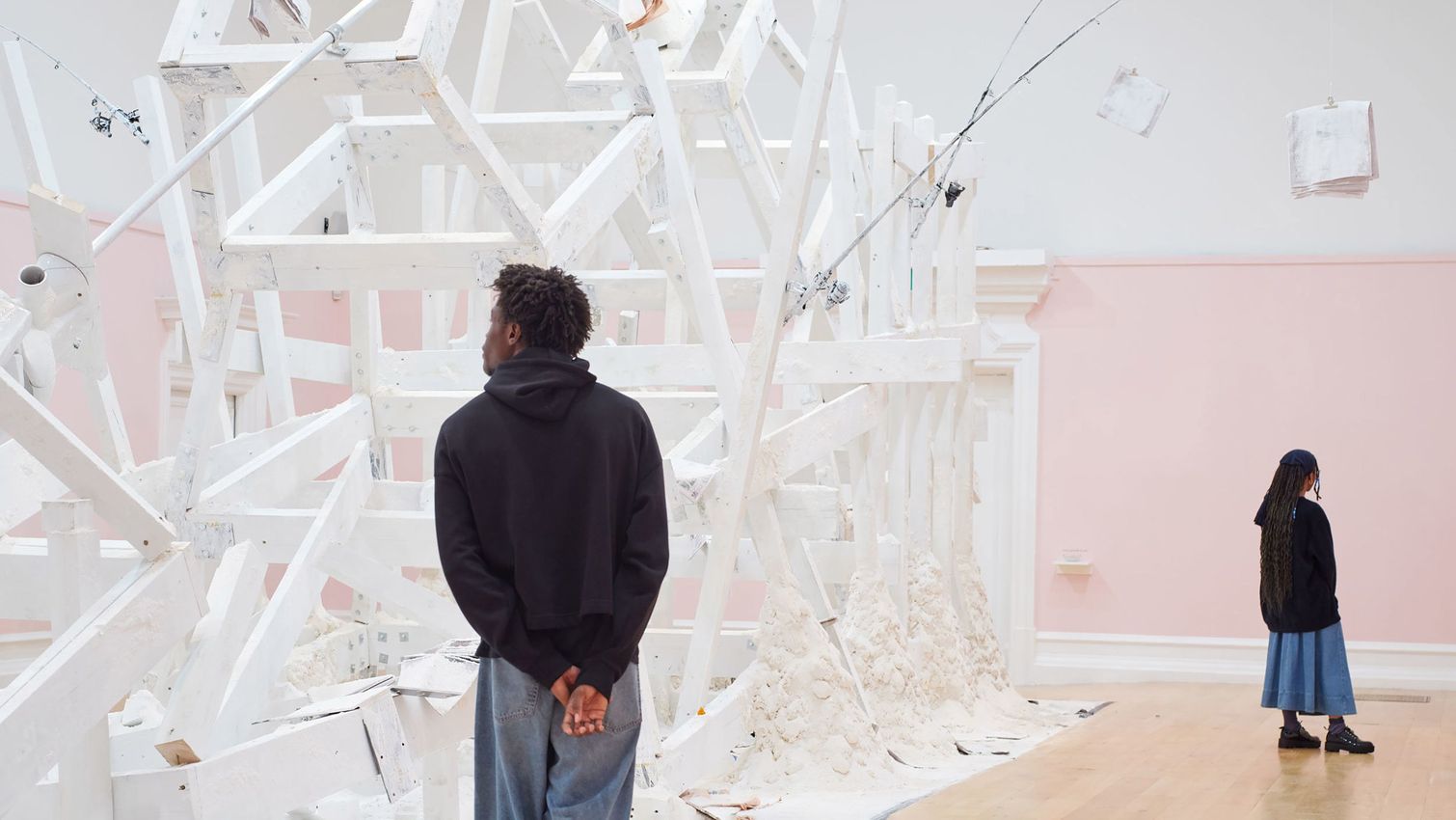
POPE.L
1955-2023, United StatesPope.L (born William Pope in 1955, Newark; died 2023, Chicago) was an American visual artist and educator best known for radical performance, interventionist public art, and text-driven works that confront race, class, and the contradictions of US democracy. Working across performance, public intervention, painting, sculpture, video, and writing, he developed a distinctive combination of endurance, slapstick humour, and institutional critique that positioned him as a central figure in contemporary performance art.
Pope.L is widely known for his ‘crawl’ pieces and for works such as The Great White Way: 22 miles, 9 years, 1 street (2001–09) and Eating the Wall Street Journal (initiated 1991), as well as major projects and presentations for institutions including the Museum of Modern Art, the Whitney Museum of American Art, documenta 14, and South London Gallery. Across his work, he explored racism, poverty, and systems of value through formally rigorous yet absurdist actions that have proved highly influential for subsequent generations of artists.
In 2026, Gladstone Gallery announced its representation of the Estate of Pope.L, coinciding with Certainly an Act: Works on Paper by Pope.L at The Drawing Center in New York that same year and preceding a solo exhibition at Gladstone’s New York space in 2027. The gallery represents the Estate of Pope.L in collaboration with Modern Art, London, and Vielmetter, Los Angeles, further extending the international reach of his practice.
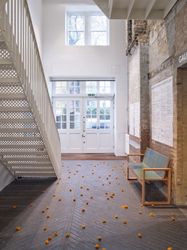
Writing for Ocula on the artist’s South London Gallery exhibition Hospital—which ran from late 2023 into 2024—Stephanie Bailey noted Pope.L’s insistence on holding ‘imaginative, speculative ground to challenge the constructs of racial supremacy—and its inevitable intersections with class divisions’ as defining his work, a legacy that continues to resonate in the years following his death.
Early life and Career
Pope.L was born in Newark, New Jersey, in 1955 and grew up in a working-class family marked by housing insecurity and economic precarity. He spent time in Brooklyn’s East Village with his grandmother Desma Lancaster—an artist who exhibited quilts at the Studio Museum in Harlem in the 1960s—as well as in Keyport, New Jersey, with his mother Lucille Lancaster, experiences that shaped his sensitivity to class and race in the urban United States. After studying at Pratt Institute, he completed a BA at Montclair State College in 1978, later attending the Whitney Museum Independent Study Program and earning an MFA from Rutgers University in 1981. Training in performance and theatre, including work with Geoff Hendricks and the experimental group Mabou Mines, fed directly into the development of his performance practice.
The artist began using the name ‘Pope.L’—combining his father’s surname with the initial of his mother’s—during the mid-1980s while teaching at Bates College in Lewiston, Maine, where students coined the pseudonym before he formally adopted it. From the late 1970s he staged early street performances in New York, including the first ‘crawl’ pieces in downtown Manhattan, and soon became part of the city’s performance and alternative-space scene at venues such as Franklin Furnace and Just Above Midtown. By the early 2000s he had gained wider institutional visibility through the 2002 Whitney Biennial and subsequent museum exhibitions, while continuing to teach and write alongside his art practice.
Works, Series, and Methods
Pope.L is best known for his endurance-based ‘crawls’, grouped under the long-running project eRacism, which began in the late 1970s. In works such as Times Square Crawl (1978) and later Tompkins Square Crawl (1991), he dragged himself along New York streets—often in a business suit—drawing attention to homelessness, vulnerability, and the racialised body in public space. These performances were physically punishing but visually simple, using the absurd spectacle of a man crawling on his stomach through the city to reframe everyday hierarchies of mobility and power.
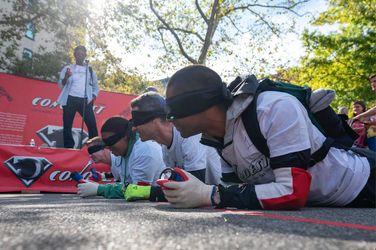
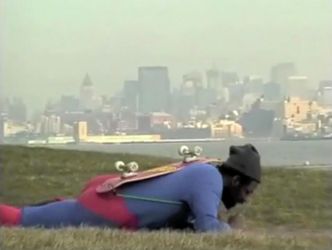
The Great White Way: 22 miles, 9 years, 1 street (2001–09) extended the crawl concept into a multipart work in which the artist set out to traverse the 22 miles of Broadway in New York over several years, at times dressed in a Superman costume. Documented on video and in photographs, the project links the mythology of the American ‘main street’ and immigrant dream to the realities of fatigue, obstruction, and bodily risk, turning the simple act of moving forward into an allegory of social struggle. Alongside the crawls, performances such as ATM Piece (1997), where he chained himself to a midtown bank door with sausages while wearing only work boots and a skirt of dollar bills, and Black Domestic aka Roach Motel Black (1994) address consumerism, race, and containment through humorous yet discomfiting tableaux.
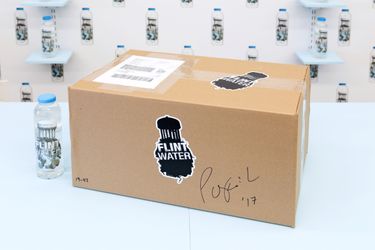
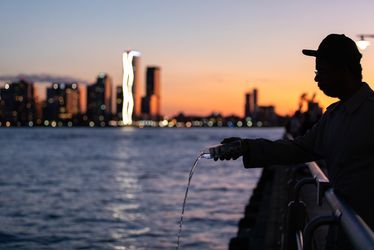
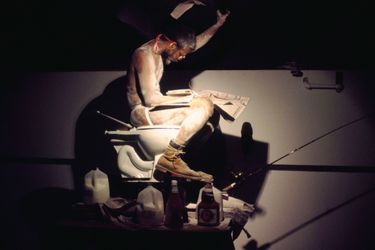
Another signature work, Eating the Wall Street Journal, first performed in 1991, involves the artist eating pages of the financial newspaper—sometimes seated on an American flag, sometimes on a toilet—washing the paper down with milk or ketchup. When restaged at MoMA in 2000, Pope.L covered his body in flour so that his skin appeared white, overlaying a critique of capitalism with a biting commentary on race and assimilation. Later projects expanded his material vocabulary: The Black Factory (2002–09), a mobile installation and performance series, invited participants across the United States to contribute objects representing “blackness”, while works like Flint Water Project (2017) in Detroit used bottled water and distribution strategies to address environmental racism and infrastructural violence.
In parallel to performance, Pope.L produced paintings, drawings, sculptures, and text works that folded language and humour into graphic compositions. These often deploy found phrases, puns, and deliberately uncomfortable titles, echoing the verbal density of his lectures and writings and extending his interest in how words structure perception. Across media, he described his aims as “joy, money, and uncertainty—not necessarily in that order”, a formulation that captures his refusal of stable meaning and his insistence on the coexistence of pleasure and critique.
Themes and Context
Pope.L’s work consistently examines how race, class, gender, and language shape who is visible, mobile, or valued in public space. Identifying as a working-class Black man from the United States, he staged his own body as both target and agent, highlighting the absurdities of everyday racism and economic inequality without reducing them to straightforward moral lessons. Many performances operate as ‘fishing’ for social reactions—he once called himself a ‘fisherman of social absurdity’—drawing out unspoken assumptions and anxieties through staged discomfort.
Situated within performance and conceptual art after the 1960s, his practice intersects with social practice, institutional critique, and Black performance histories, while retaining a stubbornly idiosyncratic tone. Works like Whispering Campaign (documenta 14, 2017) and Claim (Whitney Biennial, 2017) embed language and number within architecture to comment on migration, demographic fear, and the politics of counting. Across contexts, his art tests the limits of meaning, often embracing contradiction and failure as ways to question who has the authority to define reality.
Exhibitions, Collections, and Recognition
From the 1970s onwards, Pope.L’s performances moved from the street into key independent venues such as Anthology Film Archives, Franklin Furnace, Just Above Midtown, and later to major museums including the Museum of Modern Art, the New Museum, the Whitney Museum of American Art, MOCA Los Angeles, Walker Art Center, and the Museum of Contemporary Art Chicago. He participated in the 2002 and 2017 Whitney Biennials, the 32nd Bienal de São Paulo (2016), documenta 14 in Athens and Kassel (2017), and Prospect.2 in New Orleans, among other large-scale exhibitions.
In 2019, Instigation, Aspiration, Perspiration—a coordinated trio of exhibitions across MoMA, the Whitney, and Public Art Fund—offered a wide-ranging survey of his practice in New York. Recent solo projects before his death included Misconceptions at Portikus, Frankfurt (2021), Between a Figure and a Letter at Schinkel Pavillon, Berlin (2022), Hospital at South London Gallery (2023–24), and the exhibition Impossible Failures at 52 Walker, New York, in 2023. His work is held in major public collections, including MoMA, which houses documentation of The Great White Way and other works, confirming his position as a significant figure in late 20th- and early 21st-century art.
Pope.L FAQs
What is Pope.L best known for?
Pope.L is best known for his endurance-based performance ‘crawls’, in which he dragged himself along city streets to address race, homelessness, and social vulnerability. Works such as Times Square Crawl (1978) and The Great White Way: 22 miles, 9 years, 1 street (2001–09) have become emblematic of this approach.
Why is Pope.L considered an important performance artist?
He is regarded as a major performance artist because he combined physically demanding actions with pointed commentary on US capitalism, racism, and everyday power relations. By using humour, risk, and public participation, he expanded how performance art could intervene in social and institutional spaces.
What themes does Pope.L explore in his work?
Pope.L’s work explores racism, class inequality, consumerism, language, and the fragility of the social contract in the United States. He often stages his own body in absurd or abject situations to expose how systems of value and visibility operate on Black and working-class subjects.
Where can I see Pope.L’s work?
Documentation and objects by Pope.L are held in collections such as the Museum of Modern Art in New York and other major museums that have exhibited his work. Recent institutional projects at South London Gallery, Schinkel Pavillon, Portikus, and 52 Walker also generated catalogues and archives that continue to circulate internationally.
What is Pope.L’s ‘Eating the Wall Street Journal’ about?
Eating the Wall Street Journal by Pope.L is a performance series begun in 1991 in which Pope.L eats pages of the financial newspaper, sometimes seated on an American flag or toilet and drinking milk or ketchup. The work satirises the veneration of finance and consumption in the US and, in later versions where he whitened his skin with flour, links economic critique to questions of race and assimilation.
Ocula | 2026

Explore Pope.L's Exhibitions



Representative Artworks
View story
View story
View story
View story
View story
View story
View story
View story
View story
View story
View story



Explore and Follow Artists Shaping Contemporary Art
A respected voice in contemporary art discourse.
Focusing on ambitious storytelling and insightful art-world commentary. Ocula Magazine publishes in-depth interviews, critical essays and timely analysis on the artists, exhibitions and ideas driving the global art world.
Learn more about Ocula Magazine
Showcasing the best of the art world.
Ocula partners with galleries from around the world to highlight their artists, artworks and exhibitions. Gallery membership is by application and invitation, with each member vetted by an independent panel.
Learn more about Ocula Membership
Specialises in the sale of major artworks.
Led by a team with deep ties to the world’s leading auction houses, galleries and collectors. Ocula’s advisory team offers bespoke services to high-net-worth clients from around the world who are looking to acquire the best of contemporary and modern art.
Learn more about our team and services