



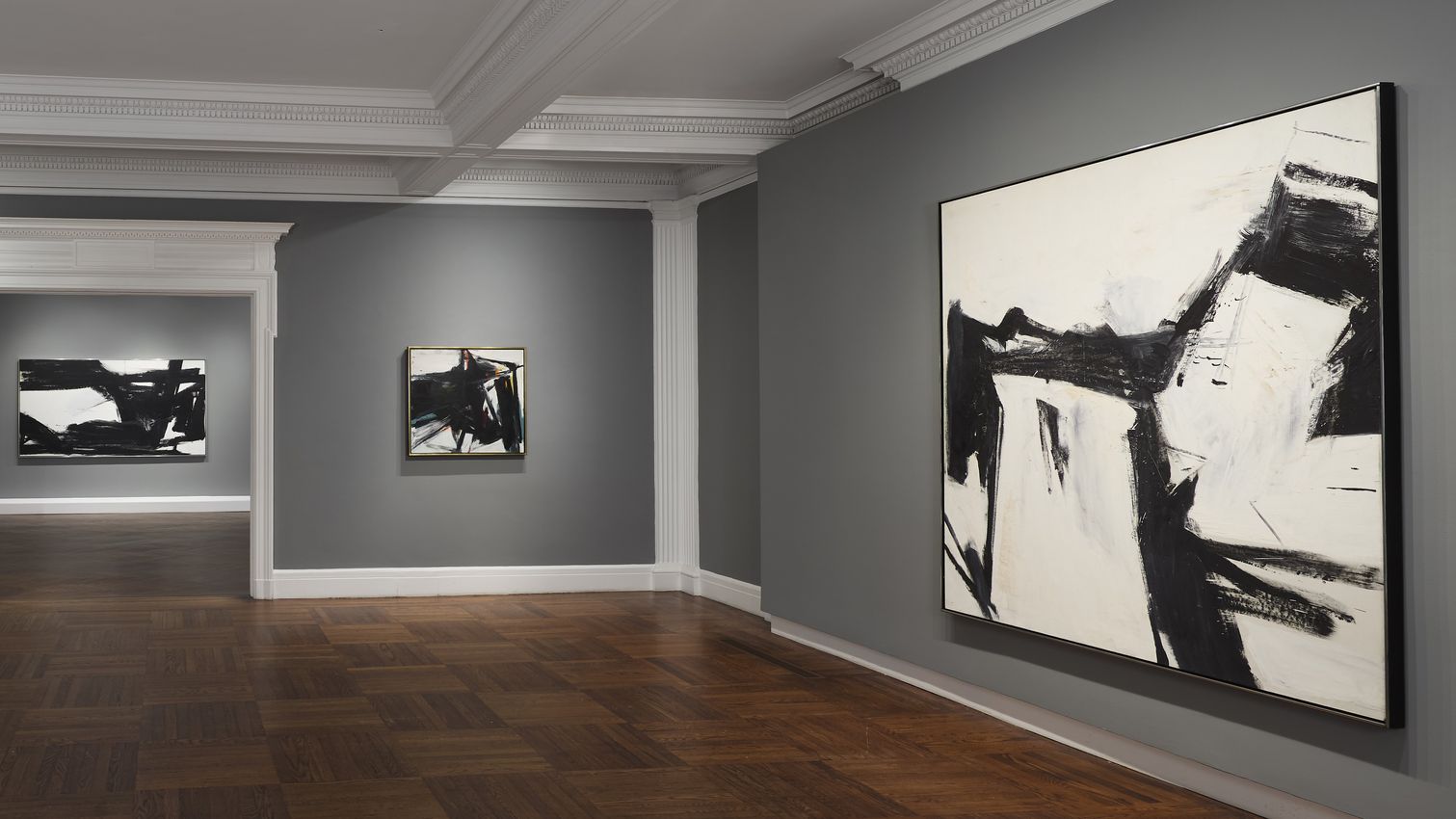
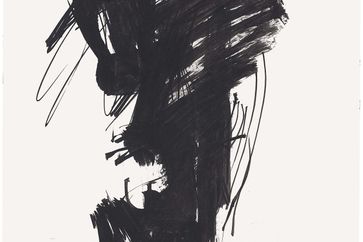
Mnuchin Gallery is honored to present Franz Kline, on view from April 23 to June 21, 2025. Featuring fifteen paintings from 1950 to 1960, along with a selection of works on paper, the exhibition offers a focused reappraisal of Kline’s oeuvre, situating his innovations within their midcentury context while engaging with the evolving discourse of contemporary abstraction. With major loans from The Museum of Modern Art, The Solomon R. Guggenheim Museum, and Glenstone Museum, as well as from prominent private collections—the presentation highlights the artist’s conceptual depth and formal power, reaffirming his position as a pivotal figure within Abstract Expressionism and a resonant force for contemporary painters. While this marks the gallery’s third exhibition devoted to Kline, it is the first to be accompanied by a fully illustrated catalogue, featuring texts by Carter Ratcliff and Robert Mattison. Ratcliff, a leading voice in American art criticism for over five decades, and Mattison, the foremost authority on Kline’s work and author of his catalogue raisonné, together bring depth and clarity to this renewed investigation of the artist’s singular vision.
Kline’s hallmark black-and-white paintings of the 1950s—bold, gestural, and instantly recognizable—are among the most iconic works of Abstract Expressionism. Works including Chief (1950) and Painting No. 7 (1957) crystallize the raw immediacy and graphic force for which he is best known. These compositions, forged through contrasts and decisive brushwork, embody Kline’s belief in the vitality of form itself—his conviction that structure and spontaneity need not be opposites. And yet, while these works anchor Kline’s legacy, they do not represent its totality. Paintings like Light Mechanic (1960), for instance, invite a more nuanced reading of the artist’s practice and palette. This late painting signals not a departure but an expansion—affirming that Kline never truly relinquished color. Pale ochres and warm creams layered within and beneath his brushstrokes, evidence Kline’s enduring sensitivity to tone and warmth. Even in his most austere-looking compositions, subtle gradations of hue complicate the convenient binary of black and white, revealing an artist attuned to the emotive resonance of even the faintest shift in value.
To fully grasp the depth of Kline’s abstraction, one must consider the subtle personal currents running beneath its surface. Though his paintings remain resolutely nonrepresentational, Kline often titled works after places from his Pennsylvania upbringing (Pittston, Forty-Fort), friends (Harleman), music (Composition), and histories that shaped his inner life (Study for Placidia). These references do not anchor his work to specific narratives but suggest the emotional charge behind his marks. The subjective power of these images hum with memory, rhythm, and feeling. When asked to explain how his work should be interpreted, Kline cooly responded: ‘I’ll answer you the same way Louis Armstrong does when they ask him what it means when he blows his trumpet. Louis says, ‘Brother, if you don’t get it, there is no way I can tell you.’
These works, though rooted in the urgency of their time, remain startlingly contemporary. Their scale, energy, and refusal of easy legibility continue to engage new generations of artists and viewers. Approached with openness, they reveal not only formal invention but also a lasting sense of freedom—proof that abstraction, in Kline’s hands, was never static but alive with possibility.
Kline was born in Wilkes-Barre, Pennsylvania. He studied painting in the Art Department, Boston University, 1931-5 and at Heatherley's School in London 1937-8, then settled in New York.

Mnuchin Gallery is located in the historic five-story townhouse at 45 East 78th Street on Manhattan’s Upper East Side and is dedicated to presenting museum-quality exhibitions of postwar and contemporary art.

A respected voice in contemporary art discourse.
Focusing on ambitious storytelling and insightful art-world commentary. Ocula Magazine publishes in-depth interviews, critical essays and timely analysis on the artists, exhibitions and ideas driving the global art world.
Learn more about Ocula Magazine
Showcasing the best of the art world.
Ocula partners with galleries from around the world to highlight their artists, artworks and exhibitions. Gallery membership is by application and invitation, with each member vetted by an independent panel.
Learn more about Ocula Membership

Specialises in the sale of major artworks.
Led by a team with deep ties to the world’s leading auction houses, galleries and collectors. Ocula’s advisory team offers bespoke services to high-net-worth clients from around the world who are looking to acquire the best of contemporary and modern art.
Learn more about our team and services