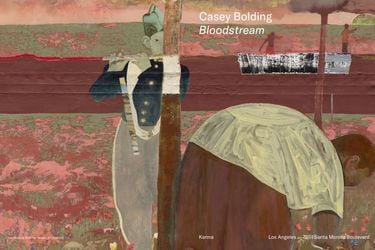





RAYMOND SAUNDERS
1934-2025, United StatesRaymond Saunders was a pioneering American artist renowned for abstract multimedia paintings, dynamic assemblages, and incisive commentary on culture, identity, and the Black American experience.
Early Years
Raymond Saunders was born in Pittsburgh, Pennsylvania, in 1934 and came of age in a culturally rich yet segregated city. His creative path was shaped by early encouragement from Joseph C. Fitzpatrick, a mentor in the city’s public school system who taught other future luminaries such as Andy Warhol and Mel Bochner.
Saunders earned a scholarship to study at the Pennsylvania Academy of the Fine Arts in Philadelphia, enrolled in courses at the Barnes Foundation through the University of Pennsylvania, then returned to Pittsburgh to complete his BFA at Carnegie Institute of Technology in 1960. He subsequently obtained an MFA from the California College of Arts and Crafts in Oakland in 1961. He taught at California State University, Hayward and later became professor emeritus at the California College of the Arts in Oakland, influencing generations of artists.
Raymond Saunders Artworks
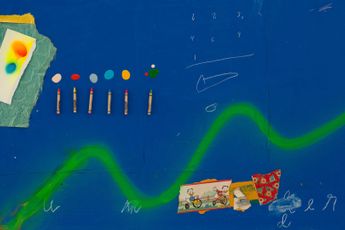
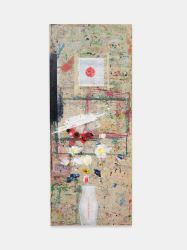
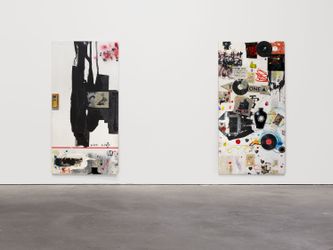
Raymond Saunders’ contemporary art practice is defined by assemblage techniques, deep improvisation, and an unorthodox fusion of materials and meaning. His paintings, installations, and works on paper bring together gestural brushwork, collage, blackboard motifs, found signage, and the detritus of city life.
Central to Saunders’s vocabulary is the recurring use of a black ground—chalkboard-like surfaces overlaid with white chalk, paint, text, and objects. This visual strategy is both a nod to his years as an educator and a conceptual device for exploring absence, presence, and the politics of visibility.
Assemblage and Improvisation
Saunders merged Expressionist and Minimal motifs with urban findings—doors, signage, ephemera—improvising layered surfaces. Blackboard-like panels, fragments of childlike notes, and notated marks speak to memory, education, and the act of making as an ongoing process of renewal.
Sociopolitical Layering and ‘Black Is a Color’
Saunders consistently used both his art and writing to unsettle fixed categories and complicate conversations on race, most notably with his seminal 1967 pamphlet Black Is a Color, written in response to Ishmael Reed’s critique of Black American art. In this text, Saunders argued that Reed misunderstood the full expanse of Black experience and creative expression, reducing Black art to mere reactions to racial politics. By rejecting the essentialism promoted by the Black Arts Movement, Saunders insisted on art’s broader possibilities: ‘the wider reality of art, where colour is the means, not the end’. Throughout his career, Saunders addressed Black experience, social history, and urban life, but continually resisted being confined by the label of ‘Black art’, interweaving personal narrative with collective histories in works that remain layered and ambiguous.
Post No Bills
Signature works like Post No Bills (1968)—a monochrome red canvas with painter’s palette and tape—heralded his irreverent approach to both art history and cultural politics. Long-running series feature found doors and signs as painting supports, further collapsing the boundaries between painting, assemblage, and installation.
Select Awards and Accolades
- National Institute of Arts and Letters Award (1963)
- Ford Foundation Award (1964)
- Rome Prize Fellowship (1964–1966)
- Guggenheim Fellowship (1976)
- National Endowment for the Arts Awards (1977, 1984)
- Visual Arts Award, Southeastern Center for Contemporary Art (1989)
Exhibitions
In later decades, Saunders’s exhibitions—such as Flowers from a Black Garden at the Carnegie Museum of Art and Déménagement at David Zwirner, Paris—affirmed his international influence and position as a major contemporary voice. His work has been included in other landmark exhibitions such as Soul of a Nation: Art in the Age of Black Power (Tate Modern, London, touring internationally), Just Above Midtown: Changing Spaces (MoMA, New York), and Now Dig This! Art and Black Los Angeles 1960–1980 (Hammer Museum, LA; MoMA PS1, NY). In the 21st century, institutional attention and critical reassessment have revived interest in the depth and innovation of his practice.
A selection of important exhibitions are referred to below.
Solo Exhibitions
- Raymond Saunders: Flowers from a Black Garden, Carnegie Museum of Art, Pittsburgh (2025)
- Post No Bills, David Zwirner and Andrew Kreps, New York (2024)
- Déménagement, David Zwirner, Paris (2025)
- Raymond Saunders: On Freedom and Trust, Sonoma Valley Museum of Art (2022)
- 40 Years: Paris/Oakland, Andrew Kreps Gallery and Casemore Gallery, San Francisco (2021)
- San Francisco Museum of Modern Art, San Francisco (1971)
Group Exhibitions
- Just Above Midtown: Changing Spaces, MoMA, New York (2022)
- Soul of a Nation: Art in the Age of Black Power, Tate Modern, London, and international (2017–2019)
- Now Dig This! Art and Black Los Angeles 1960–1980, Hammer Museum, LA; MoMA PS1, NY (2011–2012)
- Whitney Biennial, Whitney Museum of American Art, New York (1972)
Saunders work is included in the collections of MoMA (New York), the Metropolitan Museum of Art (New York), the Walker Art Center, Museum of Contemporary Art (Los Angeles), Philadelphia Museum of Art, San Francisco Museum of Modern Art, Art Institute of Chicago, Saint Louis Art Museum, Whitney Museum of American Art (New York), Centre Pompidou (Paris), and many others.
Raymond Saunders FAQs
Where can I see Raymond Saunders’s art?
Works by Raymond Saunders are held in major collections, including the Museum of Modern Art (New York), the Metropolitan Museum of Art (New York), the Whitney Museum of American Art (New York), Walker Art Center (Minneapolis), Museum of Contemporary Art (Los Angeles), Centre Pompidou (Paris), Philadelphia Museum of Art, San Francisco Museum of Modern Art, and many other international museums.
What is Raymond Saunders best known for?
Saunders is best known for his multimedia assemblage paintings, blackboard and chalk motifs, and for challenging assumptions about race and abstraction in American contemporary art through both his practice and his manifesto Black Is a Color.
What significant recognition did Raymond Saunders receive?
Among many accolades, Saunders received the National Institute of Arts and Letters Award, the Ford Foundation Award, the Rome Prize Fellowship, the Guggenheim Fellowship, and multiple National Endowment for the Arts Awards.
Has Raymond Saunders contributed to artist education?
Yes, Saunders was a longtime educator, serving as professor emeritus at California College of the Arts in Oakland. His commitment to teaching and the blackboard motif in his art reflect his pedagogical legacy.
What are interesting facts about Raymond Saunders?
He began life in Pittsburgh, studied under Joe Fitzpatrick (like Andy Warhol), lived and worked in Paris as well as Oakland, and maintained a lifelong belief that artistic freedom must transcend categorisations of race or genre. Black Is a Color remains a foundational text for subsequent generations of artists and scholars.
How do you pronounce Raymond Saunders’s name?
It is pronounced ‘RAY-mund SAWN-ders’.
Ocula | 2025

Explore Raymond Saunders' Exhibitions



Representative Artworks
View story

View exhibition






Explore and Follow Artists Shaping Contemporary Art
A respected voice in contemporary art discourse.
Focusing on ambitious storytelling and insightful art-world commentary. Ocula Magazine publishes in-depth interviews, critical essays and timely analysis on the artists, exhibitions and ideas driving the global art world.
Learn more about Ocula Magazine
Showcasing the best of the art world.
Ocula partners with galleries from around the world to highlight their artists, artworks and exhibitions. Gallery membership is by application and invitation, with each member vetted by an independent panel.
Learn more about Ocula Membership
Specialises in the sale of major artworks.
Led by a team with deep ties to the world’s leading auction houses, galleries and collectors. Ocula’s advisory team offers bespoke services to high-net-worth clients from around the world who are looking to acquire the best of contemporary and modern art.
Learn more about our team and services