Press Release

New York—Pace Gallery is honoured to present an exhibition celebrating the collaborative spirit that animated Claes Oldenburg and the late Coosje van Bruggen’s artistic achievements and romantic partnership. Over the course of three decades, Oldenburg and van Bruggen created some of the most famous landmarks in urban and civic spaces around the world. Bringing together a selection of seminal works in sculpture spanning the full arc of their shared history—from early collaborations in the 1980s to their final works of the late 2000s—the exhibition pays homage to one of the 20th century’s most influential artistic duos, highlighting in particular van Bruggen’s vital yet underrecognised role in their collective oeuvre. In addition to sculptures, models, and drawings, the exhibition debuts the large-scale work Dropped Bouquet (2021), the final sculptural collaboration that Oldenburg and van Bruggen conceived together before her death in 2009. On view from March 26–May 1, 2021 at Pace Gallery in New York, Claes & Coosje: A Duet sheds new light on the philosophical, aesthetic, and artistic dialogue between these two artists and the indispensable role it played on their collective creative output.

Among the best-known artist-couples of the post-1960s era, Oldenburg and van Bruggen’s partnership was, from the beginning, a conspiracy between artist and art historian. They met in 1971, when van Bruggen was a young curator at the Stedelijk Museum in Amsterdam, and they married six years later. During the 1980s, van Bruggen soon transformed from interlocutor into full-fledged artistic collaborator and artist in her own right. From the 1970s onward, Oldenburg and van Bruggen’s ongoing debates and conversations—first around major sculptural commissions and later in their collaborative studio practice—reflected a profound intellectual exchange shaped by the sensibility of a sculptor, on the one hand, and that of a writer, on the other. The result was one of the most fruitful, impactful, and sometimes controversial collaborations in 20th-century art. Today, Oldenburg and van Bruggen’s large-scale projects remain some of the most recognisable and beloved public artworks in the world.

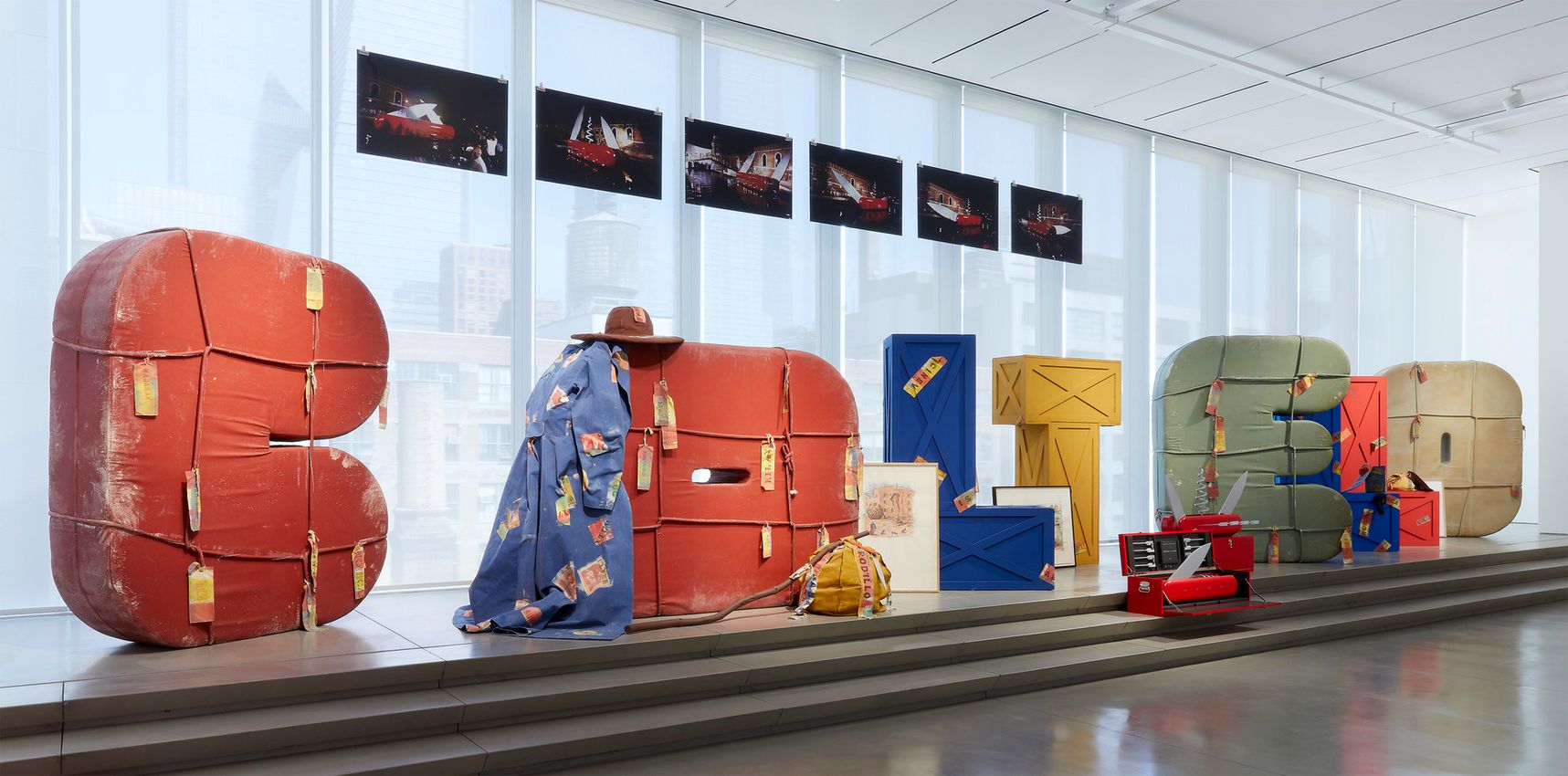
Occupying two major galleries at Pace’s 540 West 25th Street location in New York, the exhibition is anchored by Dropped Bouquet (2021), the realisation of Oldenburg and van Bruggen’s final work together. Produced at monumental scale for the first time after three years in fabrication, it evokes a garland of faux wildflowers, depicted in the midst of tumbling to the ground and frozen at the moment of impact, as if in suspended animation. Both celebratory and elegiac, flowers are a key visual motif in Oldenburg and van Bruggen’s personal iconography. The exhibition also features a selection of sculptural works from some of the artists’ best-known collaborations, including original artefacts, drawings, and soft sculptures from Il Corso del Coltello (The Course of the Knife), Oldenburg and van Bruggen’s canonical site-specific performance project for Venice, Italy, which was commissioned, conceived, and realized together with the writer Germano Celant and the architect Frank Gehry. This ambitious event involved the creation and embarkation of a sea-worthy sculpture in the shape of a giant Swiss army knife. With oars protruding from its red-enamelled hull as if from a Viking longship, the image of Oldenburg and van Bruggen’s Knife Ship sailing the Grand Canal has become iconic, while the massive kinetic sculpture was later shown in the rotunda of the Guggenheim Museum in New York, at the Centre Pompidou in Paris, and finally at the Museum of Contemporary Art, Los Angeles.

Such important early collaborations from the 1980s—including models for Spitzhacke (1982), Oldenburg and van Bruggen’s contribution to documenta 7, and The Entropic Library (1989)—will be presented in dialogue with sculptural renditions of everyday objects of labour and leisure created in the 1990s and 2000s, and which range in scale from modest to monumental. From pies to garden tools, many were designed as models for large-scale installations, among them Inverted Collar and Tie (1993) and Typewriter Eraser (1998). Others, like the swirling Collar and Bow (2005), originally designed for Frank Gehry’s Disney Concert Hall in Los Angeles, exist only in the form of models and drawings.

Further exhibition highlights include sculptures and models from the 1990s and 2000s, including selections from the celebrated suite of musical instruments that van Bruggen and Oldenburg created around the time of their last major solo show, The Music Room, which was presented at Pace Gallery in New York in 2005 and again at the Whitney Museum of American Art as part of a major exhibition of the couple’s work in 2009. Also included is an important sculptural study for Soft Shuttlecock (1995), the monumental site-specific sculpture that Oldenburg and van Bruggen created together and suspended from the Guggenheim’s rotunda on the occasion of the 1995 retrospective. The work also evokes their well-known public sculpture of monumental shuttlecocks in the garden of the Nelson-Atkins Museum of Art in Kansas City.

In tandem with Claes & Coosje: A Duet, Pace will publish a book that reproduces a series of never-before-seen letters between Oldenburg and van Bruggen dating from the beginning of their relationship in the mid-1970s. The catalogue will also feature a new critical essay by writer and artist Chris Wiley, which offers new perspectives on Oldenburg and van Bruggen’s collaborative practice.

Internationally renowned for their collaborative artistic practice, Claes Oldenburg (b. 1929, Stockholm) and Coosje van Bruggen (b. 1942, Groningen, Netherlands; d. 2009, Los Angeles) have produced sculpture, drawings, and colossal monuments that transform familiar objects into states that imply animation and sometimes revolt. A leading voice of the Pop art movement, Oldenburg came to prominence in the New York art scene of the late 1950s and early 1960s. His seminal installations The Street (1960) and The Store (1961) launched his career, subverting art-historical and institutional conventions while creating a backdrop for happenings and performances under the production name Ray Gun Theater. Coosje van Bruggen met Oldenburg in 1971, while working as a curator at the Stedelijk Museum in Amsterdam. After years of long-distance correspondence, the two married in 1977 and began their remarkable collaboration on large-scale sculptural projects, which reflected a vital exchange between the sensibility of a writer with that of a sculptor. Conflating notions of art and banality while challenging distinctions of ‘high’ and ‘low’ culture, together Oldenburg and van Bruggen staged a rigorous and poetic investigation of objecthood that lasted more than three decades.

Read More
Claes Oldenburg and Coosje van Bruggen’s Shared History Spotlight Claes Oldenburg and Coosje van Bruggen’s Shared History Pace Gallery’s latest exhibition in New York highlights the sculptural collaborations of artist‑duo Claes Oldenburg and Coosje van Bruggen. Read the story
About the Artist

Claes Oldenburg was born in Stockholm, Sweden, in 1929, but spent most of his childhood in the United States. After studies at Yale University and the Art Institute of Chicago, he moved in 1956 to New York City, where he established himself in the early 1960s with a series of installations and performances influenced by his surroundings on the Lower East Side.

View Artist Profile

Also Exhibiting at Pace Gallery

About the Gallery

Pace is a leading international art gallery representing some of the most influential artists and estates of the 20th and 21st centuries, founded by Arne Glimcher in 1960.

View Gallery Profile
Address
540 West 25th Street
New York
United States
Opening Hours
Tuesday – Saturday
10am – 6pm
(1)
New York 540 West 25th Street
Pace Gallery
540 West 25th Street, New York, United States
+1 212 421 3292
http://www.pacegallery.com

Opening hours
Tuesday – Saturday
10am – 6pm
The art world in focus