



Best known for his mobiles, which transformed the modern conception of sculpture, Calder is widely regarded as one of the most important artists of the 20th century.
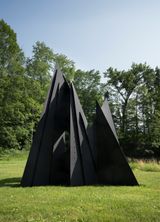
Featuring eight sculptures, ten works on paper, and one painting, this show marks the gallery’s first presentation dedicated to Calder’s work since the opening of its New York space at 540 West 25th Street in 2019. The presentation in Seoul features a selection of sculptures created by Calder over the course of three decades. It includes quintessential hanging mobiles such as Untitled (1969) and Untitled (1963) as well as the stabiles Les Arêtes de poisson (maquette, 1965) and Gwenfritz (1:5 intermediate maquette, 1968), one of the models for Calder’s 35-foot-tall sculpture outside the Smithsonian National Museum of American History in Washington, D.C. Also included in the exhibition is the magnificent standing mobile Franji Pani (1955), made during Calder’s two-month trip to India, where he realized a series of sculptures at the behest of architect and collector Gira Sarabhai in exchange for a tour around the country.
The exhibition centres on ten vibrant works on paper, which represent a lesser-known but significant aspect of the artist’s practice. The ink and gouache paintings in this presentation date to the 1960s and 1970s, ranging from works punctuated by dynamic black lines that bleed into variously coloured backgrounds to those with starkly rendered spirals and geometric forms that visually echo his sculptural practice. The collector and art historian Jean Lipman wrote that this medium, which Calder focused on in his later years, suited the artist’s ‘high-spirited, rapid, and spontaneous expression.’
Another highlight of the exhibition is Calder’s oil painting The Black Moon (1964), which sets a crescent and a series of circles against a dreamy background of soft gray and yellow tones. The composition also features a large white spherical shape, whose blue outlines suggest a third dimension beyond the canvas. Notably, Calder’s first truly abstract works of art were part of a series of small oils made in the wake of a transformative visit to Piet Mondrian’s studio in October 1930. Calder was deeply impressed by the spatial dynamics of the studio, later writing that the visit ‘gave me a shock that started things.’
Alexander Calder (b. 1898, Lawnton, Pennsylvania; d. 1976, New York) is one of the most acclaimed and influential sculptors of the twentieth century. He is renowned for the invention of the mobile, a kinetic construction of suspended abstract elements that describe individual movements, moving and balancing in changing harmony. Calder also devoted himself to making outdoor sculpture on a grand scale from bolted sheets of steel, many of which stand in public plazas in cities throughout the world. Pace Gallery has worked closely with the Calder estate since 1984.


A respected voice in contemporary art discourse.
Focusing on ambitious storytelling and insightful art-world commentary. Ocula Magazine publishes in-depth interviews, critical essays and timely analysis on the artists, exhibitions and ideas driving the global art world.
Learn more about Ocula Magazine
Showcasing the best of the art world.
Ocula partners with galleries from around the world to highlight their artists, artworks and exhibitions. Gallery membership is by application and invitation, with each member vetted by an independent panel.
Learn more about Ocula Membership

Specialises in the sale of major artworks.
Led by a team with deep ties to the world’s leading auction houses, galleries and collectors. Ocula’s advisory team offers bespoke services to high-net-worth clients from around the world who are looking to acquire the best of contemporary and modern art.
Learn more about our team and services