New York—Pace Gallery is pleased to present Intermediaries, a solo exhibition bringing together discrete yet interrelated bodies of work created by Tara Donovan throughout 2019 and 2020. Based in Donovan’s rigorous investigatory methods and aggregative logic, the exhibition’s drawings, wall-bound pieces, and free-standing sculptures transform commonplace materials into totalities that test our perceptual limits. Intermediaries also articulates the artist’s ever-deepening exploration of art’s capacity to mediate phenomenological encounters that interconnect viewers to one another and their environment. Opening on January 15, 2021, the exhibition will take place on the first floor and library of 540 West 25th Street in Chelsea and run through March 6, 2021.
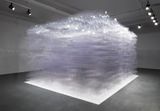
The exhibition’s primary concept underscores the structural and material openness of Donovan’s works, which are less to be looked at than looked through. Her art’s capacity to filter and reconfigure vision is most apparent in her free-standing, large-scale sculptures, made of transparent materials that refract light and distort their surrounding space. Stacked Grid (2020), for example, is marked by an orthogonality and monumentality that parallels and heightens the ‘white cube’ of the gallery. Yet it simultaneously thwarts the rationality of the grid that is at the structural core of both the sculpture and its architectural context. Through their aggregation and play with light, the work’s translucent building blocks turn the modernist grid into an evanescent, almost pixelated, entity that, at times, appears labyrinthian. If Minimalism was augured by Frank Stella’s dictum ‘what you see is what you see,’ Donovan, though operating in a minimalist idiom, tacitly questions this foundational emphasis on the self-evidence of vision.
Stacked Grid’s engagement of architecture also points to the intermedial complexity characterising all of the exhibition’s works. ‘Medium,’ from the Latin medius or ‘middle,’ is at its roots an intermediary, a middle position through which to convey or effect. Monolithic and monochromatic, Donovan’s black, wall-bound and framed sculptures, Apertures (2020), are suspended in between painting and sculpture. From a distance, their austere shape and somber hue emanate a solemnity conducive to a hushed, meditative experience. Up close, however, they exude liveliness. A soft, spectral light, filtered through the works’ strata and enlivened by the viewer’s lateral motion, animates swirling surface patterns, created by hollow stirring sticks that channel light. This light, in turn, subtly, almost imperceptibly, offers an encounter that is psychosomatic as well as visual. In their conflation of darkness and light, absence and presence, stasis and dynamism, these works invite viewers to consider relationships and identities that outstrip simplistic dualities.
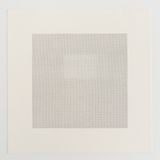
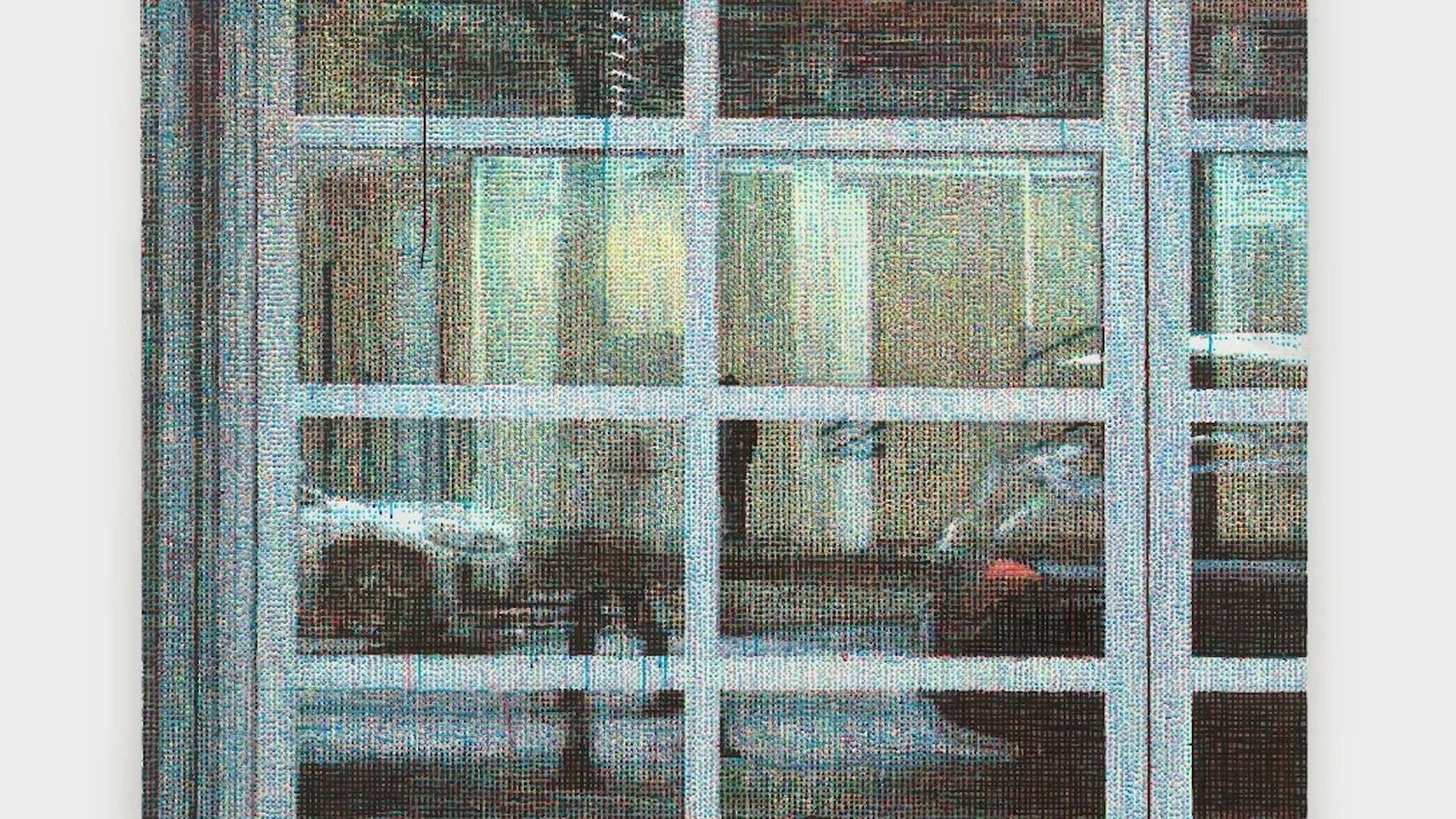
Based in a process of elimination and manipulation rather than accumulation, Donovan’s series of twenty-four drawings, titled Screen Drawings (2020), are the result of the artist’s meticulous interventions in the weave of metal screen fragments, which are coated in ink and pressed onto paper. Leveraging as much as disturbing the mathematical regularity of the grid, the drawings attune the eye to subtle shifts in pattern, the ambiguity of figure ground relations, and instability of form. Housed in Pace’s first floor library, a series of 13 large-scale drawings was similarly created through the use of malleable fibreglass screens, stretched into a variety of patterns. These works’ layered compositions—whose all-over, optical effects range from intense vibrations to aquatic dissolutions—not only suggest movement but also encourage an ambulatory experience that combines seeing and feeling, eye and body. As materials that typically cover windows and hence filter the gaze, the screens forming the field of these two series point to vision as an always mediated phenomenon, even in the moment of creation. To ‘draw’ these works, the artist had to look through and past the screen, translating their textile-like materiality into two-dimensional, graphic markings. By yet again mobilising the grid, which has long served as the infrastructure of vision in both art (e.g., the perspectival scaffolding of Renaissance painting) and science (treatises on physiological optics are rife with diagrammatic grids), Donovan parses and breaks through this paradigm in the search for new perceptual models, new intermediaries.
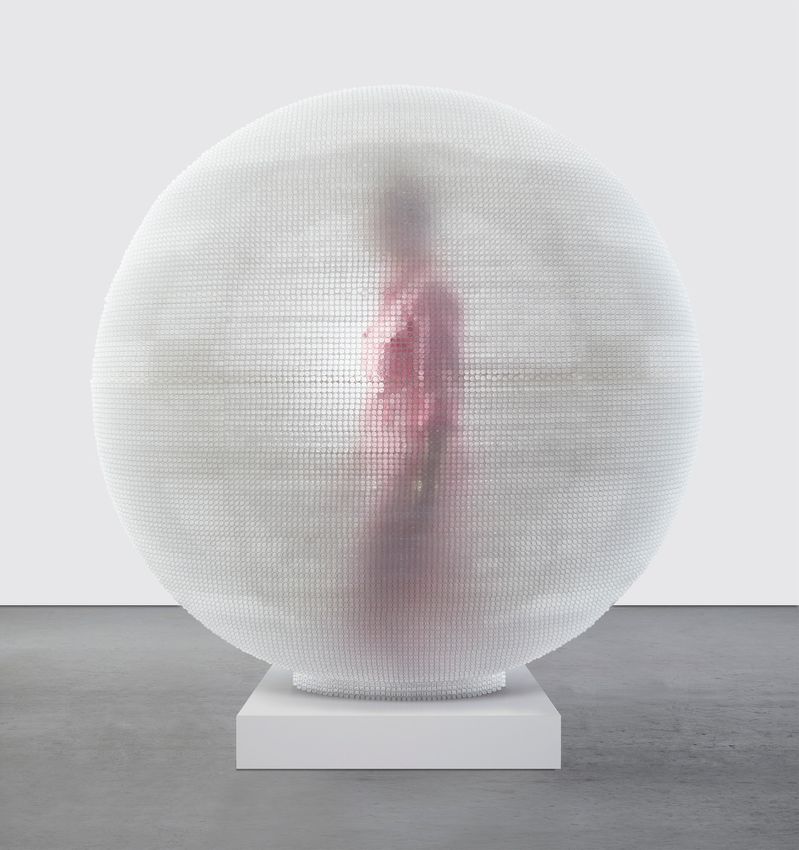
Sphere (2020) continues this investigation. Though offering a universally legible form, the massive sculpturecomplicates its pure geometry through its transparent materials, which bend light and open the work to its surrounds.Its metamorphic effects unfold gradually and indirectly, revealing their full potency when the viewer engages thework in a triangulated encounter with others. As a go-between, the sculpture pushes the solitary phenomenologicalexperiences devised by Minimalism into an interpersonal realm. The authoritative position of omniscience underwritinggrids, especially the lattice of perspective, gives way to a kind of dynamic, embodied perception that is optimisedwhen intersected by others in a moment of relational multiplicity.
Tara Donovan (b. 1969, New York) creates large-scale installations, sculptures, drawings, and prints, utilisingeveryday objects to explore the transformative effects of accumulation and aggregation. By identifying and exploitingthe usually overlooked physical properties of modest, mass-produced goods, Donovan creates ethereal works thatchallenge our perceptual habits and preconceptions. The atmospheric effects of her art align her with Light andSpace artists, such as Robert Irwin and James Turrell, while her commitment to a laborious and site-responsivemethodology links her to Postminimalist and Process artists, especially Eva Hesse, Jackie Winsor, Richard Serra,and Robert Morris. She has had major survey exhibitions at the Institute of Contemporary Art, Boston, which wasalso on view at the Museum of Contemporary Art San Diego, and Museum of Contemporary Art Denver, as well asa string of solo projects at the Metropolitan Museum of Art in New York, UCLA’s Hammer Museum, the Berkeley ArtMuseum, Smart Museum of Art, Indianapolis Museum of Art, Milwaukee Art Museum, Parrish Museum, and the Museum of Contemporary Art Cleveland, among others.
Tara Donovan (b. 1969, New York) creates sculpture, drawings, prints, and large-scale installations that transform the banality of everyday objects into the extraordinary. Known for her commitment to process, she has earned acclaim for her ability to discover the inherent physical characteristics of an object and for her exploration into the nature of accumulation. Donovan’s many accolades include the prestigious MacArthur Foundation ‘Genius’ Award (2008) and the first annual Calder Prize (2005), among others. She has been the subject of several major solo exhibitions at museums including the Parrish Art Museum, Water Mill, New York (2015); Milwaukee Art Museum (2012); The Metropolitan Museum of Art (2007), UCLA Hammer Museum (2004), and Corcoran Gallery of Art, Washington, D.C. (1999). Donovan’s first European exhibition was presented in 2013 at the Louisiana Museum of Modern Art in Humlebæk, Denmark, and traveled to the Arp Museum Bahnhof, Rolandseck, Remagen, Germany. In September of 2018, her work will be presented in the solo exhibition Tara Donovan: Fieldwork at Museum of Contemporary Art, Denver. Pace has represented Donovan since 2005.


Pace is a global art gallery of and for the future, modeled on a set of core values established during its founding in 1960 and designed to serve its artists, estates, and collectors in a way that is focused, responsive, and aligned with its enduring mission.

A respected voice in contemporary art discourse.
Focusing on ambitious storytelling and insightful art-world commentary. Ocula Magazine publishes in-depth interviews, critical essays and timely analysis on the artists, exhibitions and ideas driving the global art world.
Learn more about Ocula Magazine
Showcasing the best of the art world.
Ocula partners with galleries from around the world to highlight their artists, artworks and exhibitions. Gallery membership is by application and invitation, with each member vetted by an independent panel.
Learn more about Ocula Membership

Specialises in the sale of major artworks.
Led by a team with deep ties to the world’s leading auction houses, galleries and collectors. Ocula’s advisory team offers bespoke services to high-net-worth clients from around the world who are looking to acquire the best of contemporary and modern art.
Learn more about our team and services