‘Our task is to make trouble, to stir up potent response to devastating events, as well as to settle troubled waters and rebuild quiet places.’ – Donna Haraway, Staying with Trouble
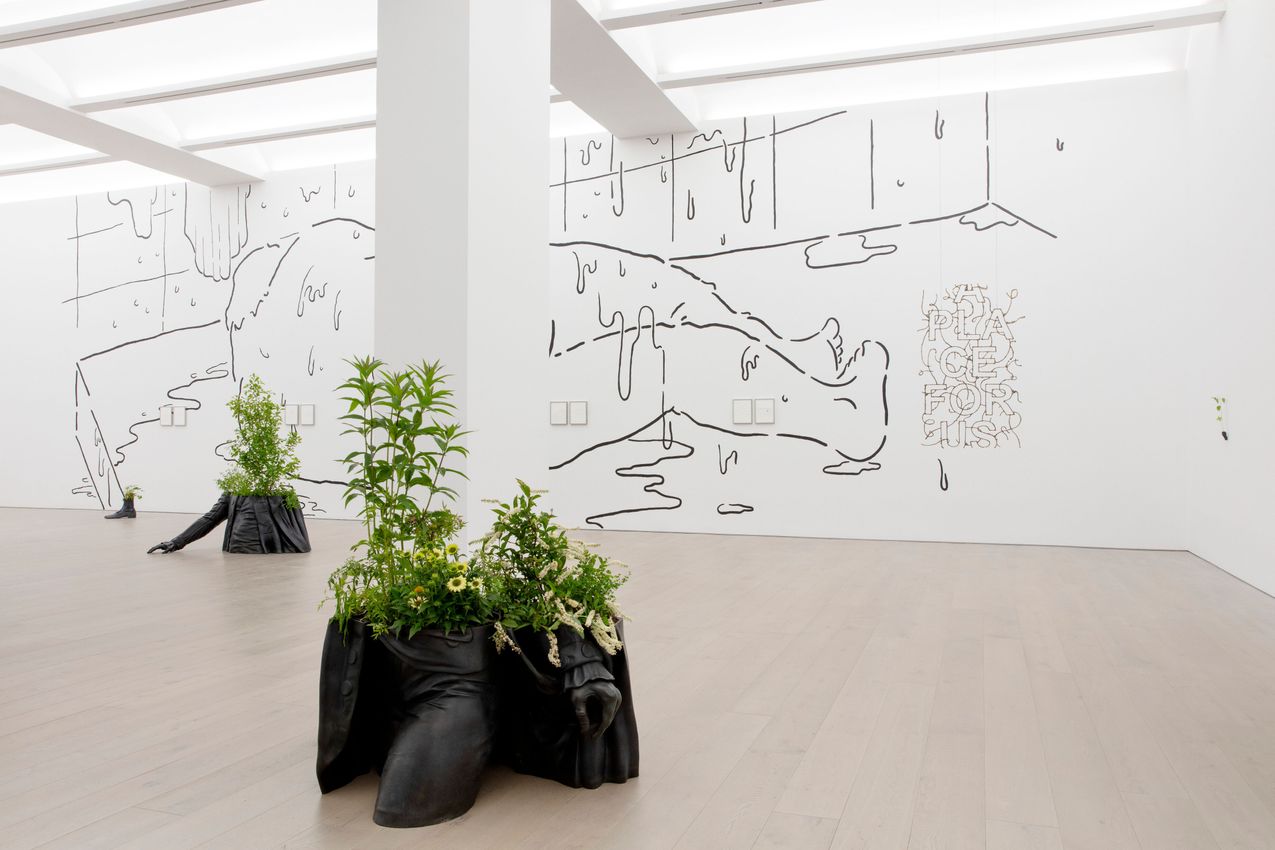
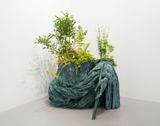
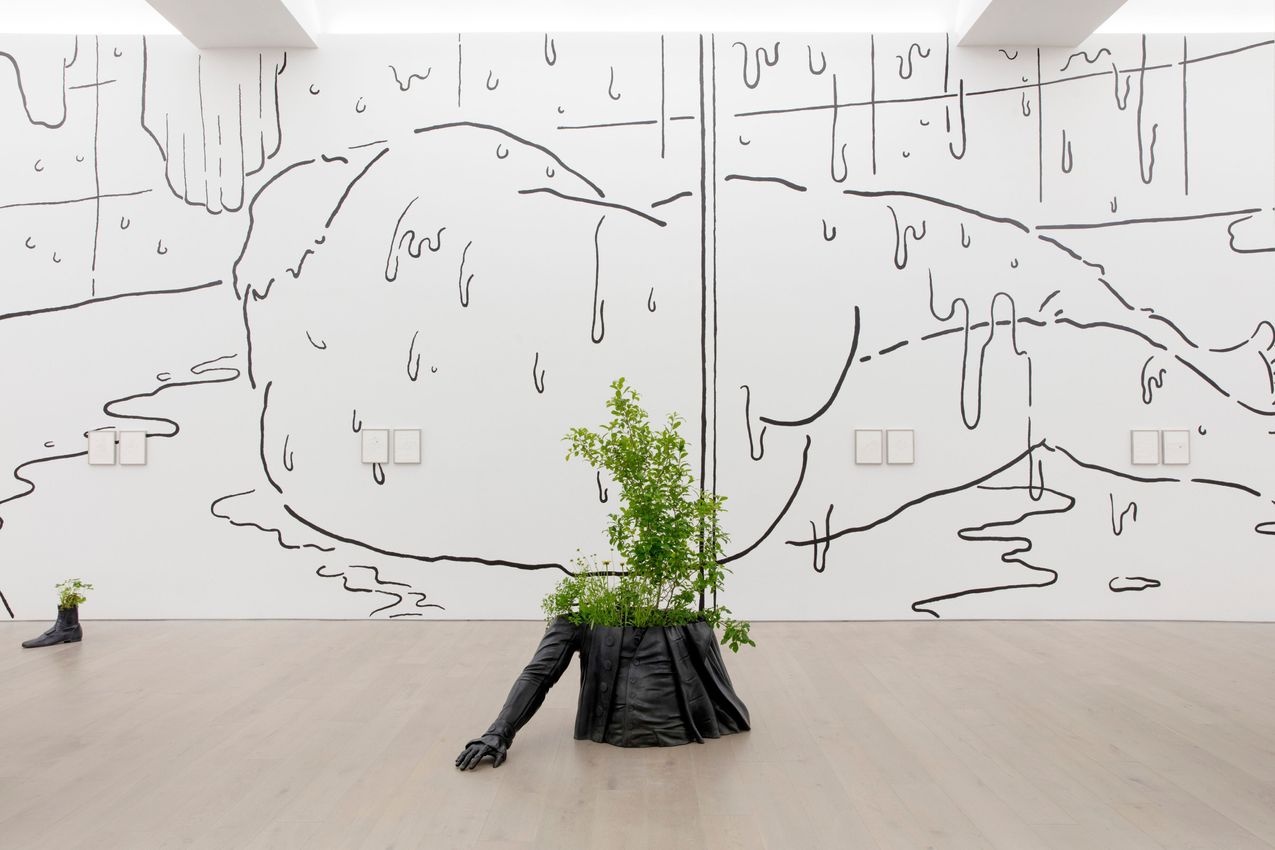
After the last statue falls, broken apart limb by limb, with it the reminder of the power of the oppressive colonizer finally fades away. In that place, imagine a surrounding landscape that is a speculative account of the future. Approaching the environment as a living ruin whose palimpsest of political erosions lays now on gardens where nature has taken over, covering pieces of the statues, encouraging new ways of looking at the spaces in and around us. The sole purpose of the broken statue is now to be a holder or container in which wildflowers and plants live and thrive and which points toward different possible futures.
For the last 15 years, Iván Argote has been investigating and creating interventions on public monuments from his home country of Colombia to his current home in France. Influenced by the 2020 global uprisings of a new generation of young social activists confronting systems of inequality, oppression, and racial hierarchy, Argote’s artistic works come through as poetic and political gestures. At Perrotin, he will present six new series that propose alternatives for contested monuments within major historic cities—namely Bogotá (his ancestral home), Paris (his current home), and New York (the exhibition’s home)—ultimately using fiction as a tool to change the present.
In A Place For Us, Iván Argote deploys a series of tactics—disappearance, eroticization, natural decay, and fiction—in order to theorize a new future for historical monuments. The centrepiece of this exhibition is Argote’s immersive installation, Wild Flowers, which includes planters made from disembodied fragments of Wall Street’s iconic George Washington monument. Scattered across the third floor of the gallery, Washington’s torso, hands, and feet are hollowed out and reimagined to contain regional plants and flowers, as modes of replenishment and regeneration.
Entering the exhibition, we are met by a series of new and historic works that pose the fictional removal and subsequent revision of existing monuments. In the gallery’s entryway is a large-scale photograph, titled Etcétera, based on a series of interventions the artist conducted in Bogota, Colombia from 2012–2018. There, Argote disrupted statues in public parks around the city by disappearing them with a mirror shell, like the one covering a statue of Francisco de Orellana, a conquistador who was the self-proclaimed discoverer of the Amazonian Forest. The resulting optical illusion obscures the statues while reflecting its surroundings. Building upon this, in his new ‘Etcétera’ (2021) series, Argote uses architectural intervention with mirrors to entirely replace statues, reflecting the gaze back on us. Another series, titled ‘Bondage’ (2021) is based on the artist’s daydreams of removing specific statues of conquistadores—such as Christopher Columbus and Sebastian de Belalcazar. Collectively, we are questioning whose history is told, whose is seen.
Activations and engagement are at the core of Iván’s practice. In the artist’s latest intervention, Au Revoir - Joseph Gallieni (2021), he focuses on the statue commemorating French military leader Joseph Gallieni. The prominent memorial in Paris’ 7th Arrondissement was the site of protests by anti-racism activists who aimed to bring to light the massacres that took place under Gallieni in French colonies in Asia, Africa, and the Caribbean.
For Au Revoir - Joseph Gallieni, Argote orchestrated an elaborate hoax to encourage further debate around the topic of removing public monuments. Without permission, but acting the part of a city sanctioned worker in an orange uniform, he hired a crane service to park a truck next to the statue so he could climb up while hired extras, who appeared to be civil servants or politicians, waited below. Next Argote placed ropes around the statue. As soon as Argote gives a ‘thumbs up’ the camera stops recording. Then, the footage is sent to Barcelona to a group of animators and special effects designers. Working from a 3D scan of the monument captured by a drone, Tigrelab digitally removes the statue. With the resulting ‘removal,’ the artist created a public debate using Fake News. Argote was influenced by Orson Wells’s seminal live radio broadcast drama War of The Worlds (1938) where he famously convinced listeners that Martians were attacking and invading New York. By the end of the day, more than twenty-thousand people viewed Argote’s video. Word reached the mayor of Paris, Anne Hidalgo, who sent a staff member to the site to confirm whether or not the statue was still there. Argote released a statement, saying ‘My intention with Au Revoir - Joseph Gallieni is to create the possibility of that day that has not yet come, but that will come.’
Together, the works in A Place For Us offer radical propositions for building equitable spaces, or as Argote reminds us, ‘If we want a common future, we need to be fearless and hopeful.’
–Julio César Morales
Born in Bogotá, Colombia, in 1983, Iván Argote settled in Paris in 2006. Argote creates videos, photographs, sculpture, public interventions and performances, as a way to explore our inextricable links to history, tradition, art, politics and power. Argote investigates the city as a place of transformation and potentiality, traveling the world in search of vestigial signs of fallen power, studying the indirect manifestations of control, and observing the conventions that gain acceptance in order for one vision of history to become the official version. Public monuments and sculpture are also recurring themes in the artist’s work. Through his personal narratives, and their connections to history, ideology, and consumerism, Iván Argote questions a Western perspective of history. Emmanuel Perrotin met Iván Argote in 2008 while the artist was a student at Paris Fine Arts School. Perrotin has represented Argote since 2009.


A respected voice in contemporary art discourse.
Focusing on ambitious storytelling and insightful art-world commentary. Ocula Magazine publishes in-depth interviews, critical essays and timely analysis on the artists, exhibitions and ideas driving the global art world.
Learn more about Ocula Magazine
Showcasing the best of the art world.
Ocula partners with galleries from around the world to highlight their artists, artworks and exhibitions. Gallery membership is by application and invitation, with each member vetted by an independent panel.
Learn more about Ocula Membership

Specialises in the sale of major artworks.
Led by a team with deep ties to the world’s leading auction houses, galleries and collectors. Ocula’s advisory team offers bespoke services to high-net-worth clients from around the world who are looking to acquire the best of contemporary and modern art.
Learn more about our team and services