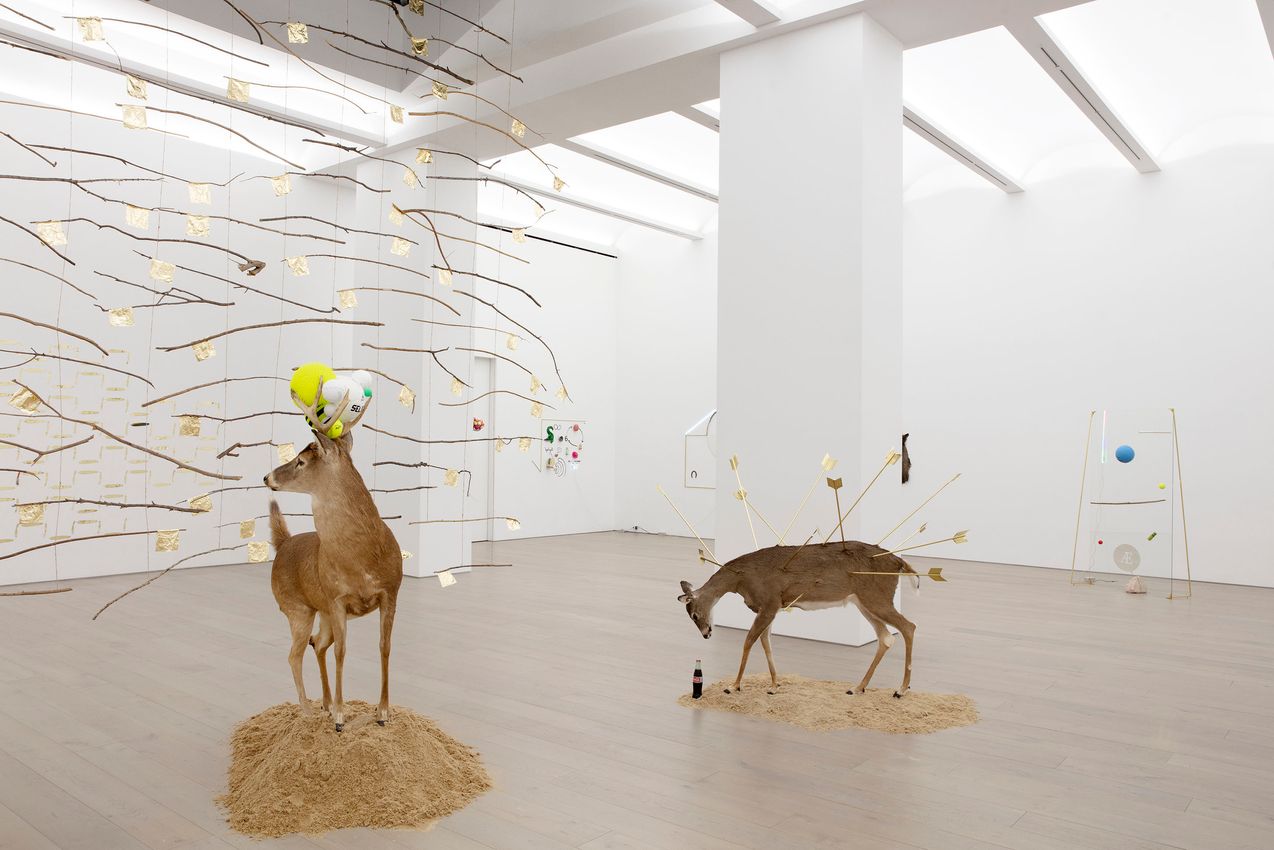
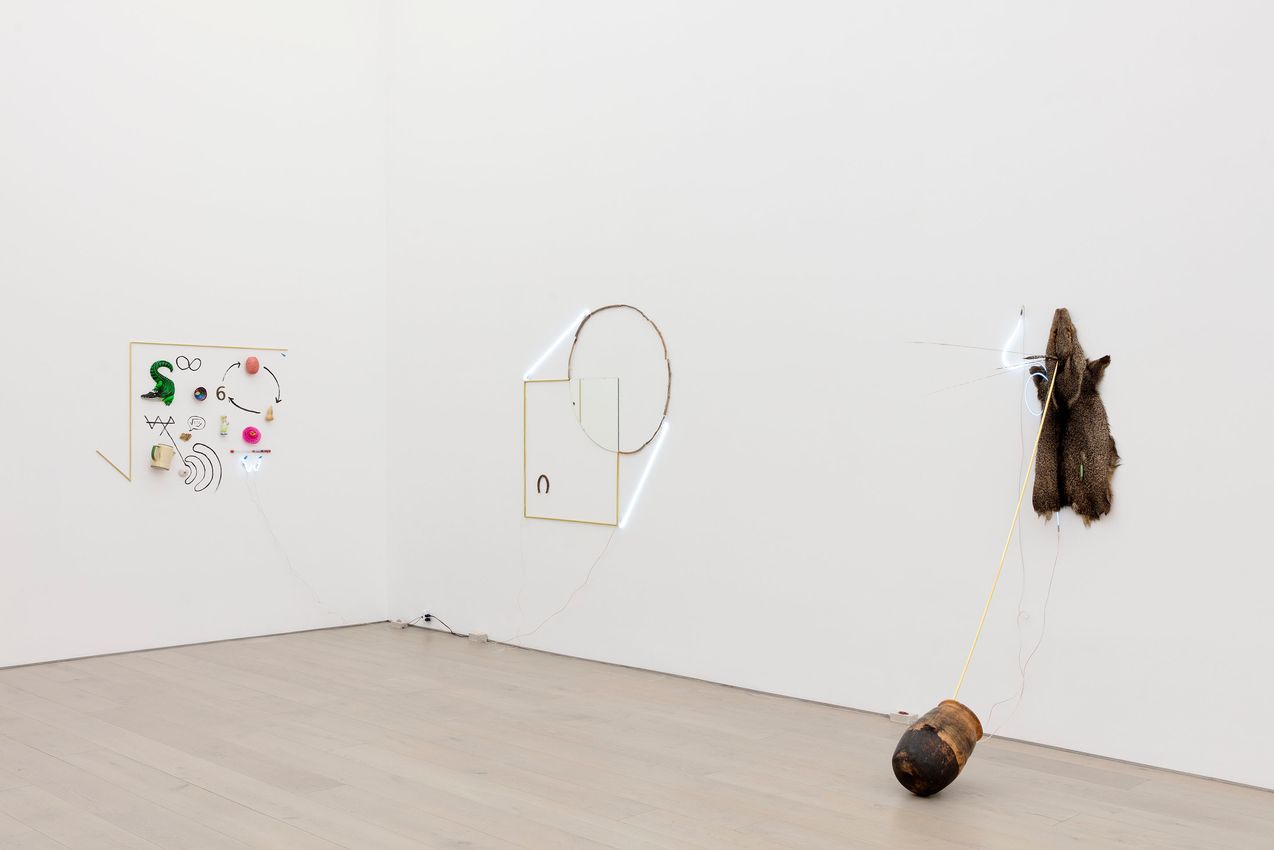
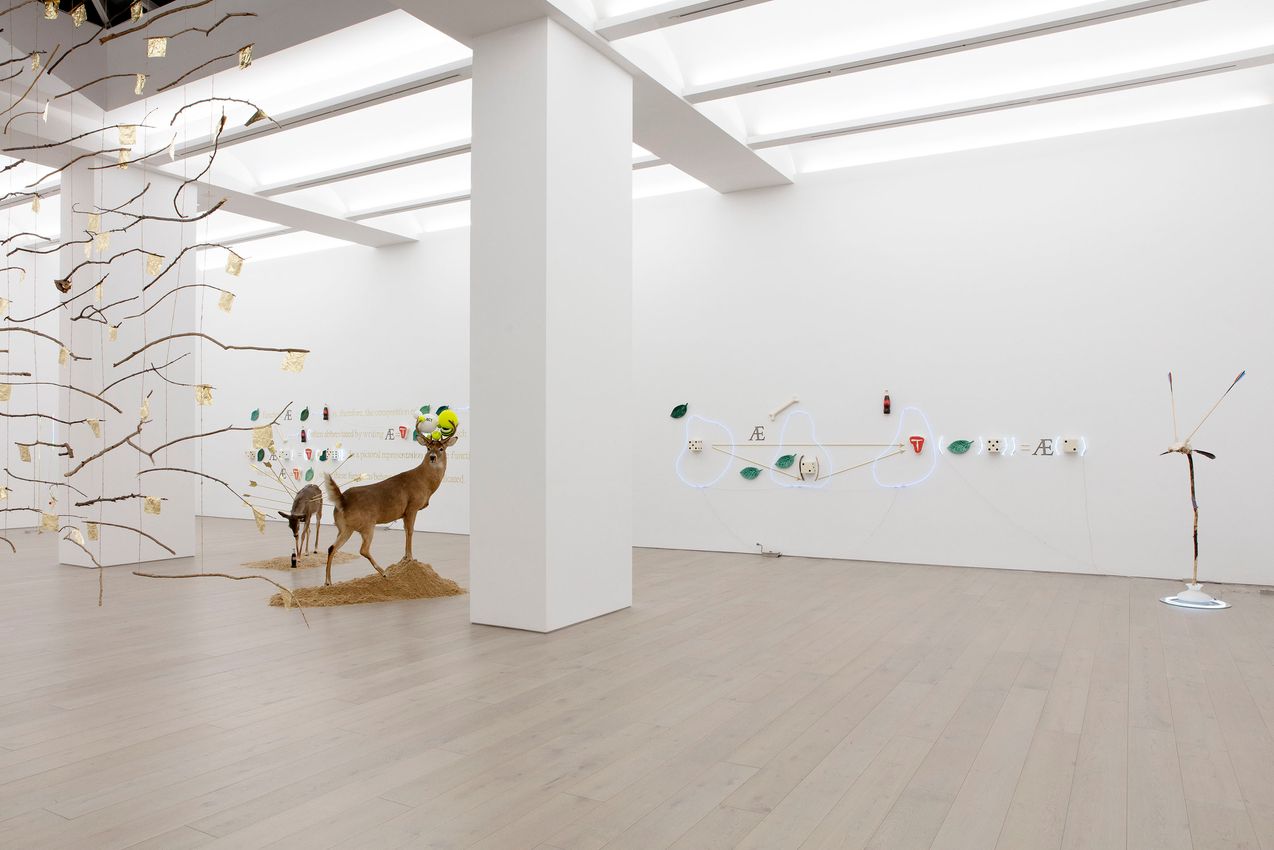
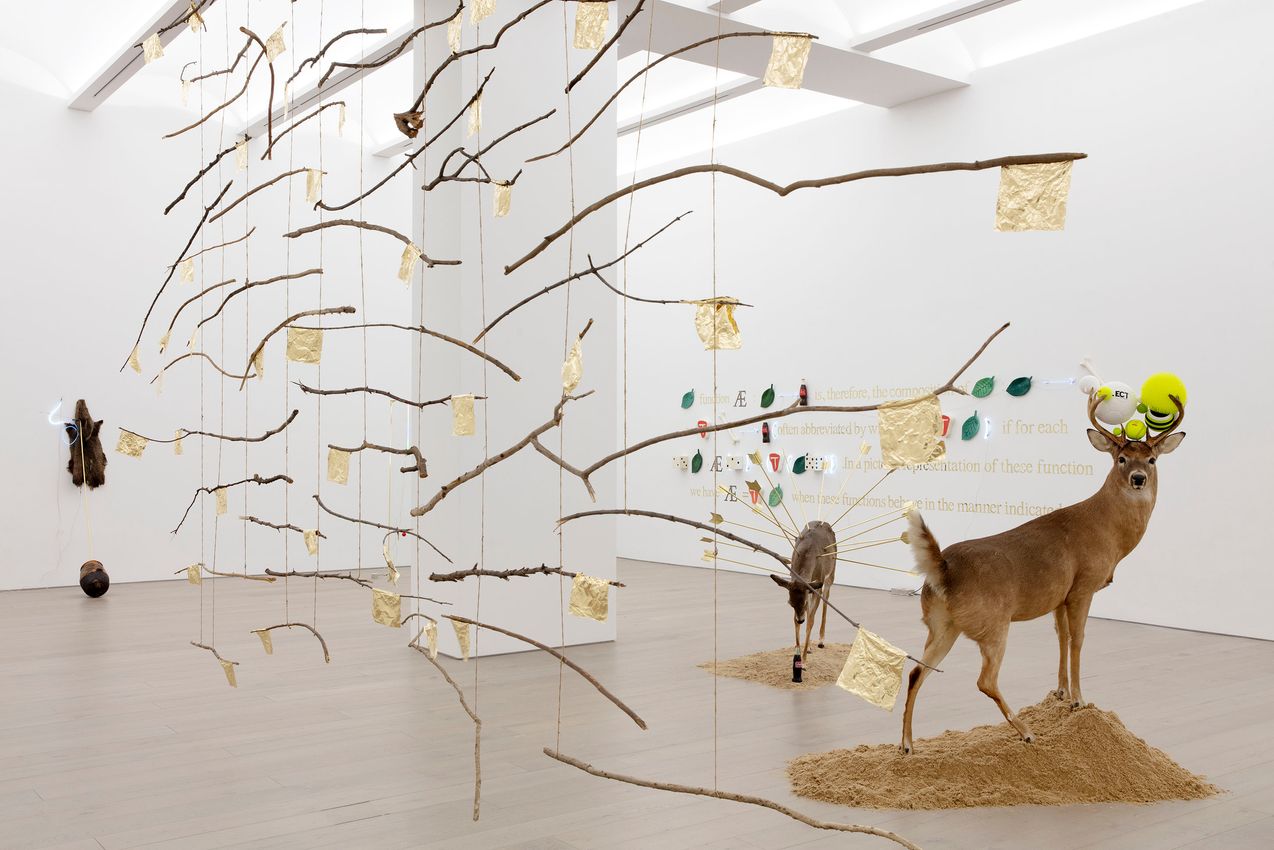
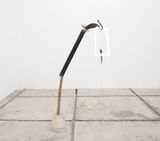
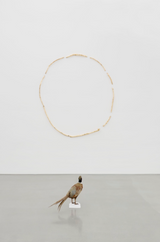
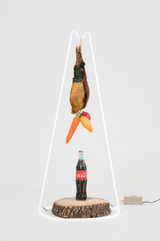
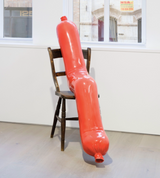
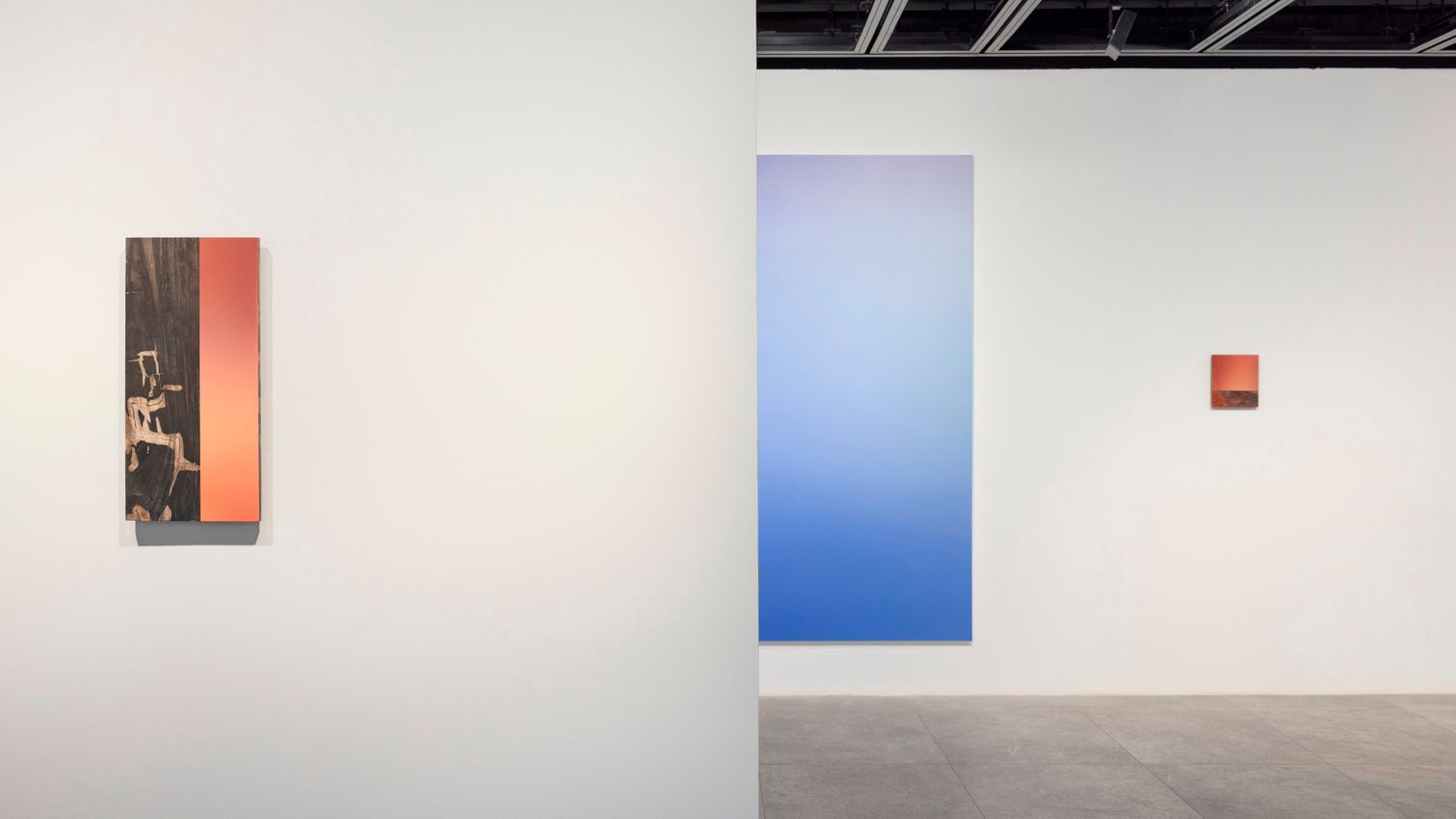
Perrotin New York is pleased to present Of Beauty and Consolation, a solo exhibition by Guadalajara-based artist Gabriel Rico, opening on April 29 and on view through June 5. For this exhibition, Rico introduces new bodies of work, including a series of sculptural objects and wall installations.
Gabriel Rico actively engages theory by studying a broad range of philosophical works, scientific research, and ancient texts. A confessed ontologist, Rico brings to existence these theoretical musings through curious and fantastical juxtapositions of found objects—man-made and natural—with crafted pieces that together interrogate humanity’s species-being vis a vis the world of things, and to create visual formulae to help solve a myriad of universal existential problems.
Rico’s exhibition title, Of Beauty and Consolation, is a direct quotation from a Dutch television series of the same title, created and hosted by journalist Wim Kayzer, who interviewed 26 philosophers and thinkers, scientists, artists, musicians, writers, and other learned celebrities, and asked them a question: ‘What makes life worth living?’ Rico also asks big questions as such, though not verbally, but visually through his work, through each of the objects he uses, and the implied relationships these objects have with each other and with the viewers. Rico acts as an interlocutor between the material world and the noetic space, with this exhibition reflecting a studied approach to contemporary thought, and a methodology for ontological experiments.
The entirety of the exhibition, consisting of 13 works of art, can be considered in fractal terms where the structure of the whole is also found in the structure of each piece. Every work of art in this exhibition is formed from the imaginings of innocent precocity, while executed with mathematical acuity of Einsteinian proportions. Indeed, both wonder and analysis exist on the same plane in each of Rico’s work and is imbued with the same philosophical -scientific approach to the synthesis of the visual experience. For this reason, the works act as formulae—a set of terms that expresses its composition while also being a set of procedures that reveal the relationships between the part and the whole—that can be plugged into any equation of varying scale.
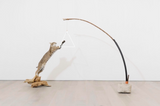
These experiments cannot be solved without the requisite participation of the viewers to apply these visual formulae to their own experiences and calculate a personal solution. Upon entering the space and beholding these formulations, we, the viewers, are asked to be peers and replicate these experiments, not to refute Rico’s findings, but to enrich it with our own conclusions. In X from the series –Excessive butter– (2021), Rico has given us his formula: a wall piece consisting of deer taxidermy + sports balls [basketball, soccer ball, volleyball, tennis ball, football, ...], so what is the equation we are solving? Is this a formula to be used in the environmental problem set, or does it problematize the nature of sports?
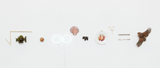
Rico’s role oscillates like a pendulum, swinging from one extreme point as a philosopher and as a scientist on the other, with the role of the artist at the equilibrium. His visual formulae drive the pendulum back and forth from scientific equations to philosophical propositions as seen in the piece, V from the series –The poller and exacter of fees– (2020). Enframed within a golden radical sign are rainbow stickers, a rubber toy bug, a honed piece of stone, a plate with a classical motif, a white neon right-angle, a plastic bunch of grapes, an ink drawing on white paper, along with black scribbles—75, upside down and backward, a short slightly bent double-headed arrow, a curved double-headed arrow, circles connected by lines, and an equation: square equals A over M. The pendulum swings to the mathematical extreme giving the viewer discernible symbols of a numerical equation and a hope for a solution. But as the pendulum swings the other way, this equation becomes more philosophical, more relational, and asks questions like, ‘what makes rainbow stickers identical to a piece of stone’ and ‘what element is shared between the bunch of grapes and the plate?’
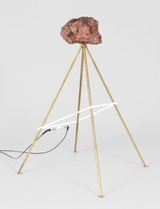
A chamomile branch in the shape of the number 2, and a quarry rock are connected by two strips of neon light shifting colour from pale blue on the left and bright white on the right. This piece, titled, XXXVIII from the series—More robust nature... more robust geometry (2021), reveals Rico’s motivation in creating these visual formulae—to establish the incalculable relations between nature and mathematics, from which the sublime emerges. The philosophical penchant of the artist is confounded by his deployment of mathematics, a strategic manoeuvre to force the viewer to meander through a constellation of objects to contemplate their form and geometries in order to reformulate the calculus of beauty, and to gain consolation from their materiality. This is Gabriel Rico’s ultimate enterprise.
Text by Ricardo J. Reyes, Curator and Director, University of Hartford. Courtesy Perrotin.
Born in 1980 in Lagos de Moreno, Mexico, Gabriel Rico now lives and works in Guadalajara, Mexico. His work is characterised by the interrelation of seemingly disparate objects. Self-proclaimed ‘ontologist with a heuristic methodology’, Gabriel Rico pairs found, collected, and manufactured materials to create sculptures that invite viewers to reflect on the relationship between humans and our natural environment. Rico frequently uses neon, taxidermy, ceramics, branches and more personal pieces of his past to create an equation or formulation. His works achieve a precise geometry despite the organic, roughly hewn character of their materials. His installations ironically and poetically combine natural and unnatural forms, insisting on a necessary contemplation on their asymmetry as well as our own cultural and political flaws.

A respected voice in contemporary art discourse.
Focusing on ambitious storytelling and insightful art-world commentary. Ocula Magazine publishes in-depth interviews, critical essays and timely analysis on the artists, exhibitions and ideas driving the global art world.
Learn more about Ocula Magazine
Showcasing the best of the art world.
Ocula partners with galleries from around the world to highlight their artists, artworks and exhibitions. Gallery membership is by application and invitation, with each member vetted by an independent panel.
Learn more about Ocula Membership

Specialises in the sale of major artworks.
Led by a team with deep ties to the world’s leading auction houses, galleries and collectors. Ocula’s advisory team offers bespoke services to high-net-worth clients from around the world who are looking to acquire the best of contemporary and modern art.
Learn more about our team and services