



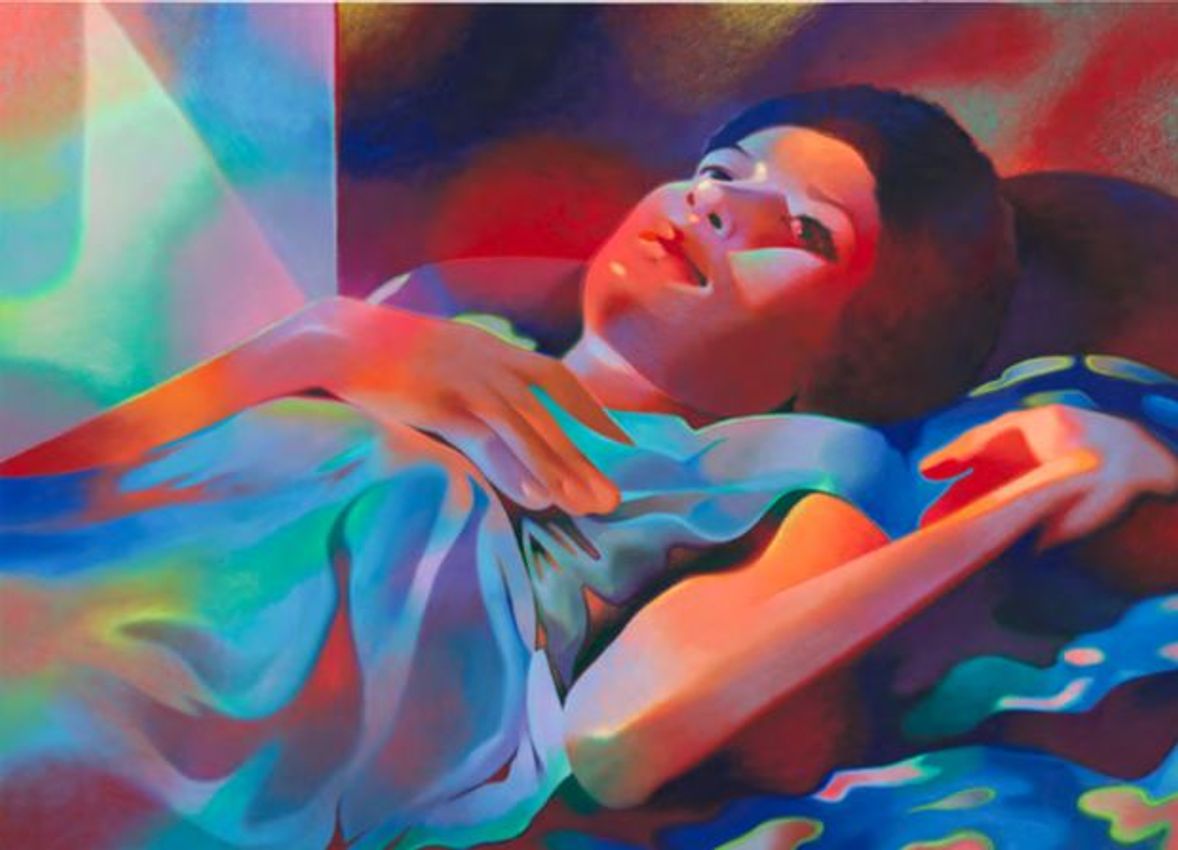
Robin F. Williams: Undying comprises a selection of new paintings anddrawings that explore the psychological dimensions of intimacy acrossmultiple film genres. Some scenes capture moments of leering tenderness.Others, the afterglow of an unholy encounter. Each explores the dynamicsof coercion, transgression, and submission that shape obsessiverelationships while embracing the ambiguity of sexual agency therein.Undying is her first exhibition with the gallery. Her solo exhibition, Robin F.Williams: We’ve Been Expecting You, is currently on view at the ColumbusMuseum of Art through August 18.
Undying extends Williams’s enduring engagement with the representationof women and the construction of gender in portraiture, advertising,folklore, social media, and film. Her vivid imagery is as diverse as hersource material. Known for highly stylised figures composed throughlayers of brushwork, marbling, airbrushing, sponging, and stenciling,Williams often employs an arsenal of tools more familiar to crafting than toeasel painting. These techniques anchor the lush opticality of her imagesin haptic relatability, humbling the gravitas of oil painting while creatingrichly textured surfaces that reward careful looking.
Williams herself is a close observer. While creating Undying, she recalledlooking for ‘the painting’ in films, searching for shots where story andcomposition crystallized into an emotional punch. The resulting paintings,based on film stills, offer themselves up as a type of fan fiction thatattenuates what is otherwise a fleeting erotic exchange. The Man WhoFell to Earth (2023), Persona (2023), Blue Velvet (2023), and Thirst(2023) offer a study in cinematic convention: all feature women on theirbacks under hulking partners, captured from the intrusive vantage point ofan over-the-shoulder shot. Blacula (2023) and Videodrome (2023) studya slightly different trope, staging women who luxuriate under the influenceof sinister forces beyond the frame. They may later meet their demise, buthere, they are the only girl in the world.
The ambiguity of gendered pleasure and its mediation on film formed thecentral topic of early feminist theory. Indeed, the heyday of b-movieslashers in the 1970s was accompanied by a wave of canonical textsincluding Laura Mulvey’s treatise on visual pleasure and narrative cinema. The essay posited that film was a visual language developed by men formen, whose very structure preclude the possibility of female agency.Scholars since have insisted on greater complexity. Carol J. Clover’sconcept of the ‘final girl’ and Linda Williams theory of excessive emotionas cathartic cinematic experience offer models of identification foraudiences of any gender to enjoy horror films as embodied subjects. Andyet the idea of enjoyment sits uneasily with horror. Our pleasure as viewersis often proportional to the misery that unfolds on screen. For example, the ‘final girl’ is always tortured and miraculously survives, only to becondemned to return, again and again, in sequel after sequel, to facedown the killer once more. What do we extract from these femaleprotagonists? Film theorist Linda Williams suggests that extreme violence,sex, and emotion are hallmarks of the genre, whose excesses audiencesconsume like the vampires they watch on screen. Taken together, theworks in Undying deliver a closely cropped meditation on the dynamics ofthe vampiric in both filmic subject and spectator alike.
As with vampires and their victims, in Williams’s paintings, oppositesattract. The artist plays secondary and tertiary colours off one another toundergird the pictures with maximum tension. Vermillion and teal vibrateacross the canvass in The Man Who Fell to Earth, Videodrome, and Thirst.Red and green clash in Persona. Grafting the laws of attraction onto thedogma of the colour wheel, Williams plays at the edge of representation: complimentary colours provide maximum contrast when paired togetherbut result in grey obliteration when fully combined. Photorealistic as theymay appear, these paintings in fact hover at the edge of legibility. Onebrush stroke out of place, and the integrity of the whole would collapse.
Williams locates the fine line between the erotic flirtation of colours versusthe grey oblivion of their total imbrication; between the only girl and the ‘final girl’; and between the romance of an undying love versus the horrorof the undead. Despite the ambiguity of the paintings, Williams wrylypoints out that their source films ‘are all tragedies, in the end.’ The worksin Undying walk the tightrope between self-determination and self-destruction, snaring both fictional subjects and real-time viewers in thefrisson of a suspended moment where—as in good fan fiction—anotherending is always possible.
-Katherine Rochester, PhD
Press release courtesy Perrotin

A respected voice in contemporary art discourse.
Focusing on ambitious storytelling and insightful art-world commentary. Ocula Magazine publishes in-depth interviews, critical essays and timely analysis on the artists, exhibitions and ideas driving the global art world.
Learn more about Ocula Magazine
Showcasing the best of the art world.
Ocula partners with galleries from around the world to highlight their artists, artworks and exhibitions. Gallery membership is by application and invitation, with each member vetted by an independent panel.
Learn more about Ocula Membership

Specialises in the sale of major artworks.
Led by a team with deep ties to the world’s leading auction houses, galleries and collectors. Ocula’s advisory team offers bespoke services to high-net-worth clients from around the world who are looking to acquire the best of contemporary and modern art.
Learn more about our team and services