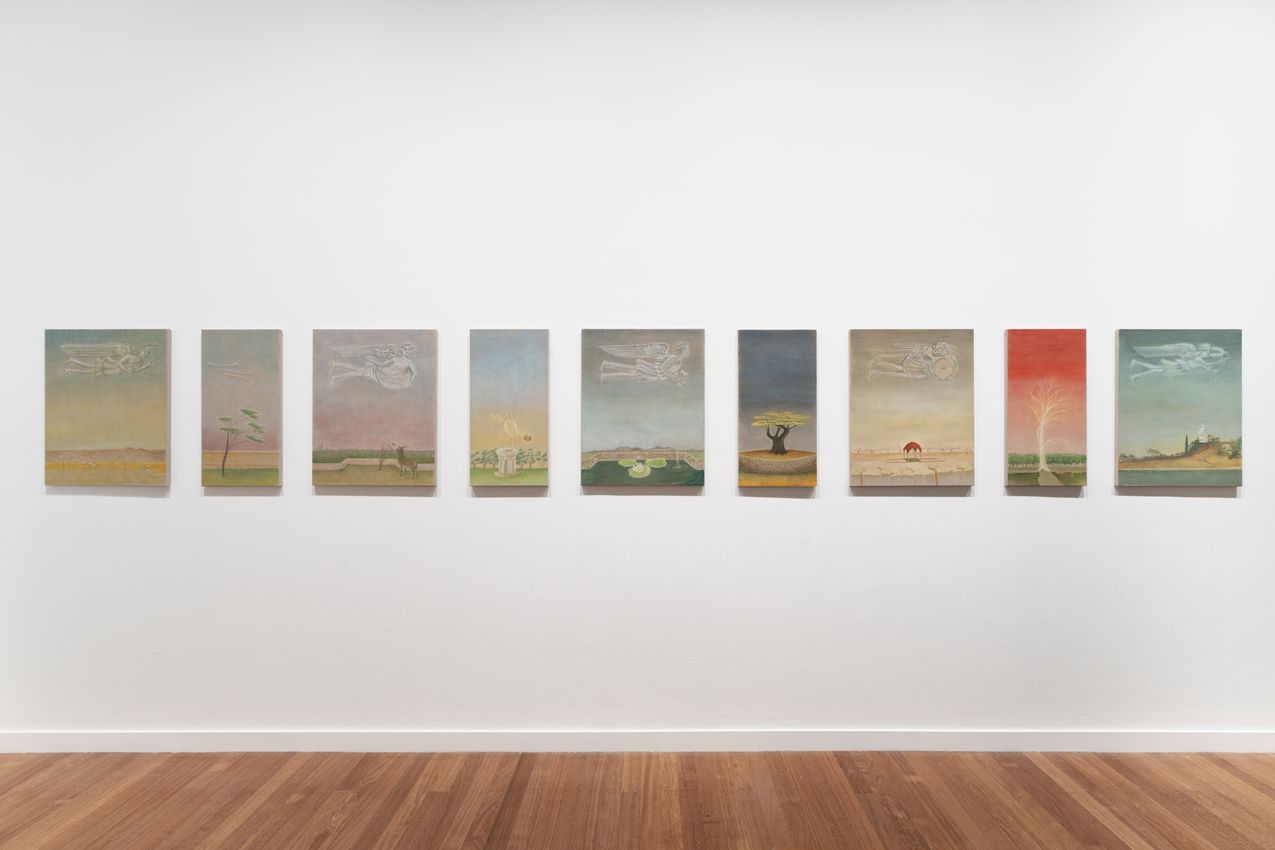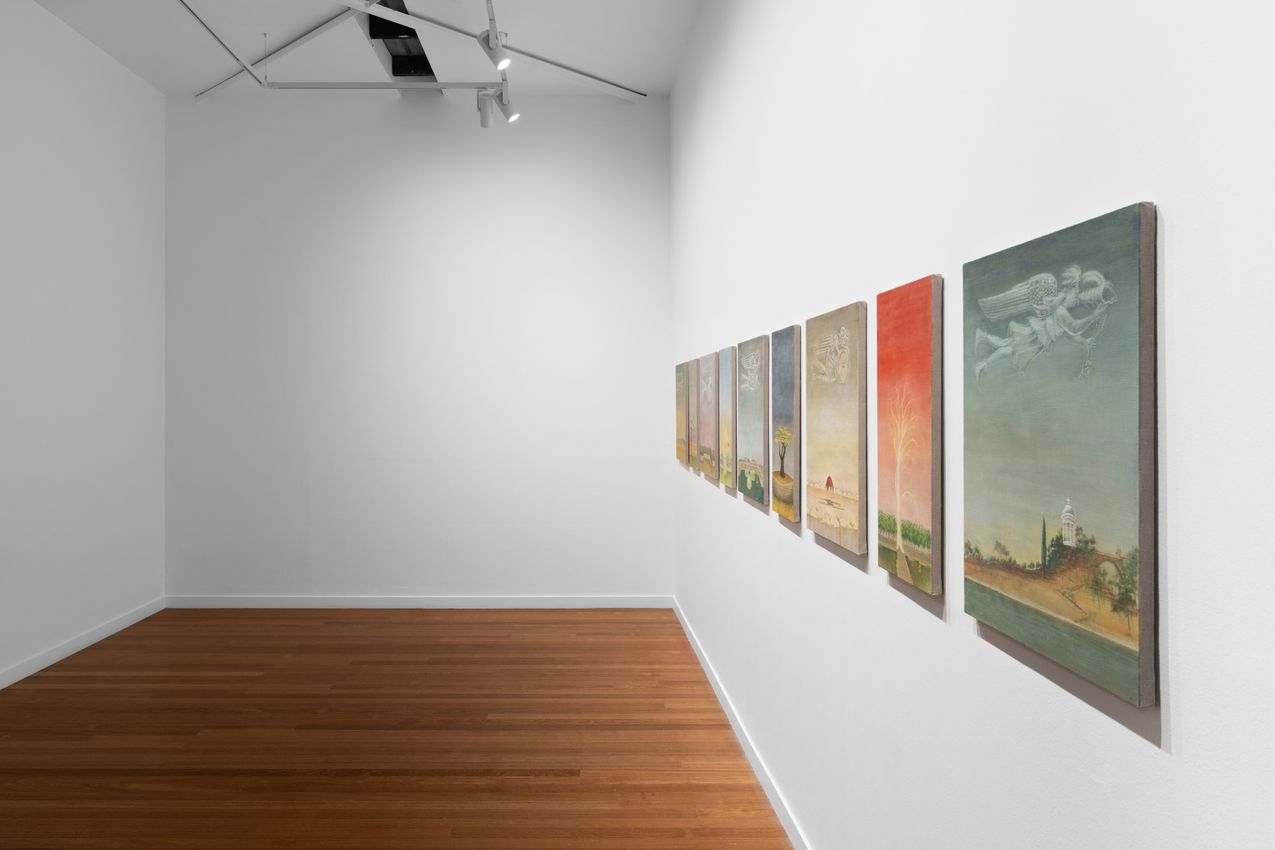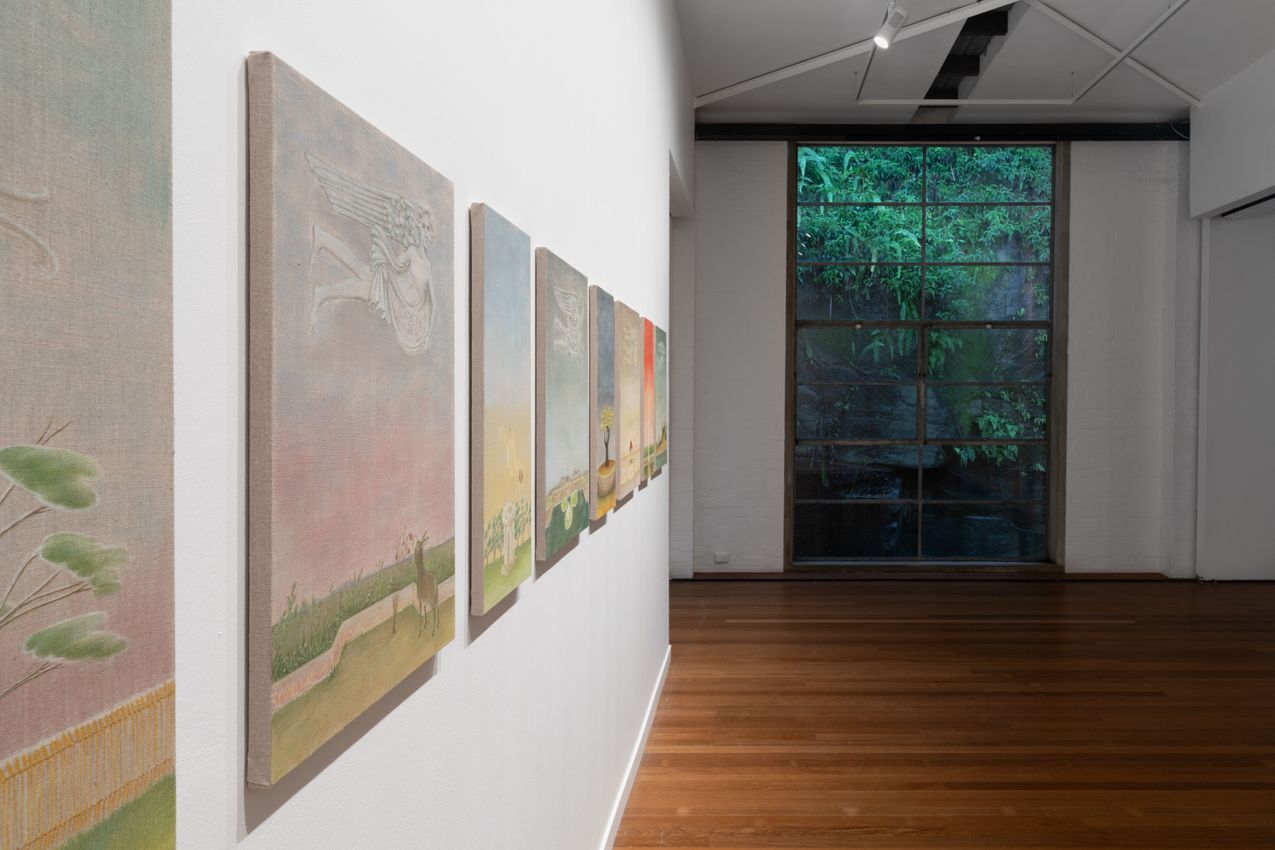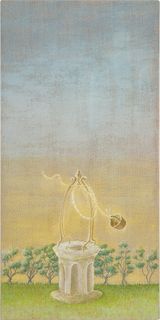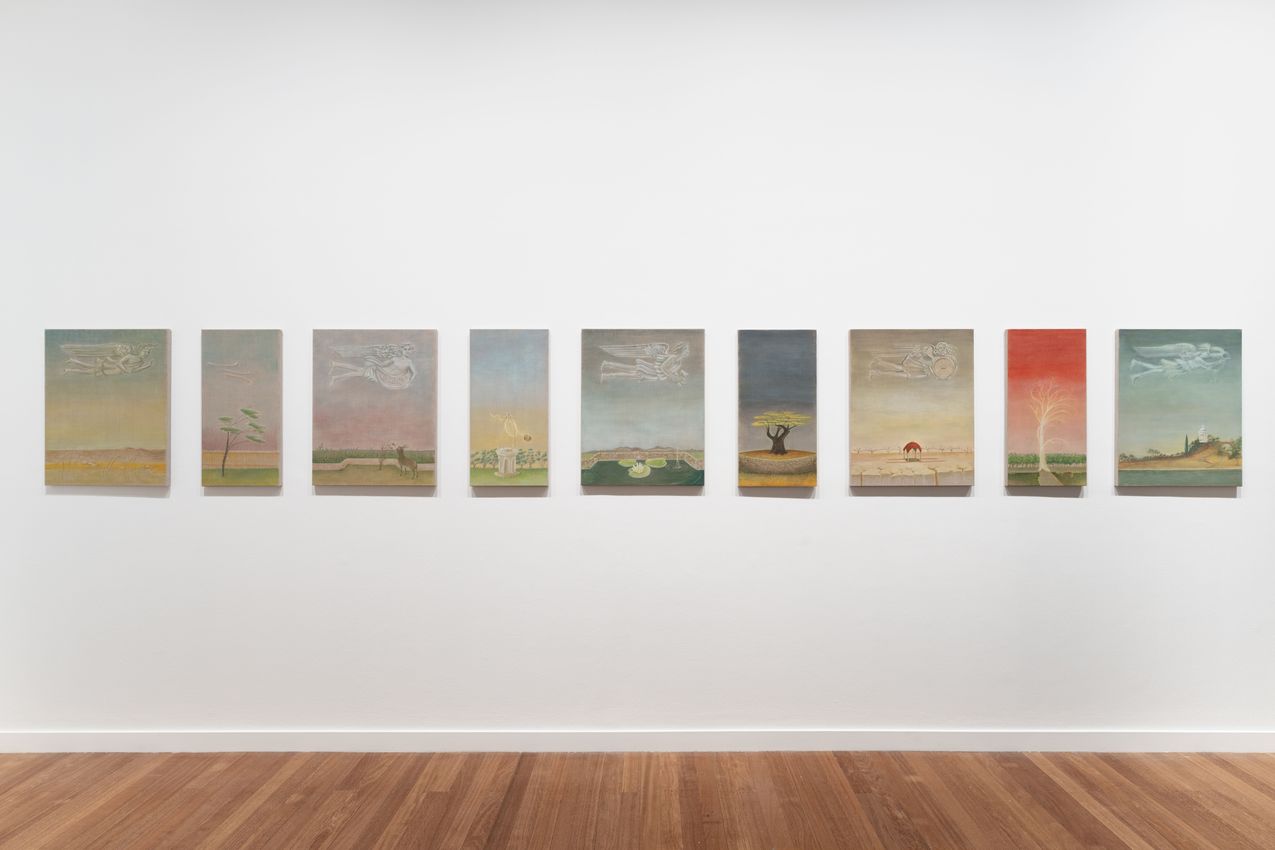
A new suite of paintings from Vivienne Shark LeWitt_, The Wind Cries Mary_, 2023–2025, draws together visual archetypes and cues associated with our inner life and conceptions of soul, spirit and self. It takes inspiration from the enclosed garden of the Virgin Mary, as well as the Greek myth of Psyche and her ‘labours’ to transcend her earthly world and be emancipated. For LeWitt, Psyche’s story represents the ‘task of survival’, while the garden is a place of protection – ‘simple, undemanding and humble’.[1] Weaving together both ideas, she creates an imaginary allegory of individual freedom and agency.
In medieval religious imagery and poetry, the hortus conclusus, or enclosed garden, encapsulated both ideals of monastic life and harnessing the wildness of nature and women.[2] LeWitt identifies a more interesting connection to the enclosed garden – to the cloistered world of the artist’s mind, acknowledging the late Melbourne art dealer Georges Mora (1913–1992), who would often describe the artist’s studio as being in their heads. But equally, LeWitt takes an interest in religious orders who separate themselves from the external world, pointing to the Franciscans who saw their entire world as an enclosure and their bodies as cells carrying within it a hermit soul, who remained inside to pray and meditate.
Ideas such as these constantly inhabit LeWitt’s studio practice. She captures them and releases them, allowing herself the freedom to reinterpret and revise them in the making of her paintings. In The Wind Cries Mary, LeWitt isn’t literally concerned with replicating the hortus conclusus, observing and abstracting some of its reoccurring motifs across the series of paintings: a cedar pine tree, olive trees, a rose, a well and a fountain. The first painting depicts a barren landscape with a small stream with reeds, while the second features a classical Roman stone pine blowing in the wind. In the third image, a donkey nibbles at a rose bush against a low wall and in the next, a prominent stone well sits, surrounded by olive trees. A lily pond or moat floats across the lower foreground in the last panel. Such imagery also speaks to depictions of the indoor gardens painted on the walls of ancient Roman villas, such as the Villa of Livia, where frescoes decorate the underground dining room, these depicting exotic birds and wild vegetation behind an illusionistic fence.
LeWitt’s gardens are interspersed with references to Psyche, the goddess of the soul. LeWitt was drawn to the beneficent power of nature in Psyche’s story, represented by the gentle westerlies of the wind god Zephyrus, which enable Psyche to triumph over death. In her depiction of the wind deities – the southwest wind (Livas), the west wind (Zephyrus) and the northwest wind (Skiron) – and their attributes, LeWitt adopts imagery that draws loosely on the Roman friezes found on the Pýrgos tōn Anémōn (Tower of the Winds) in Athens, considered to be the first meteorological station. But, unlike the heaviness and heroism depicted on the real sculptures, LeWitt’s figures appear light, summoned into the atmosphere and hovering above a small strip of landscape at the base of each canvas.
Drawing these two recognisable narratives together, The Wind Cries Mary points to a broader idea about caring for the self and looking after the inner mind and, ultimately, expresses what the artist describes as ‘a special feeling of being free ... free and safe – free as the wind!’[3]
– José Da Silva, 2023 for Inner Sanctum, 18th Adelaide Biennial of Australian Art
–––
[1] Conversation with the artist, 24 August 2023.
[2] The term stems from the poem ‘Song of Songs’ in the Hebrew Bible or Tanakha, where Solomon defines human love and relationships through a private, sealed garden. It has been subject to male imaginings and allegories associated with controlling and containing the female body; see Liz Herbert McAvoy, The enclosed garden and the medieval religious imaginary, D.S. Brewer, Suffolk, Eng., 2021, p. 35.
[3] Conversation with the artist, 5 October 2023.
Painter Vivienne Shark LeWitt refers to the act of painting as an intense, albeit subconscious and intuitive process. “As the zen masters say, a painting is already there before it is painted,” notes LeWitt. Her paintings often depict dream-like instances and moments of delicate reminiscing. LeWitt is also a trained cartoonist, which is reflected in her sinuous figures and soft palatte. She has participated in group and solo shows around Australia.


Established in Sydney by influential Australian art dealer and gallerist Roslyn Oxley and her husband Tony Oxley in 1982, Roslyn Oxley9 Gallery is one of Australia’s leading commercial galleries.

A respected voice in contemporary art discourse.
Focusing on ambitious storytelling and insightful art-world commentary. Ocula Magazine publishes in-depth interviews, critical essays and timely analysis on the artists, exhibitions and ideas driving the global art world.
Learn more about Ocula Magazine
Showcasing the best of the art world.
Ocula partners with galleries from around the world to highlight their artists, artworks and exhibitions. Gallery membership is by application and invitation, with each member vetted by an independent panel.
Learn more about Ocula Membership

Specialises in the sale of major artworks.
Led by a team with deep ties to the world’s leading auction houses, galleries and collectors. Ocula’s advisory team offers bespoke services to high-net-worth clients from around the world who are looking to acquire the best of contemporary and modern art.
Learn more about our team and services