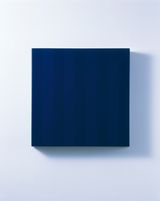
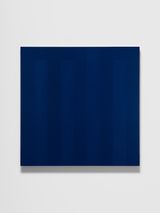
For the past twenty years, Atsushi Saga (b.1970) has been challenging the medium of painting through his unique technique of repeatedly polishing painted surfaces by hand to create a mirror-like texture. In Synchronicity, his first solo exhibition at SCAI THE BATHHOUSE in eight years, he presents a new series entitled Sync, which evokes the presence of sound through the smooth curves visible on red-coloured surfaces, and invites viewers into the depths of the subconscious and the sensory fields of the visible and invisible.
Upon entering the exhibition space, an intense red colour sets the tone—a vibrant hue that is both universal and emotionally charged. Red has historically held a unique meaning throughout history and culture, embodying opposing dimensions such as life and death, dynamism and tranquility, sacredness and the mundane. Saga’s glossy, lacquer-like red colour in Sync is made by the artist’s distinct blending of four different reds that he chose after years of experimentation, and by polishing layers upon layers of colour. The fine overlapping colour fields delicately reflect light while providing a sense of depth, conjuring a nonverbal record of time, and history of movement.
Close observation of the depth of field within the coloured surfaces reveals graceful curves painted in slightly varied reds and different shapes faintly visible on adjacent surfaces. This articulation of the Lissajous curve—a geometric shape formed when two wavelengths interact and harmonise with one another—is often used to visualise invisible phenomena like sound. The background of the curve underlies a “shippō” or cloisonne pattern in slightly different shades. This pattern of repeated interlocking circles symbolises eternity in traditional Japanese decorative art, establishing a peaceful harmony on the surface while accentuating the motion of the transforming curves.
A large work exhibited prominently in the exhibition, 25 Syncs, consists of twenty-five panels systematically titled from Sync/001 to Sync/025. Each measuring 60.6 cm square and 5 cm deep, they are positioned in a total symmetry vertically and horizontally. Without a beginning or end to the score, the individual colour surfaces retain subtle differences, yet the entire work remains in harmony. Each surface has its own distinct curve, indicating the presence of twenty-five different sounds. This ethereal, red landscape reads as an imagined chord as viewers approach or withdrawal from the colour plane. Through the complex interplay of multiple elements, rather than a linear phenomenon—such as a mirror-like-reflecting light, the work reminds visitors that the act of seeing itself is a multi-layered event that evokes memories and experiences.
Sync, the title of each panel, means synchronisations of different elements. Although the term is now commonly employed in the technological content, it initially referred to the synchronisation of sound and images. The exhibition title, Synchronicity, is derived from a psychological concept that aims to portray the supernatural phenomenon of coincidence, in which no casual relationship can be recognised.
The coupling of these titles, both suggesting temporal aspects, directs our attention to the enigmatic phenomenon of synchronisation of elements that compose a harmonious space. Through ‘seeing_’,_ this exhibition awakens the depth of sensory experience beyond visual perception, which is often overlooked in todays visually-oriented society, calling into question the complexity and multilayered nature of ‘the visible’. Saga’s new works silently hint that the unknown, which science cannot fully explain, continues to expand before our eyes.
SCAI The Bathhouse is a contemporary art gallery located in Yanaka, with a town ambience reminiscent of Old Tokyo. In walking proximity to Ueno, an area dense with museums and art schools, the gallery was converted from a venerable 200-year-old public bathhouse. Take a step inside, and you will find a white cube with soft natural light descending from the high ceiling.

A respected voice in contemporary art discourse.
Focusing on ambitious storytelling and insightful art-world commentary. Ocula Magazine publishes in-depth interviews, critical essays and timely analysis on the artists, exhibitions and ideas driving the global art world.
Learn more about Ocula Magazine
Showcasing the best of the art world.
Ocula partners with galleries from around the world to highlight their artists, artworks and exhibitions. Gallery membership is by application and invitation, with each member vetted by an independent panel.
Learn more about Ocula Membership

Specialises in the sale of major artworks.
Led by a team with deep ties to the world’s leading auction houses, galleries and collectors. Ocula’s advisory team offers bespoke services to high-net-worth clients from around the world who are looking to acquire the best of contemporary and modern art.
Learn more about our team and services