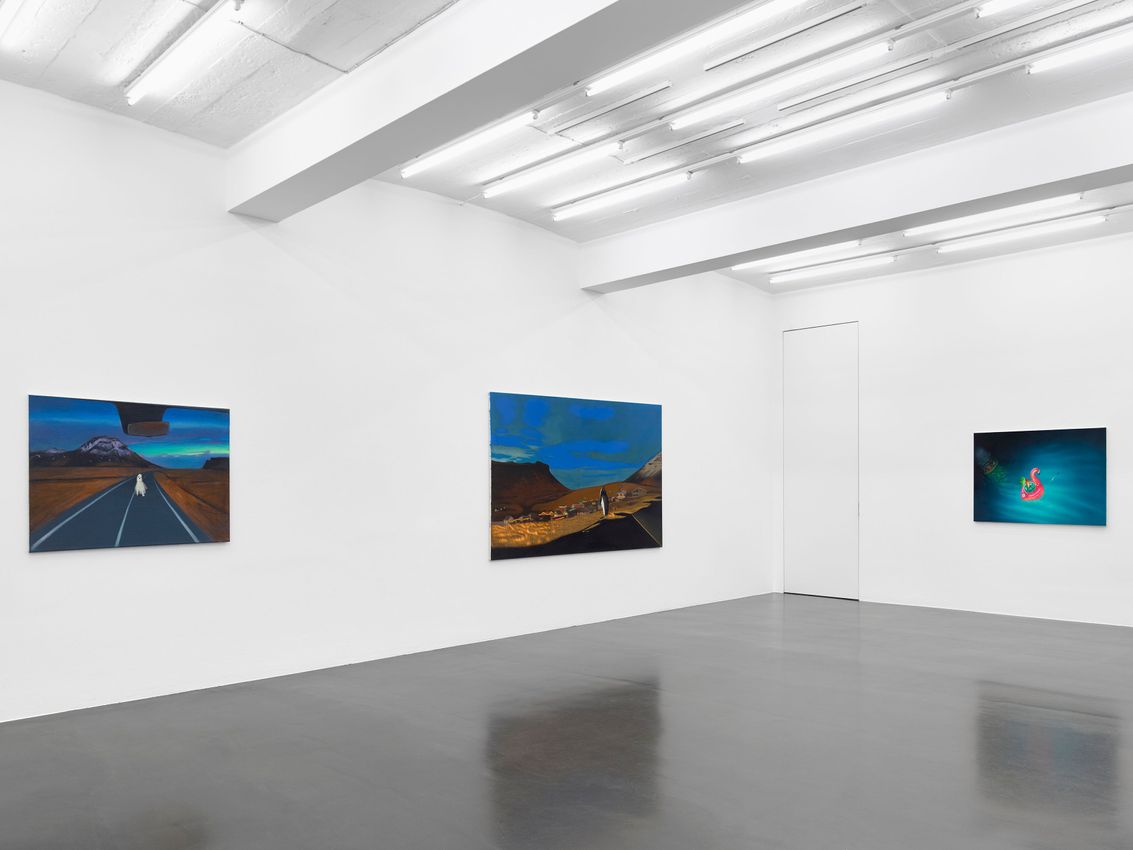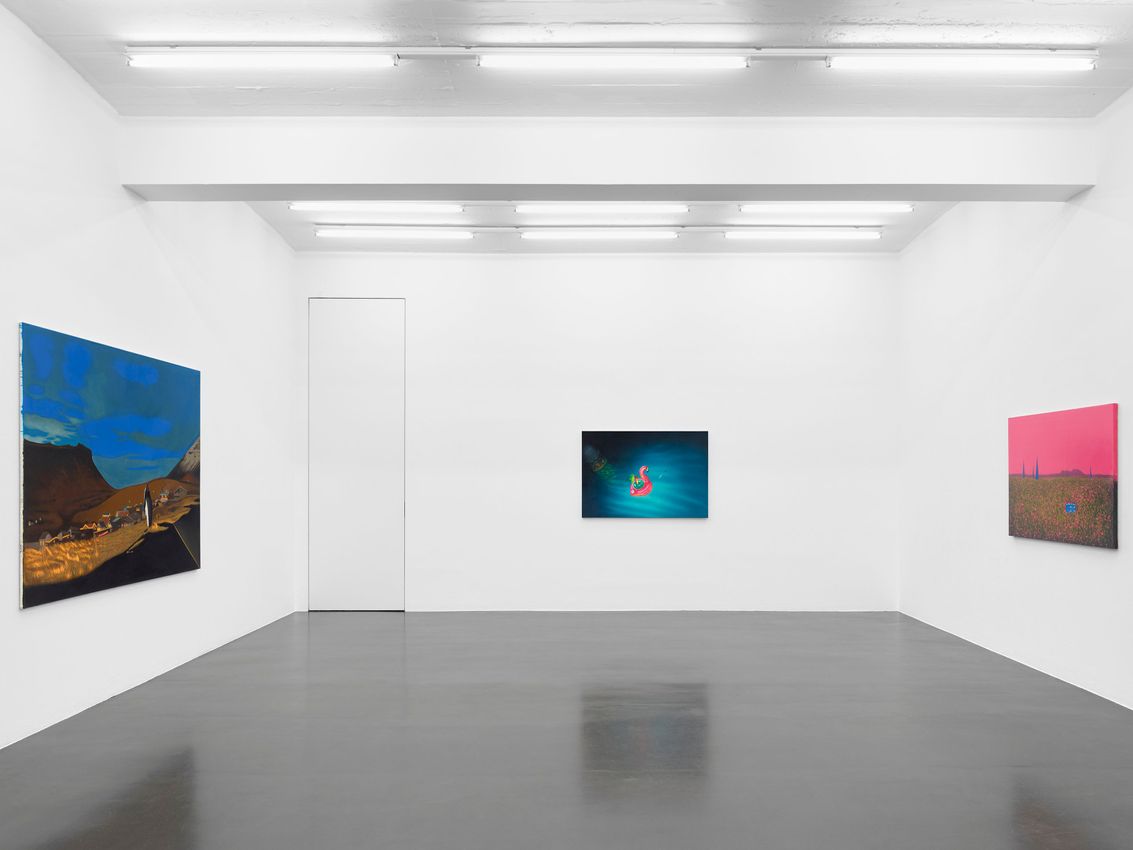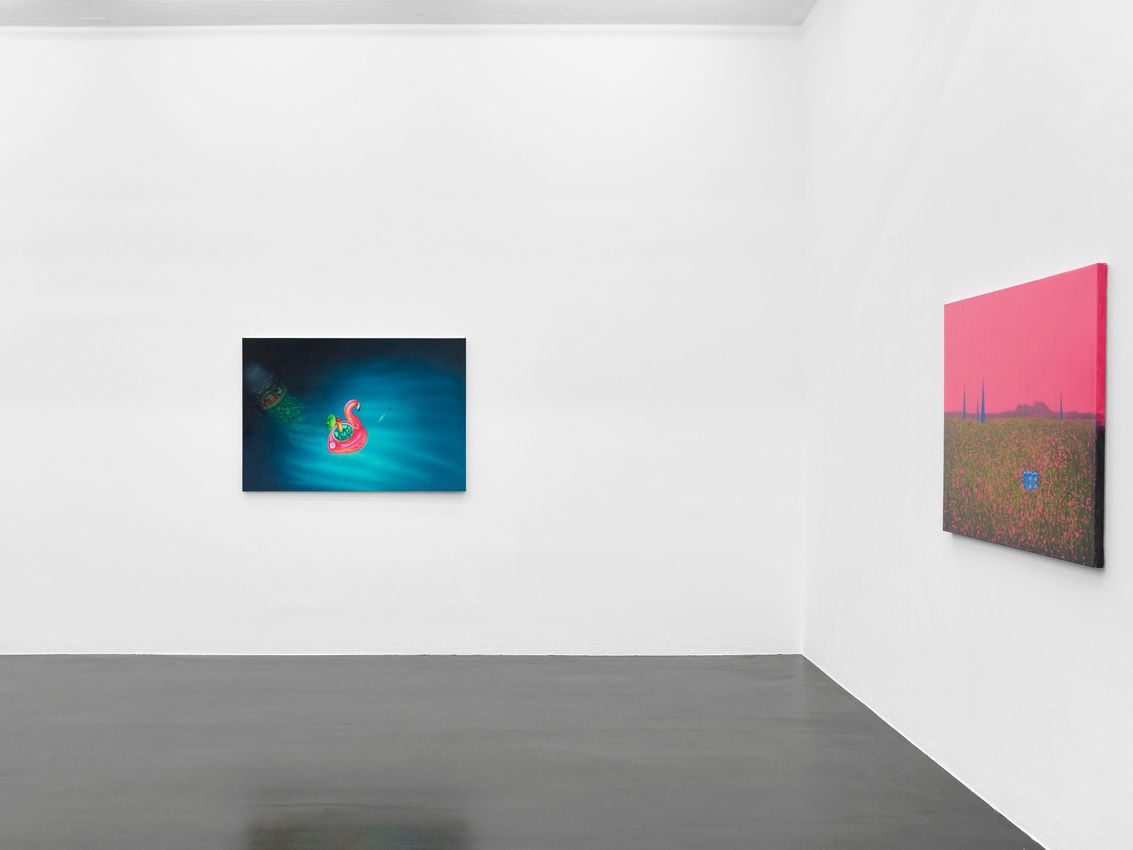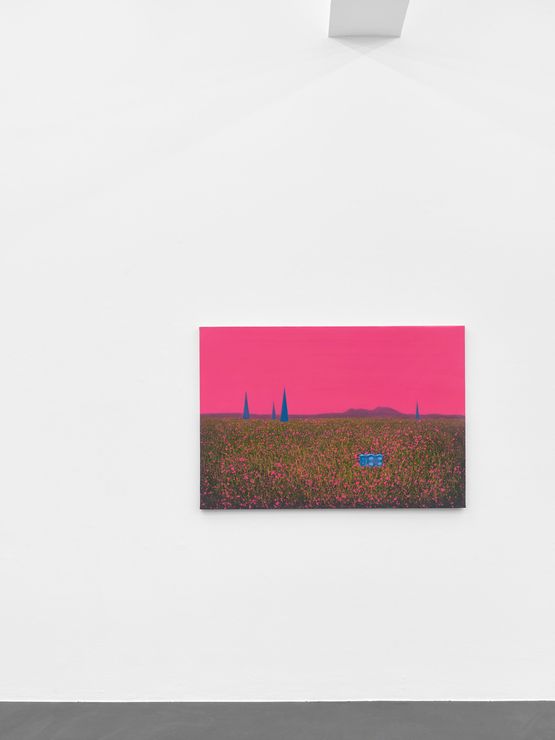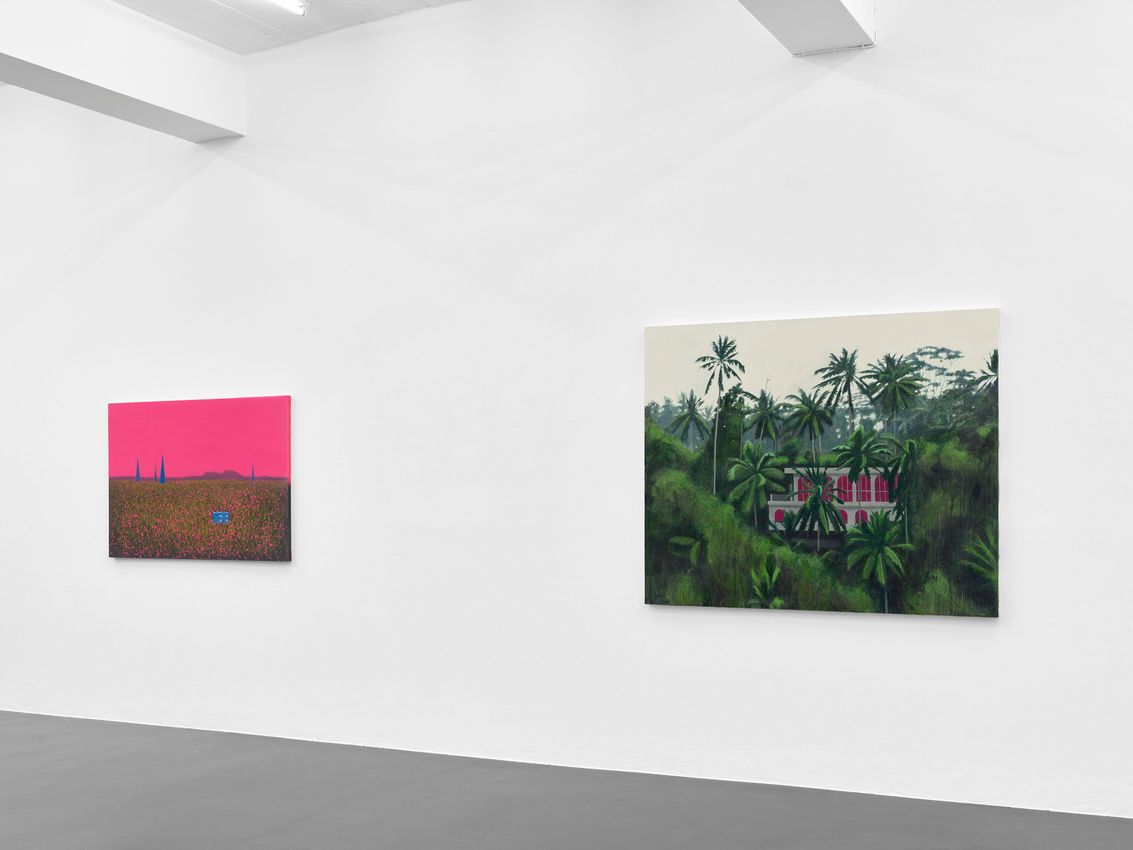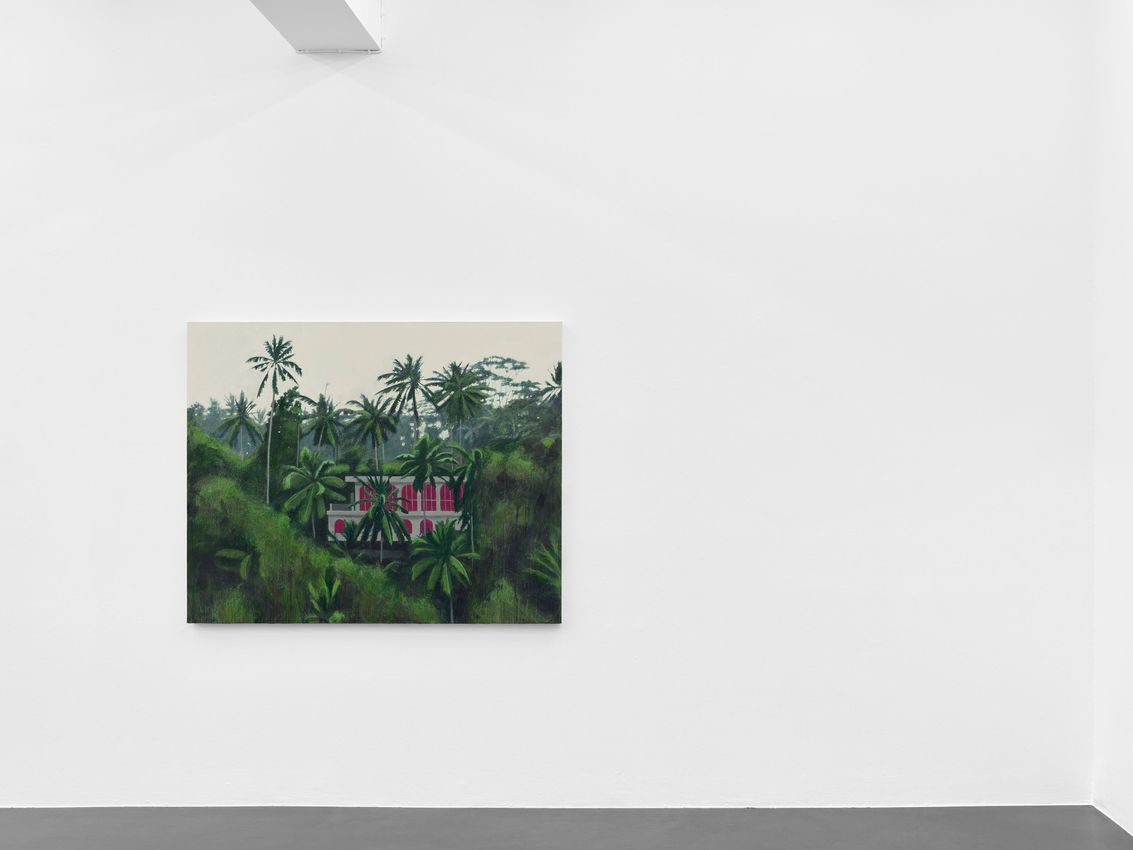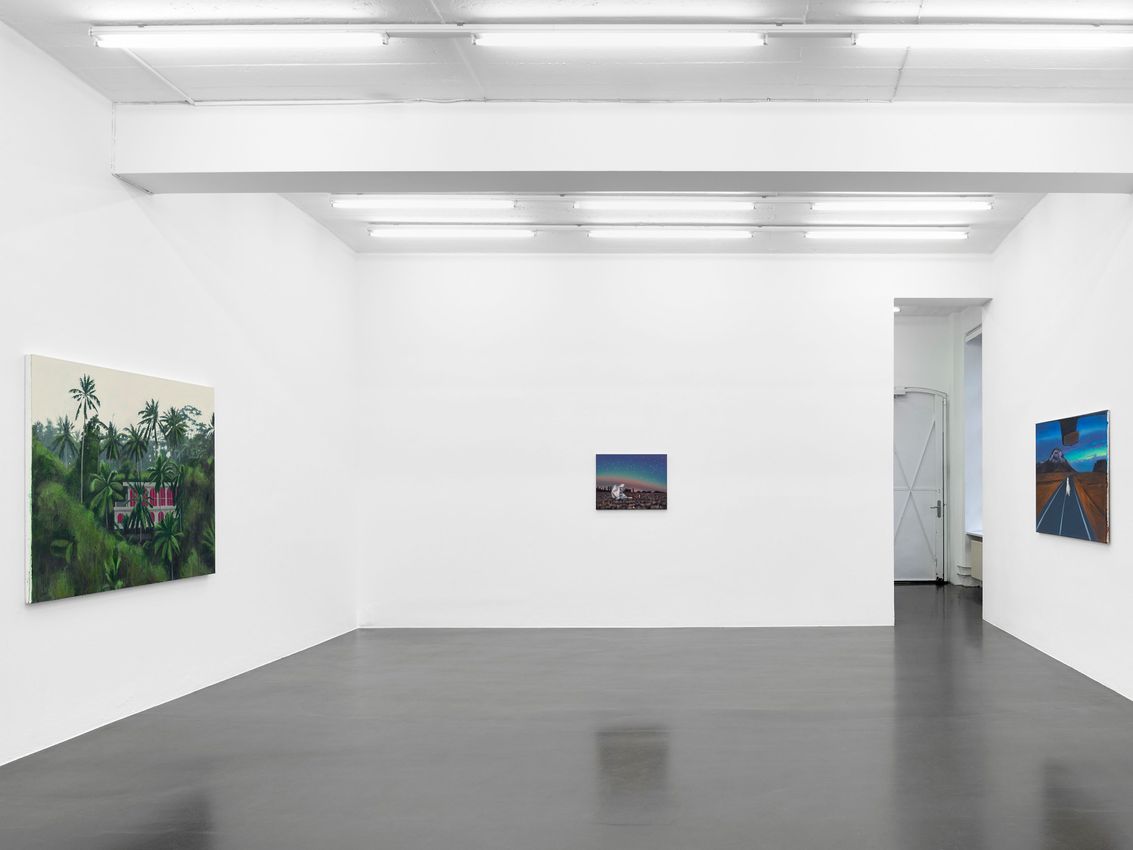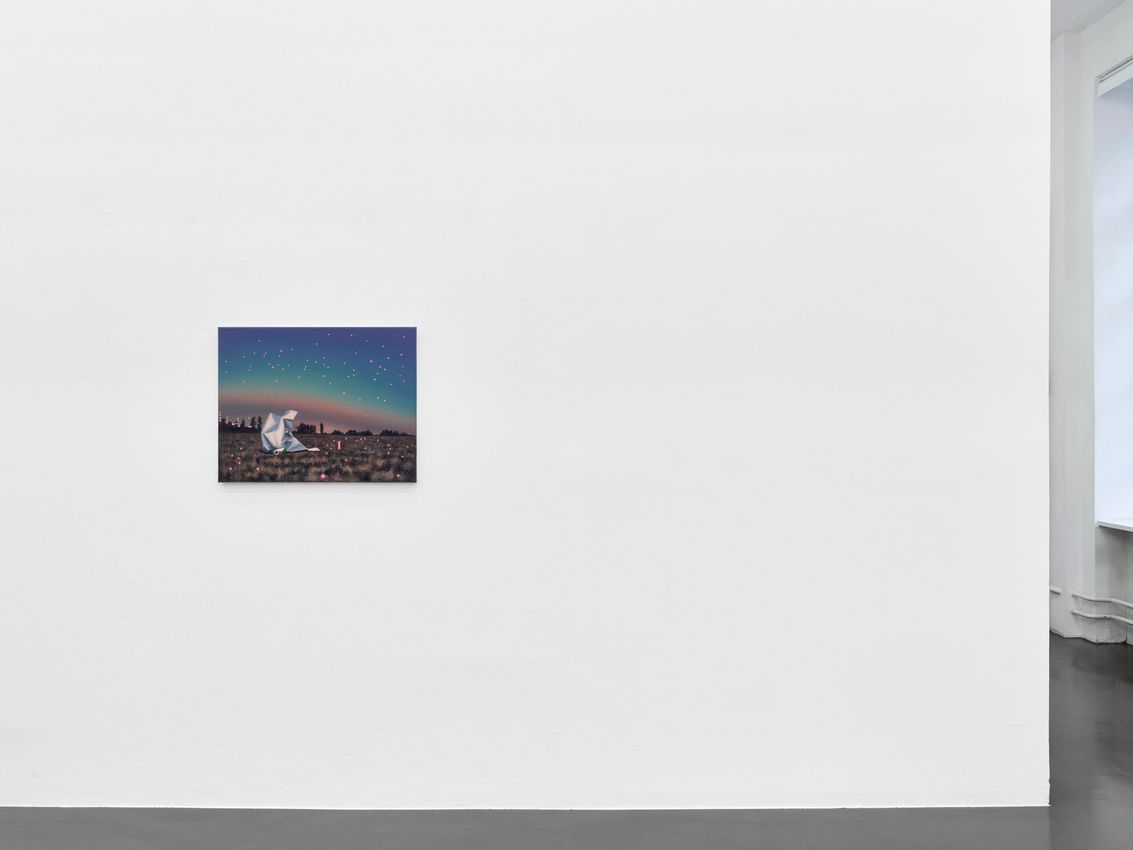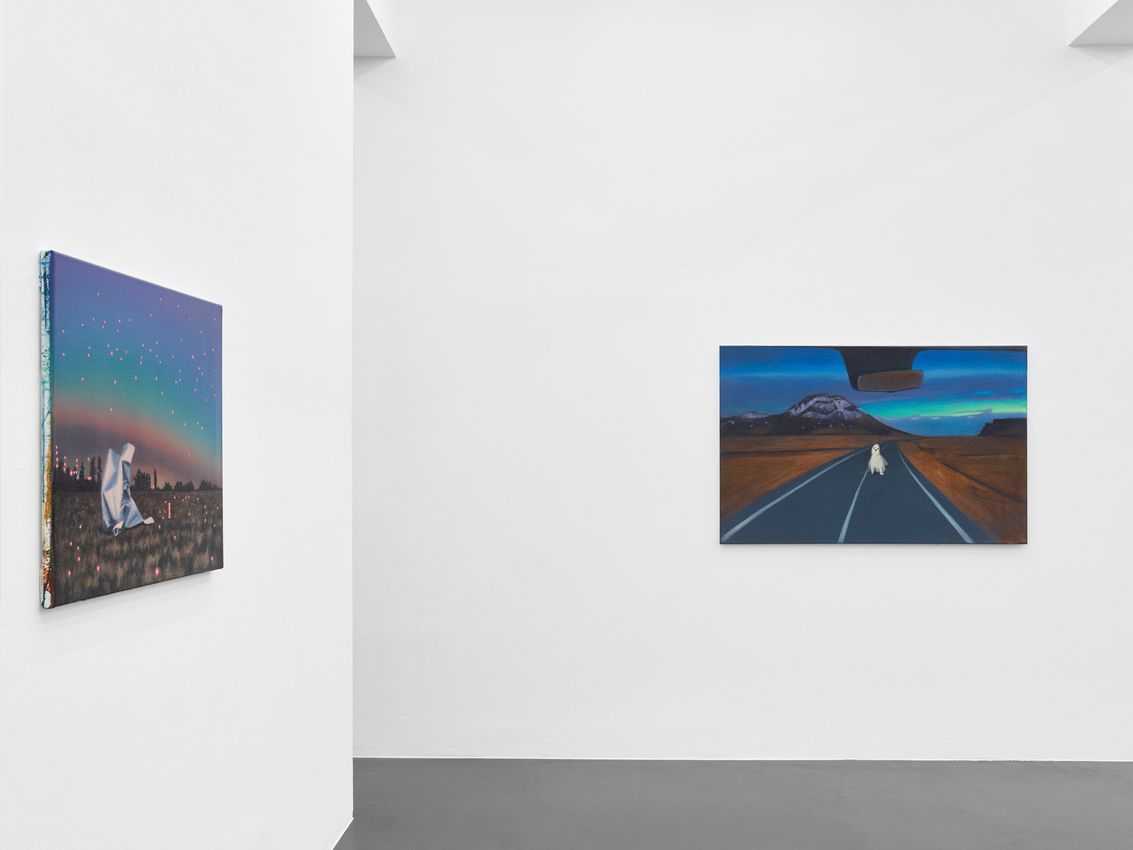


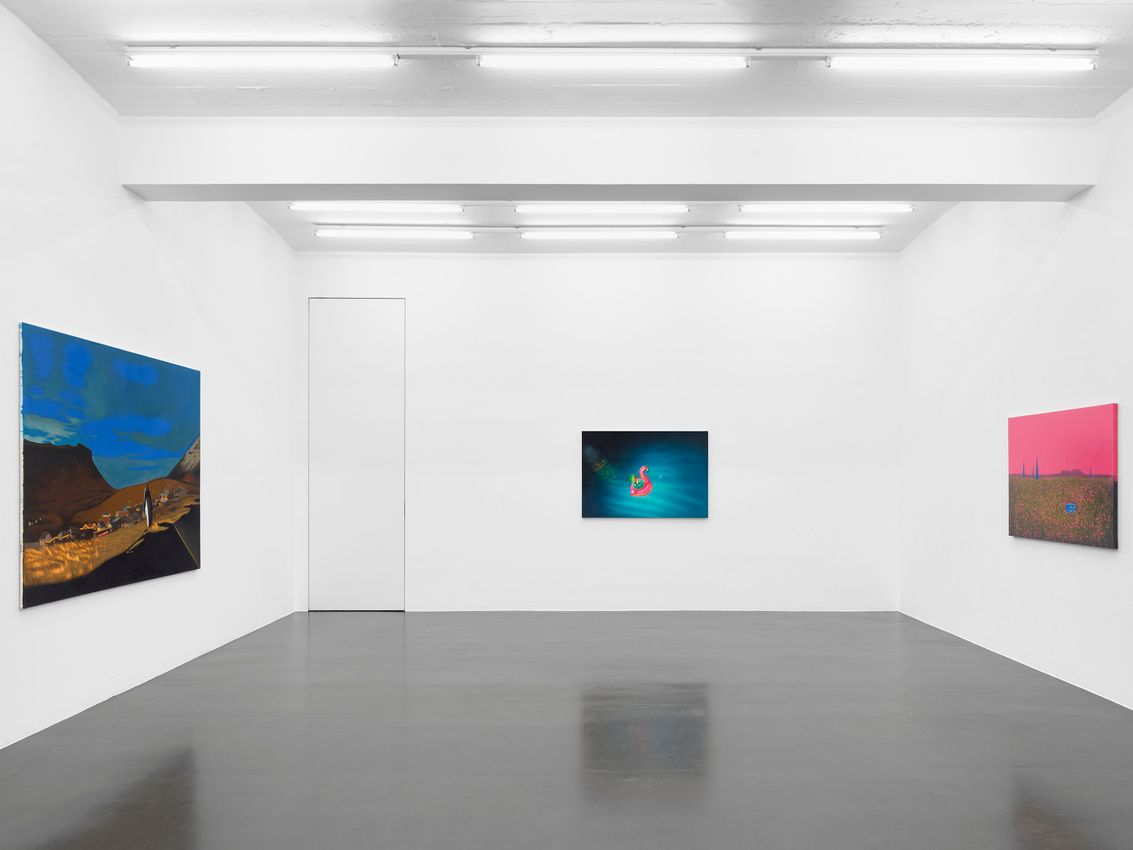
The exhibition Drowning in Blue marks Minju Kang’s first solo presentation at Sies + Höke, bringing together a body of work that oscillates between sober realism and surreal introspection. Kang’s paintings unfold idiosyncratic pictorial worlds and fragmented, associative narrative structures in which plausibility and absurdity coexist in a fragile balance. At first glance, her compositions appear to adhere to the conventions of representational realism—mountains, streets, animals, or architectural fragments are rendered with meticulous precision. Yet upon closer inspection, subtle ruptures emerge: In Alpaca Caution (2024) a spectral figure interrupts the stillness of an abandoned road; in Hide and seek (2024), a cobalt-blue gummy bear emerges from a meadow of fluorescent pink blossoms beneath an almost surreal magenta sky.
It is precisely in this tension—between recognition and estrangement—that the core of Kang’s practice unfolds. By subtly distorting and veiling reality, she constructs pictorial realms that are at once unsettling and suffused with quiet humor. Irritation and humor here are not ornamental additions but structural principles, destabilizing perception and suspending the gaze between intimacy and distance. Such principles recall art historical precedents—from the dreamscapes of Surrealism to the Romantic Rückenfigur that guides the viewer into a space of imaginative projection. Kang translates these aesthetic paradigms into a contemporary pictorial language that probes the thresholds between subjective imagination and collective vision.
Her canvases are atmospherically charged and allegorically encrypted. In Arboretum (2025), a whitewashed villa asserts itself as an architectural intruder within an overgrown tropical environment. The geometric clarity of the villa’s façade stands in stark contrast to the organic exuberance of the vegetation, evoking the enduring opposition between culture and nature, order and wilderness. Yet in the absence of human figures, the presence shifts from subject to architecture itself—its magenta-lit interior pulsating as if the building were about to transform into a living organism.
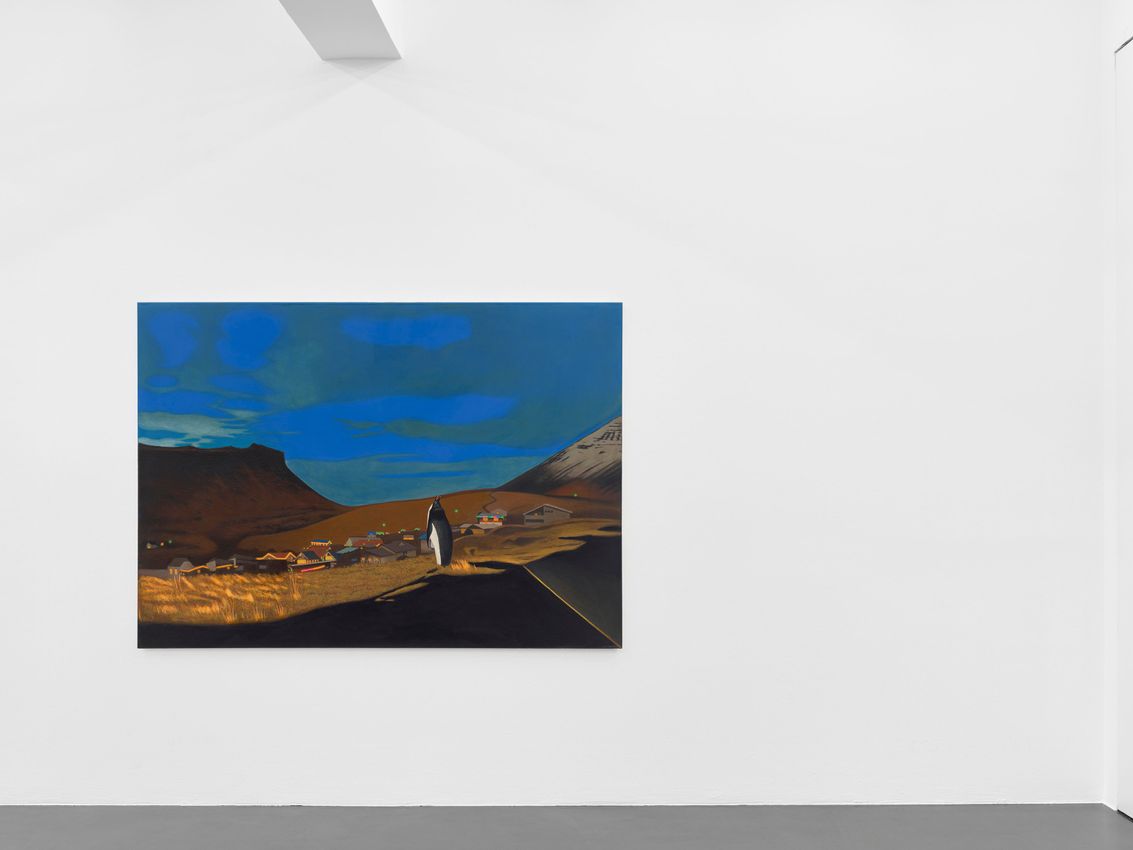
In Penguin in Iceland (2022), too, familiarity is unsettled: a solitary penguin gazes upon a village bathed in the glow of Christmas lights. The incongruity between arctic wildlife and festive domesticity generates a dreamlike tension in which nostalgia and unease intertwine. The penguin’s stance evokes the Romantic Rückenfigur, a motif through which the viewer’s subjectivity is projected into the depicted space. Here, this anthropomorphic alignment between animal and observer renders the scene at once absurd and affectively resonant.
Kang’s practice resonates closely with Masahiro Mori’s concept of the Uncanny Valley—that peculiar unease that arises when the almost perfectly imitated slips into the disturbingly imperfect. On her canvases, meticulous precision turns into exaggeration and absurdity; the real reveals itself as a construct. This tension between realism and artificiality simultaneously invokes psychoanalytic readings of Freud’s notion of the uncanny—the moment in which the familiar collapses into estrangement.
In this way, Kang creates psychological landscapes that function like lucid dreams: spaces of imaginative suspension in which the viewer’s gaze oscillates between critical reflection and childlike wonder. Her painting discloses not only the fragility of perception but also the poetic possibility of grasping the real and the impossible in a single breath. Although Kang’s works may initially appear detached, they are suffused with the sediments of lived experience. Her pictorial language emerges from a sensibility that spans multiple cultural and perceptual registers, situating her practice within a state of in-betweenness that resists fixed coordinates. This oscillation between the familiar and the strange evokes a phenomenological tension between presence and withdrawal—a mode of seeing that is at once intimate and estranged. In this sense, Kang’s practice may be understood as an inquiry into the translation of perception into image, in which memory, imagination, and reality converge within the ambivalent space of representation.


Sies + Höke is one of the leading contemporary art galleries in Germany. The gallery represents over 25 established and emerging artists from Europe, the United States and Latin America. In addition to the gallery program, Sies + Höke has developed a distinguished legacy over the years by showcasing well-researched historical exhibitions.

A respected voice in contemporary art discourse.
Focusing on ambitious storytelling and insightful art-world commentary. Ocula Magazine publishes in-depth interviews, critical essays and timely analysis on the artists, exhibitions and ideas driving the global art world.
Learn more about Ocula Magazine
Showcasing the best of the art world.
Ocula partners with galleries from around the world to highlight their artists, artworks and exhibitions. Gallery membership is by application and invitation, with each member vetted by an independent panel.
Learn more about Ocula Membership

Specialises in the sale of major artworks.
Led by a team with deep ties to the world’s leading auction houses, galleries and collectors. Ocula’s advisory team offers bespoke services to high-net-worth clients from around the world who are looking to acquire the best of contemporary and modern art.
Learn more about our team and services