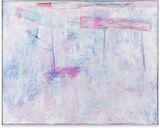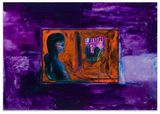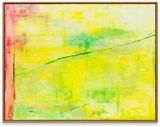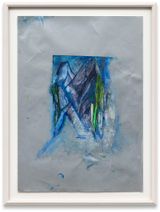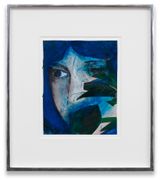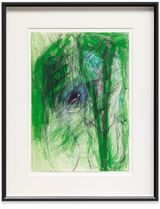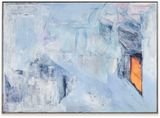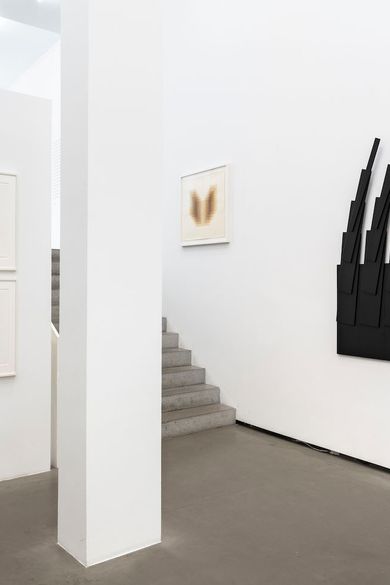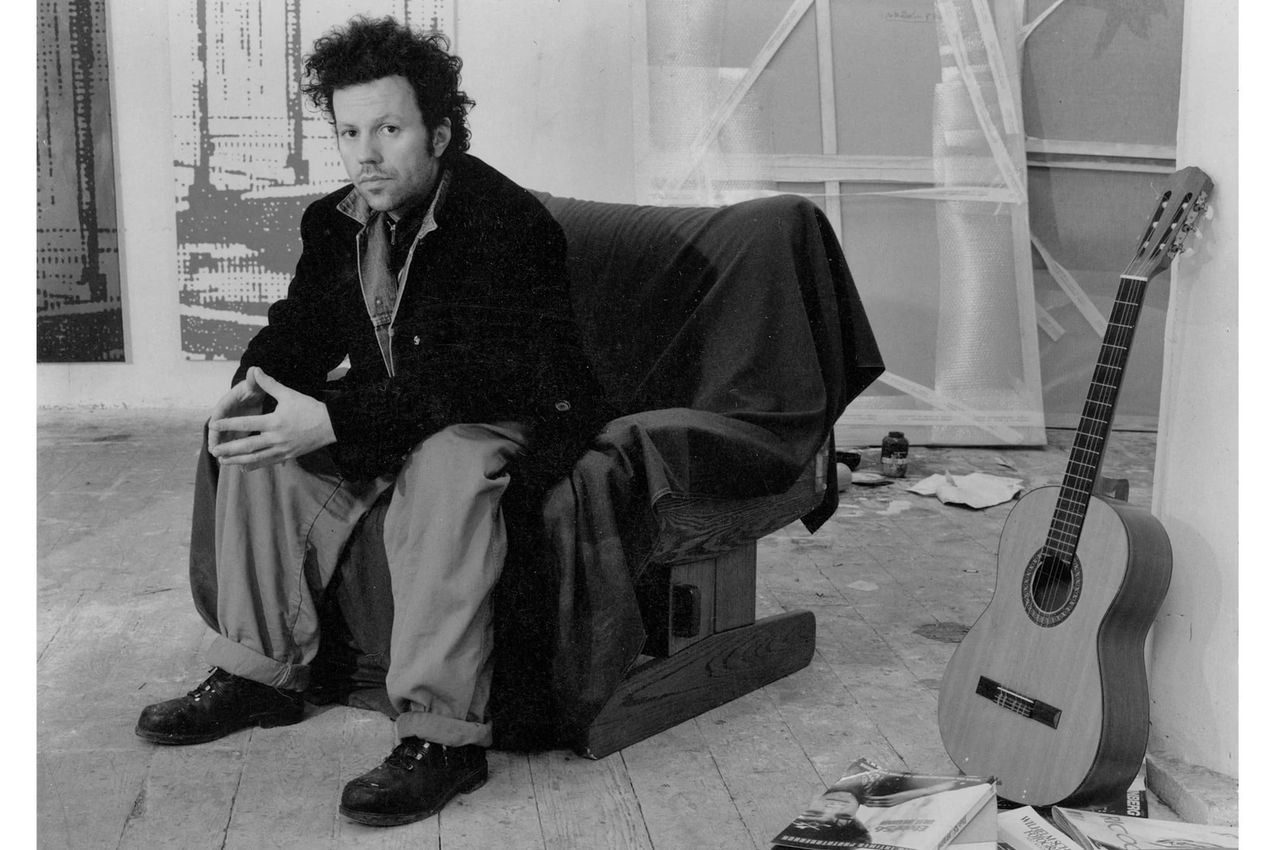



Monika Sprüth and Philomene Magers are pleased to present a solo exhibition of new paintings by Andro Wekua. This new body of work builds on elements of his painting practice, which frequently oscillates between figuration and abstraction, with a more pared-down visual language than is typical for the artist. Wekua’s works conjure images, associations, and memories that defy straightforward interpretation.
Known for his dense, multilayered paintings and collages, Wekua’s It Seems Like That (2021) is striking in its comparatively lean imagery, though both its motif and subtle formal language echo his earlier mannequin figures as well. At the centre of an otherwise empty canvas is a figure painted with a single, sketchily-rendered blue line. It leans on a balustrade indicated in pencil and yet also appears strangely afloat in the picture plane, its posture testing the limits of what is physically possible. The slightly mannerist proportions of the figure’s limbs are typical Wekua; its body refuses any clear gender classification. Heightening this impression of androgyny is the figure’s cropped hairstyle: although the definitive line indicates chin-length hair, whispers of blue hint that it might be longer. The figure’s vague, unfocused gaze seems momentarily directed at the viewer until a closer look reveals its eyes to be looking in different directions.
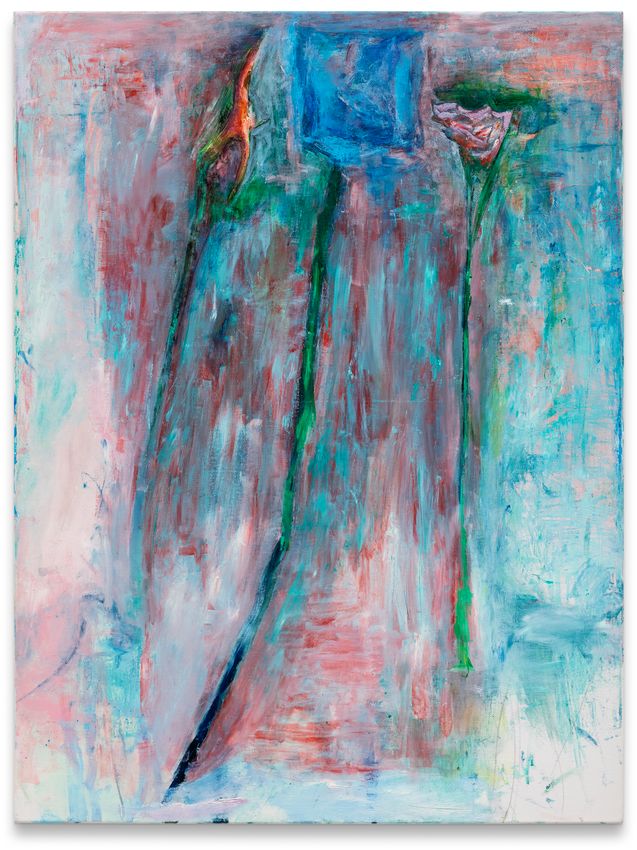
june berlin (2021) finds the artist taking up a classic painting motif—still life with flowers—and fragmenting it with his typical, expressive brushstrokes. Highlighted against the broader canvas is a towering blue rose, flanked by two smaller, reddish flowers. The background undulates in flickering shades of soft pink, blue and pencil strokes. Though the rose is a very loaded symbol in many cultures, its significance is downplayed here; instead the work explores painting in itself. Attesting to this are the other paintings featured in the exhibition, which can be read as landscapes concealed beneath flat layers of richly-hued paint and distinct, gestural fields of color.
Many of Wekua’s works have a dream-like quality. His associative tapestry of motifs and moods, personal memories and cultural histories evinces a play with the unknown and sublime. Boundaries between naturalness and artifice dissolve, as do those between past and present, impression and feeling. Hints at a narrative remain elusive, challenging any presumed specificity. Thus the artist’s practice exposes not only the inherent impermanence of any kind of representation, but also that of perception itself.
Andro Wekua (*1977, Sukhumi, Georgia) lives and works in Berlin. Selected solo exhibitions include those at Kunsthalle Zürich and Garage Museum of Contemporary Art, Moscow (both 2018); Kölnischer Kunstverein, Cologne (2016); Benaki Museum, Athens (2014); Kunsthalle Wien, Vienna; Kunsthalle Friedericianum, Kassel; and Castello di Rivoli, Turin (all 2011); Wiels, Brussels; and Museion Bolzano (both 2010); Museum Bojmans van Beuningen, Rotterdam (2007) and Kunst Museum Winterthur (2006). Selected group exhibitions include those at Haus der Kunst, Munich (2019); Fondation Vincent van Gogh, Arles; Albertina Museum, Vienna (both 2018); Museum of Contemporary Art, Cleveland (2016); High-Line Art, New York (2015); Pinakothek der Moderne and Brandhorst Museum, Munich (2015); Palais de Tokyo, Paris (2014); Centre d’Art Contemporain, Geneva (2013); New Museum, New York and the 54th Venice Biennale (both 2011); Kunsthaus Zürich (2008); Carnegie International, Pittsburgh (2008); Centre Pompidou, Paris (2006) and the 4th Berlin Biennale, Berlin (2004).

Known for his uncanny evocations of architecture and memory through exhibitions that imply a non-linear narrative, Wekua here creates a psychologically charged interior. A figure, at once robotic and lifelike, is isolated in a clean gallery space, behind a forbidding block wall that restricts the view to the outside world. The device from which the figure hangs suggests a playground swing, yet he or she hangs in a physically impossible position. Wekua poses questions about interior and exterior, private and public space, performance and imprisonment, revelling in an ambiguity that serves to provoke the viewer’s imagination.
Sprüth Magers has expanded from its roots in Cologne (Germany) to become an international gallery dedicated to exhibiting the very best in groundbreaking modern and contemporary art. With galleries located in Berlin Mitte, London’s Mayfair and the Miracle Mile in Los Angeles–as well as an office in Cologne and an outpost in Hong Kong–Sprüth Magers retains close ties with the studios and communities of the German and American artists who form the core of its roster.

A respected voice in contemporary art discourse.
Focusing on ambitious storytelling and insightful art-world commentary. Ocula Magazine publishes in-depth interviews, critical essays and timely analysis on the artists, exhibitions and ideas driving the global art world.
Learn more about Ocula Magazine
Showcasing the best of the art world.
Ocula partners with galleries from around the world to highlight their artists, artworks and exhibitions. Gallery membership is by application and invitation, with each member vetted by an independent panel.
Learn more about Ocula Membership

Specialises in the sale of major artworks.
Led by a team with deep ties to the world’s leading auction houses, galleries and collectors. Ocula’s advisory team offers bespoke services to high-net-worth clients from around the world who are looking to acquire the best of contemporary and modern art.
Learn more about our team and services