



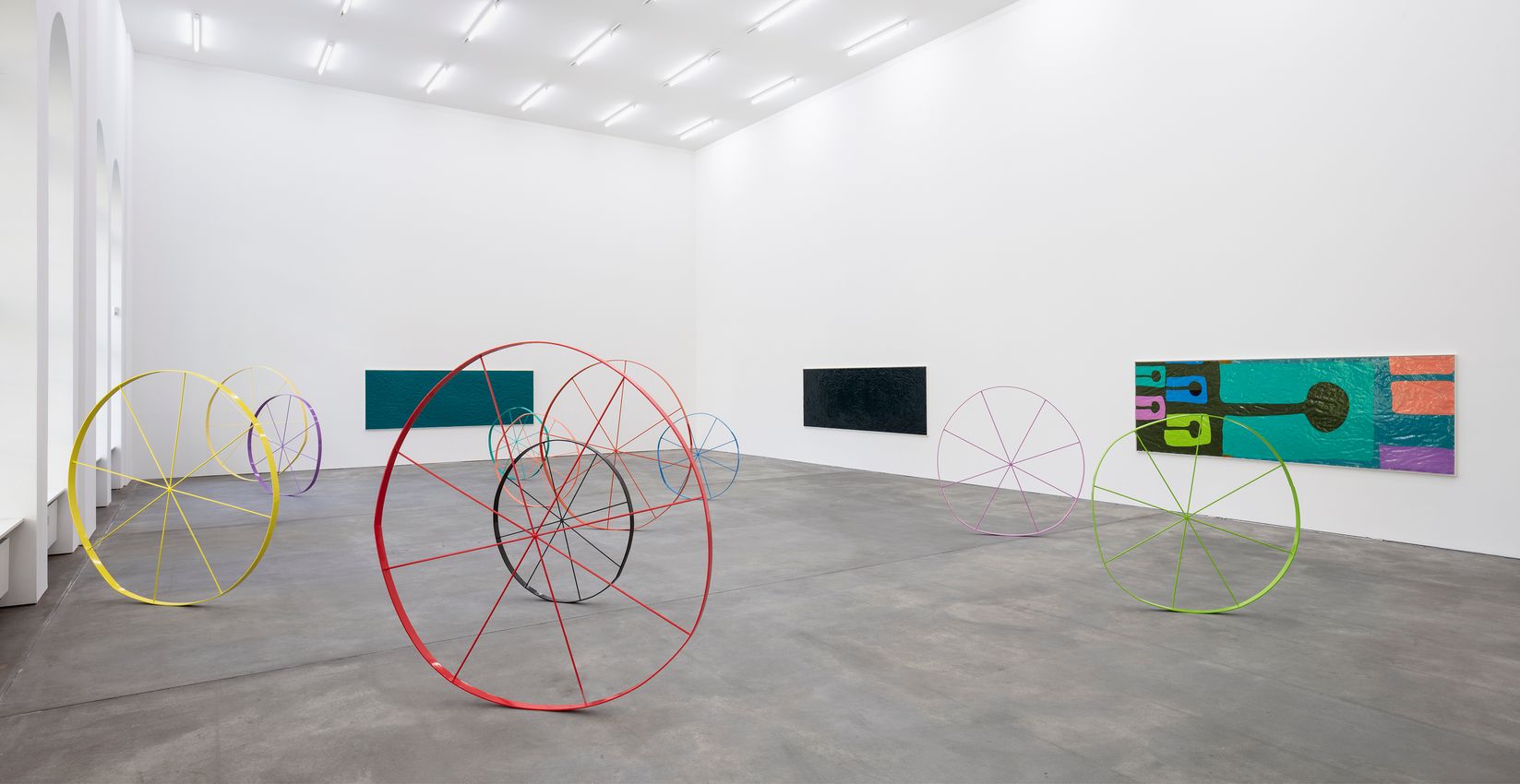
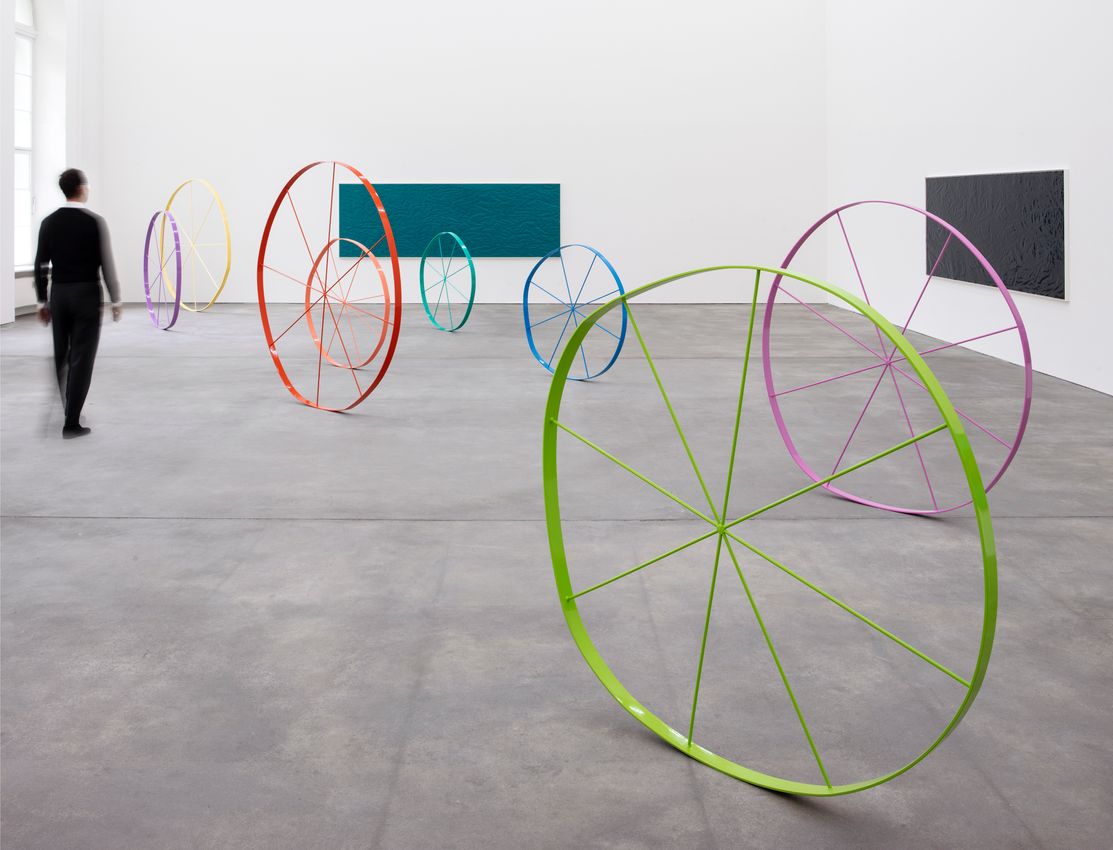
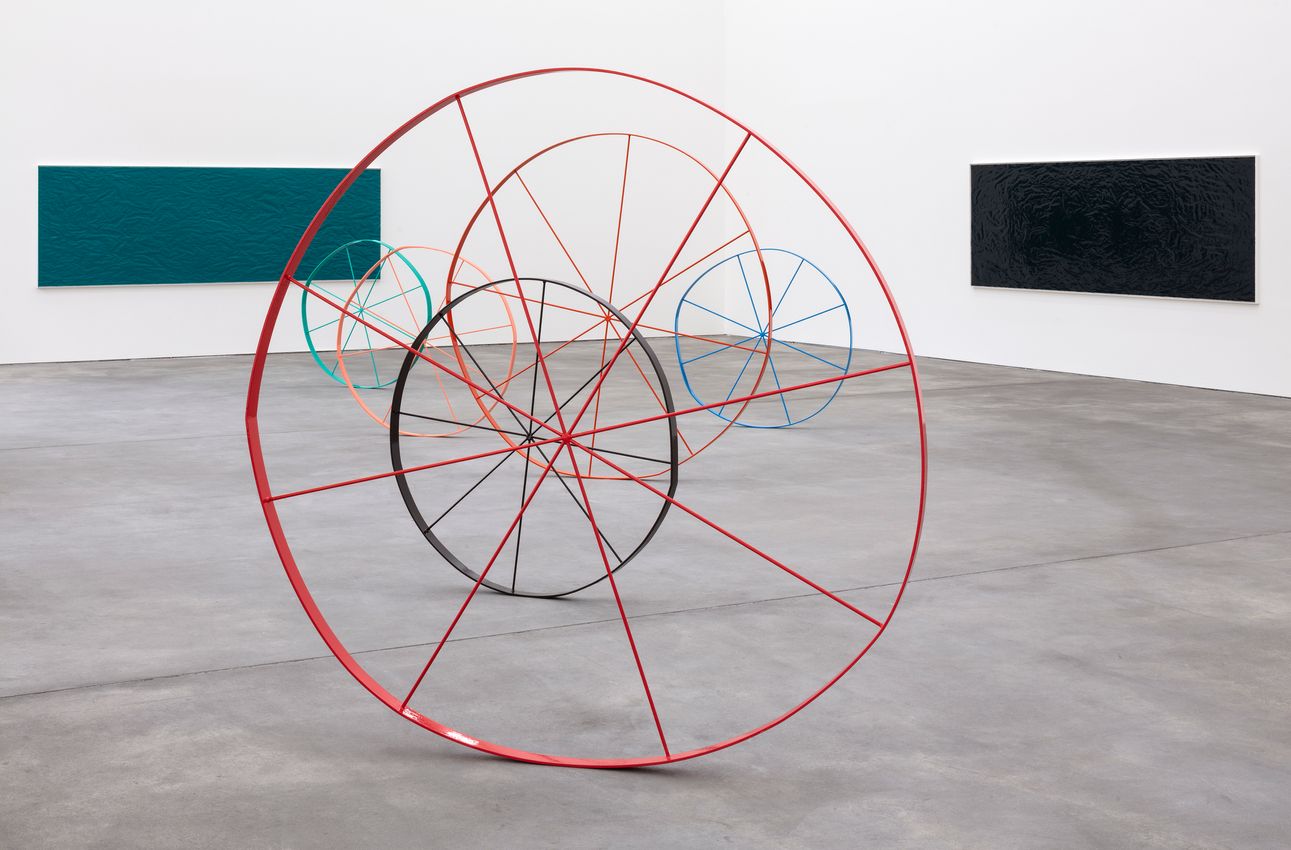
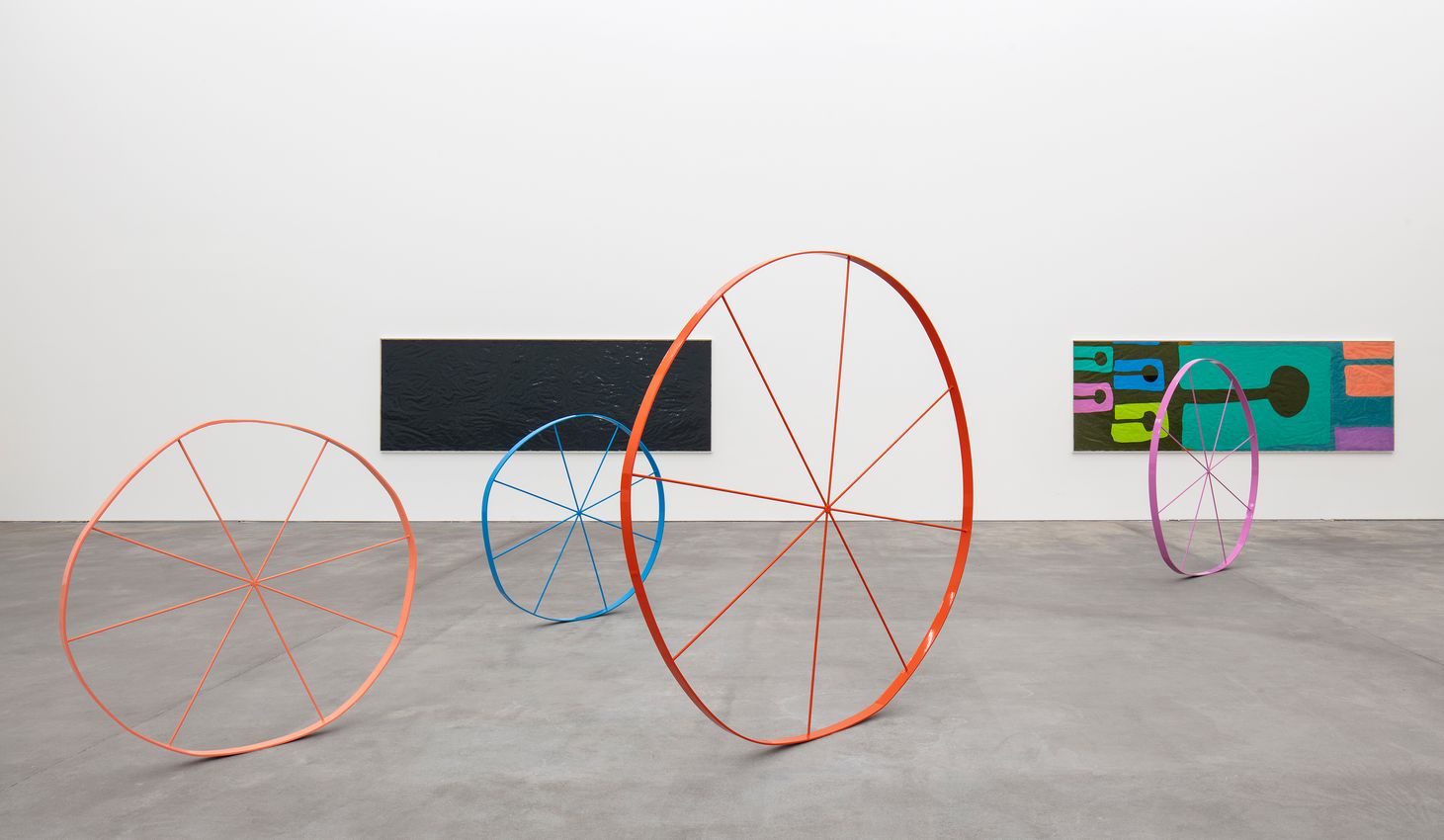
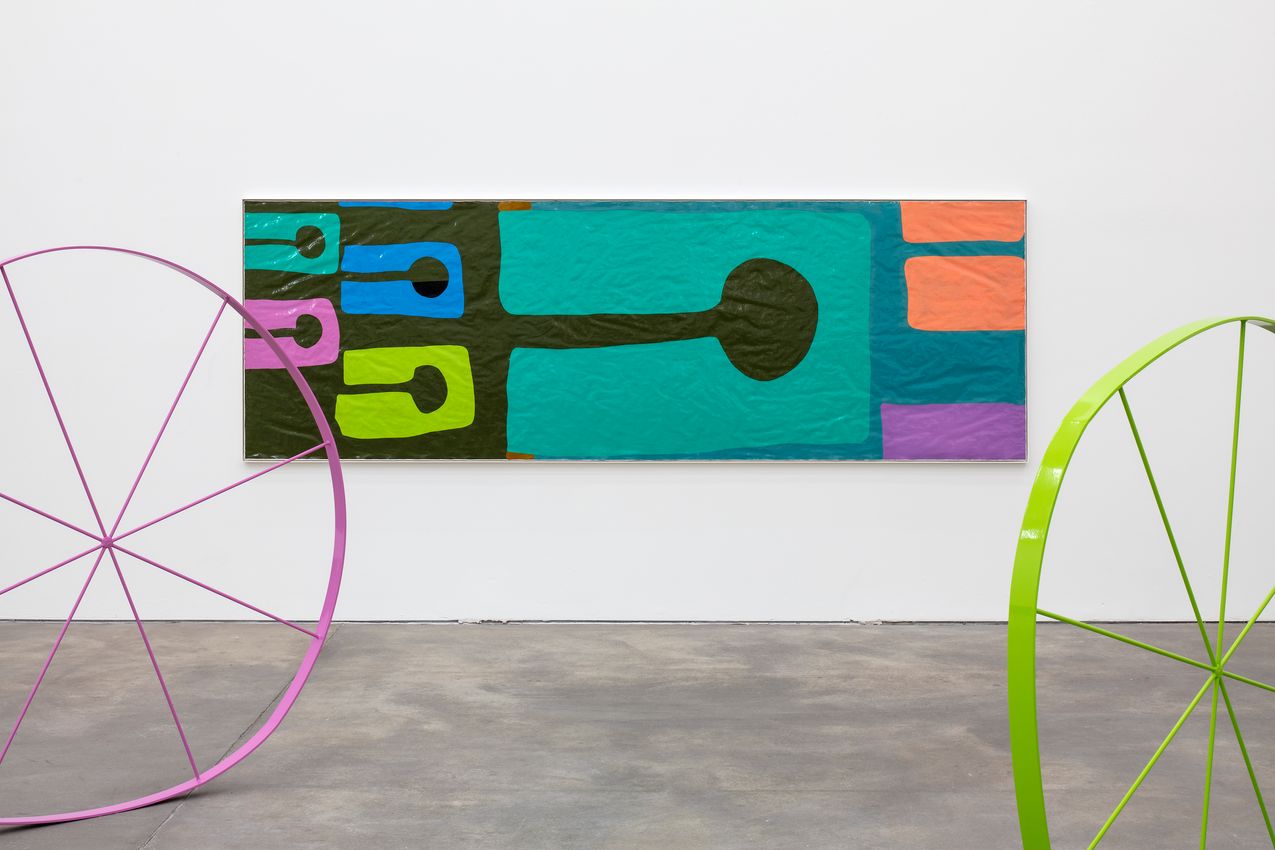
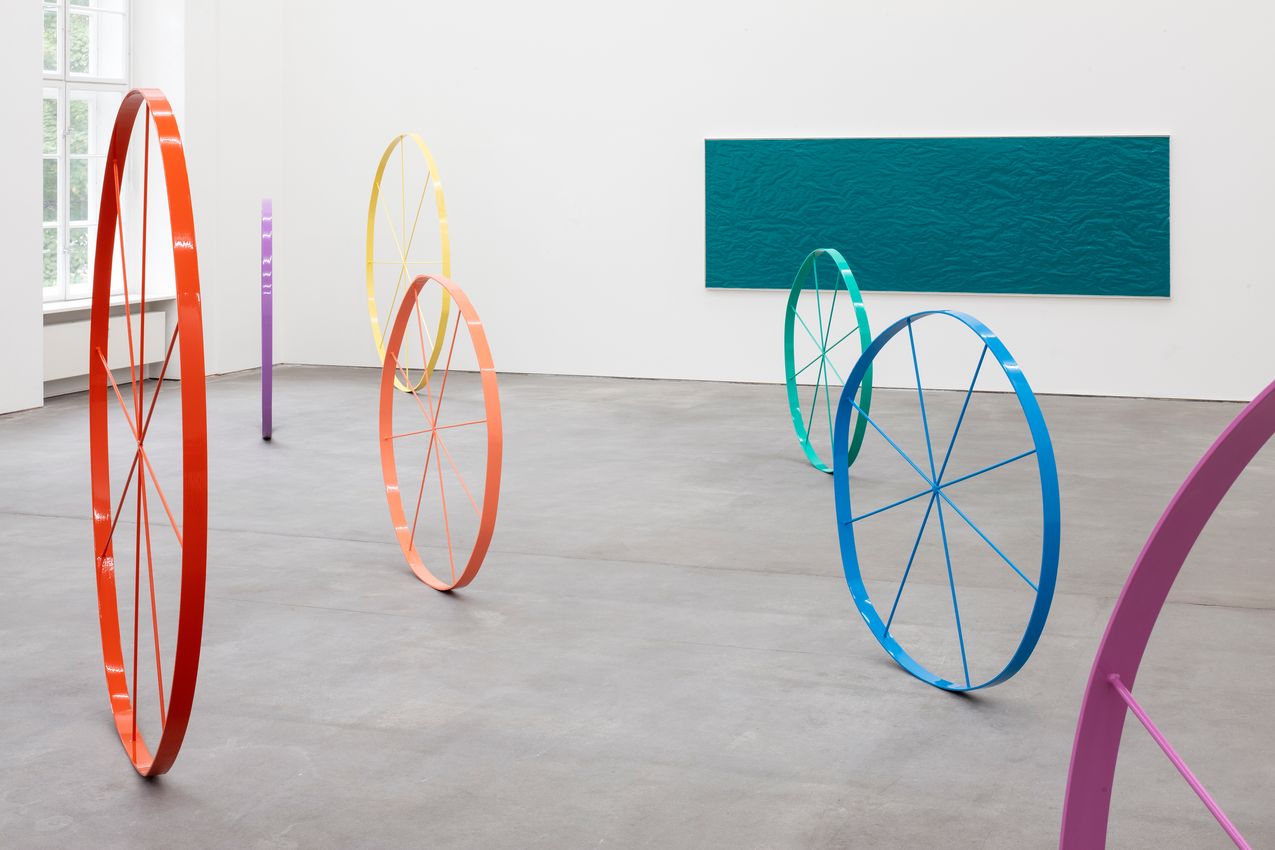
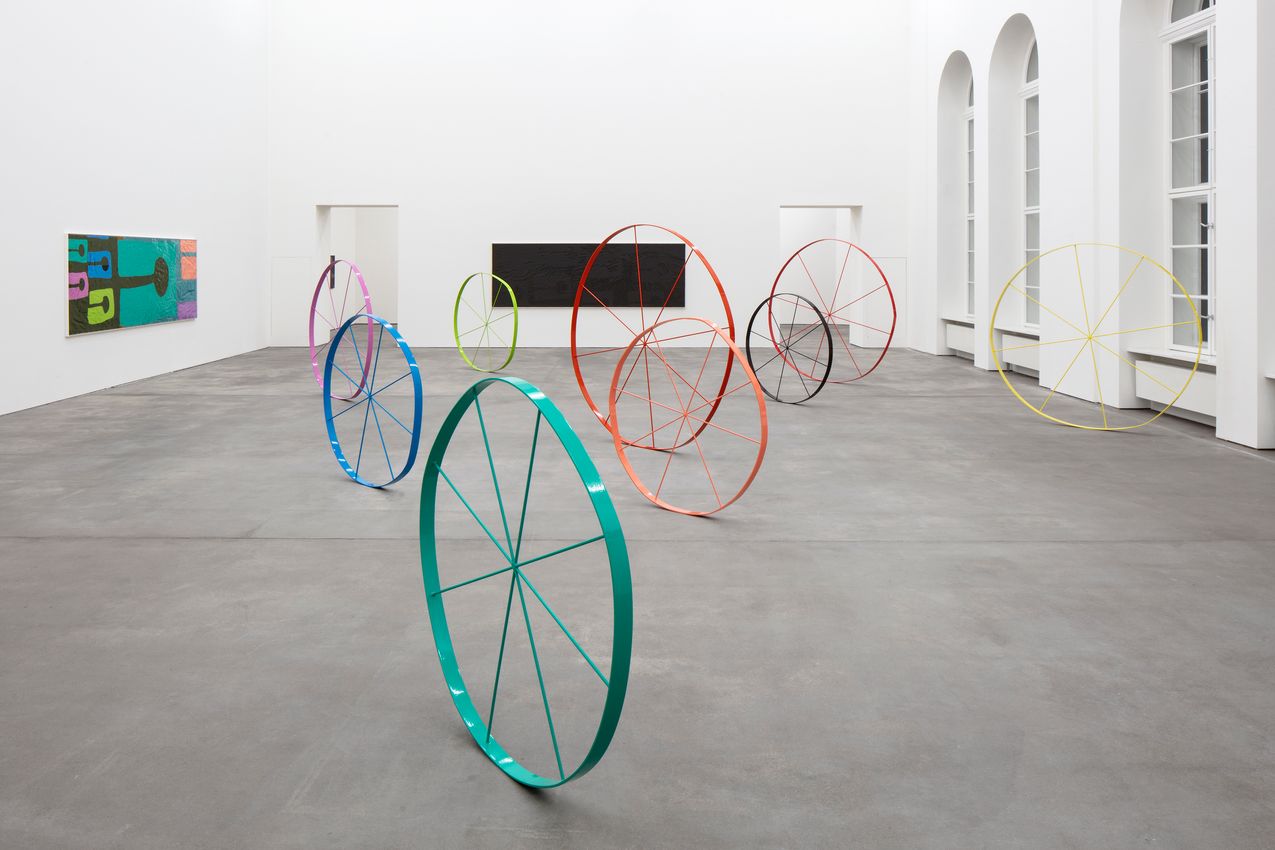
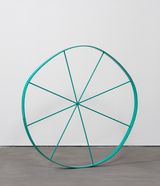
Monika Sprüth and Philomene Magers are pleased to present a selection of paintings and sculptures by Gary Hume. Thirteen brightly hued sculptures and four large paintings on paper present the viewer with immediate colour and curves. The sculptures, all from the series Wonky Wheels, are imperfectly round, wheel-like armatures rendered in steel and brightly coloured enamel. The wheels measure between one and three metres in diameter and are pulled and manipulated into shape by the artist, rendering each unique in form and character. The economy of line and slightness of shape means the wheels appear to balance precariously, vulnerable to the slightest touch or influencing action, teetering on the verge of a bumpy movement that could go back or forth, or result in a fall. Outside in the garden, one wheel is embedded in the ground, impeding its progress. Individually, the sculptures reference an imperfect wheel of life and, collectively, they conceive a carnival of time and a ‘wonkiness’ of both personal and historical experience whose narrative, though inevitable, is never stable.
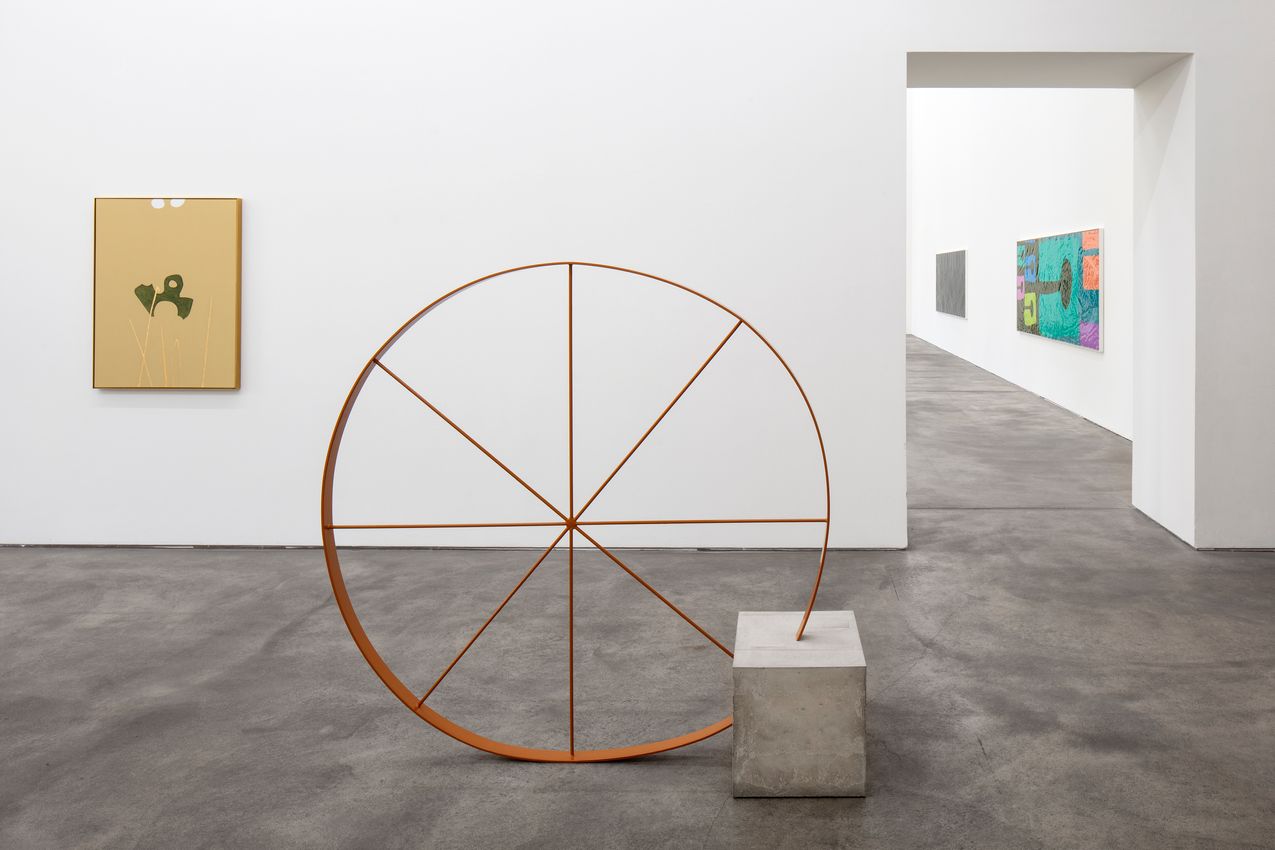
In a second space is the single sculpture, Small Hitch (2018), a wonky wheel whose lower quadrant is partly encased by a cube of concrete. The wheel is fully stopped, or stable and ready to start. It’s a beginning and an end, a punctuation in time. Alongside the sculpture are four brass-framed paintings on canvas, works from the Modernist Paintings series, whose formal appearance belies their specific conception. For example the original source of Carapace (2015), was a photograph of a dust-covered New York Fire Department jacket and helmet, hung on a hydrant in the aftermath of the attack on the World Trade Centre.
Accompanying the Wonky Wheels are four large-scale paintings on paper (all 120 x 361 cm), including two monochromatic paintings in serenely aqueous hues that form part of the artist’s new Water Series. The expansive blue surface of Water (2018) mimics the intrinsically sublime appeal of water in nature as a source for introspection and singularly experienced reverie. The companion painting Flotsam (2018), however, shifts suddenly into something public and deeply tragic. The dark surface of the painting is abraded with sandpaper to reveal an ambiguous sequence of life jackets. Hume has discussed the organic appearance of these forms, whilst also acknowledging them as a personal response to news coverage of the deaths of thousands of refugees attempting to cross the Mediterranean in recent times. In 361cm (2018), the same motif has been subsumed in a pattern that resembles a West African textile print - potentially a shroud.
The exhibition is the latest iteration of a long series of works by Hume that leads us to consider trauma and suffering. His seminal Door paintings from the early nineties were explorations in formalism that abstracted the hospital door as an exit route to cure or death. The wheel itself is a recurring motif for the artist that has evolved from an earlier series of sculptures and paintings exhibited in New York in 2013, which referred to the assassination of Osama Bin Laden and the enduring conflict in the Middle East. Hume asserts that his interpretations of the imagery of geopolitical conflict and warfare are highly personal manoeuvres in seeing, creating, and commenting, rather than solving. In light of this, the current exhibition proves a deft, poetic exercise in ambiguity, and the seemingly affable wheels and colourful water paintings belie their inspiration and the tragedy and anguish that linger just beneath the surface.
Gary Hume lives and works between London and New York. He represented Britain at the Venice Biennale in 1999 and the São Paulo Biennial in 1996, the same year he was nominated for the Turner Prize. In 2001 he was elected to the Royal Academy of Arts, London. Recent solo exhibitions include Aspen Art Museum (2016), Tate Britain, London (2013), Modern Art Oxford (2008), Kestnergesellschaft, Hannover (2004), Kunsthaus Bregenz (2004), Irish Museum of Modern Art, Dublin (2003), ICA, London (1999), Fundação La Caixa, Barcelona (2000) and The National Galleries of Scotland, Edinburgh (1999). Group shows include National Portrait Gallery, London (2018), Birmingham Museum and Art Gallery (2017), Astrup Fearnley Museet, Oslo (2016), Kunstmuseum Wolfsburg (2014), Pinchuk Art Centre, Kiev (2011), Museum of Modern Art, New York (2006), Tate Britain, London (2004), Louisiana Museum, Denmark (2004), Kunsthalle Basel (2002) and Museum of Contemporary Art, Los Angeles (2001).
The Berlin gallery is concurrently presenting exhibitions by Robert Irwin and Mika Rottenberg.
Hume first received critical acclaim with a body of work known as the Door paintings. These minimal and abstract works, with their high gloss paint and insistent reflective surfaces, developed in the early 1990s into a broader set of motifs, such as the nude, the portrait, the garden, as well as a pictorial idiom drawn from childhood, with images of polar bears, snowmen, rabbits, owls and close-up faces. His subject matter broadened yet more through the mid 1990s to incorporate images from popular culture, making portraits of celebrity figures such as Tony Blackburn, Kate Moss and Patsy Kensit. For the British Pavilion at the Venice Biennale, 1999, he produced the Water Paintings, large-scale works of multiple, overlapping line drawings of nudes punctuated by flat areas of colour. Hume’s Cave Paintings are marble tableaux composed of a variety of different stones set against each other in collaged sections that appear like tectonic plates. These are held together by a lead tracery that provides the edge to the expanses of colour, traced by the natural faults and veins inherent in the stone itself. These monolithic compositions combine motifs from the natural world with imagery suggestive of fundamental emotions. In American Tan, Hume explored the motif of the American cheerleader in a series of paintings and sculptures, commenting that they offer ‘responses to America and how we’re all being tanned by American policy and culture, the war and simple, complicated stuff like that. It started off with cheerleaders. The form of them is absolutely fantastic.’ Hume continues to push his media in new directions, his striking compositions and vivid surfaces among the more original voices in contemporary painting.
Sprüth Magers has expanded from its roots in Cologne (Germany) to become an international gallery dedicated to exhibiting the very best in groundbreaking modern and contemporary art. With galleries located in Berlin Mitte, London’s Mayfair and the Miracle Mile in Los Angeles–as well as an office in Cologne and an outpost in Hong Kong–Sprüth Magers retains close ties with the studios and communities of the German and American artists who form the core of its roster.

A respected voice in contemporary art discourse.
Focusing on ambitious storytelling and insightful art-world commentary. Ocula Magazine publishes in-depth interviews, critical essays and timely analysis on the artists, exhibitions and ideas driving the global art world.
Learn more about Ocula Magazine
Showcasing the best of the art world.
Ocula partners with galleries from around the world to highlight their artists, artworks and exhibitions. Gallery membership is by application and invitation, with each member vetted by an independent panel.
Learn more about Ocula Membership

Specialises in the sale of major artworks.
Led by a team with deep ties to the world’s leading auction houses, galleries and collectors. Ocula’s advisory team offers bespoke services to high-net-worth clients from around the world who are looking to acquire the best of contemporary and modern art.
Learn more about our team and services