Sprüth Magers is pleased to present a solo exhibition of work by the late GretchenBender, an artist who in the 1980s gained renown as a key observer of the effects ofcapitalist society and mass media on the human experience. Closely aligned with theappropriation strategies of the artists of the Pictures Generation, her emphasis on filmand television as her source material ensured she was also an integral part of thevideo art movement. This is her first solo exhibition with the gallery, having first shownat the seminal Eau de Cologne at Monika Sprüth Galerie, Cologne, in 1987.
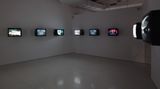
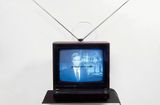
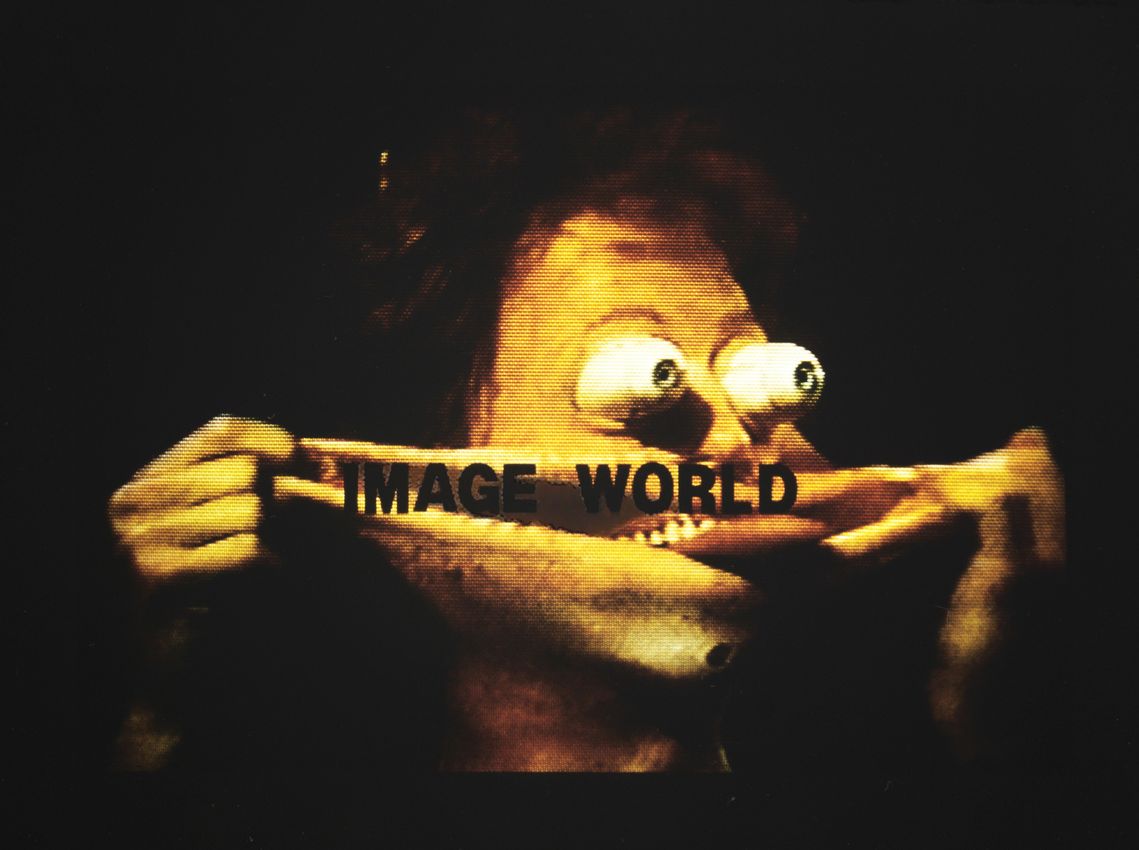
The show begins, viewable from the street, with works from her _TV Text & Image_series. A number of television monitors broadcast live television, each tuned to adifferent channel. 24-hour news streams raucously compete with teleshopping,cartoons and mundane sitcom re-runs. Carefully chosen, often politicised, phrases aresuperimposed over the images, applied to the screen in black vinyl text. NARCOTICSOF SURREALISM. MILITARY RESEARCH. PEOPLE WITH AIDS.
The confusing multiplicity of corporate-sponsored information lacks focus, with theshort turns of phrase demanding closer attention and thought. There are momentswhen the text and image fleetingly relate, but what is also apparent is a disconnectbetween the all-caps issues of political importance and the ceaseless movingdistractions beneath. Passive viewership equals death. Layering text over movingimage is as familiar now in memes, tweets and social media posts, the same mediachannels that have usurped television’s dominance, which with their ownindiscriminate wealth of perspectives contribute to the banal stream of mass media.
Both realized as single-screen works, which convey an intrusion into domestictelevision consumption, as well as site-specific arrangements, Bender’s TV Text &Image series was a major part of her artistic output throughout the late 80’s and early90’s. In contrast to her larger ‘Electronic Theater’ installations where she highlightsher skill as an editor, manipulating everyday moving images into aggressive montages,here she allows the cadence of typical broadcasts TV to remain unaltered, allowingthe simple intervention of text to filter the content.
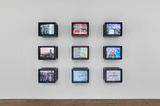
On the first floor of the gallery, Aggressive Witness – Active Participant, 1990combines the live television streams of the TV Text & Image works with computer generated imagery. White lines on a black background produce pulsating abstractshapes that form and dissolve across four of the twelve monitors, thesechoreographed digital designs state of the art in 1990. Their sci-fi resemblances areaccentuated with a soundtrack by her musical collaborator Stuart Argabright, hissinisterly crunchy and rumbling soundscape adding a sense of ascending unease. Thecombination of sound, graphics and the monitors with text upon them further createsa sense of distance, thwarting any ability to cogently digest the multifarious mediastreams.
The final room of the show presents one of her earliest multi-channel video works,Wild Dead, 1984, a four-monitor set-up that prefaces her monumental installations ofstacked monitors that she titled ‘Electronic Theaters’. The soundtrack by theaforementioned Argabright and colleague Michael Diekmann interposes harshfragmented synths with yelps and gunshot, as a jarring collage of computer generatedgraphics and mass media appropriated imagery vie for attention.
The opening sequence of He-Man is swiftly followed by news footage of missiles firingin international conflicts, juxtaposed with corporate idents such as the AT&T logo thatBender likened to the Death Star, and distorted animated heads that contort their wayacross the screens. Again, the viewer is overloaded with information, subject to thepowerfully attractive pull of broadcast media. The work also sets the stage for herlater commercial work, including music videos she produced for R.E.M., New Orderand Megadeth, each of which transposed the same degree of criticality and disjointedproduction to the slickness of the then-new MTV.
Simultaneously entertaining and critical, Bender’s work foreshadows many of today’simmersive installations, and proves to be a prescient voice as we continue to navigateour relationship to screens and content to this day. By eulogizing our rapturoussubmission to the interminable flow of moving images, she simultaneously drawsattention to its homogenizing powers of repugnance.
Gretchen Bender (1951–2004). Solo exhibitions include Red Bull Arts, New York(2019), Everson Museum, Syracuse; San Francisco Museum of Modern Art (both 1991)and Museum of Fine Arts, Houston (1988). Selected group shows include the Instituteof Contemporary Art, Boston (2018, 1986), New Museum, New York (2004, 1986),Museum of Contemporary Art Chicago (2012) and Museum of Contemporary Art, LosAngeles (1989). Exhibitions of Total Recall followed at the Kitchen, New York,Moderna Museet, Stockholm (both 1987), Tate, Liverpool and Schinkel Pavillon, Berlin(both 2015). Her work is in the collections of the Museum of Modern Art, New York;the Metropolitan Museum of Art, New York; Tate Modern, London; the Art Institute ofChicago; the Museum of Contemporary Art Los Angeles; Centre Georges Pompidou,Paris; and the Menil Collection, Houston.
Gretchen Bender was an influential figure in late twentieth-century American art and a key observer of the effects of the inundation of mass media on the human experience. The immersive ‘electronic theater’ installations that she produced in New York in the 1980s are groundbreaking mixtures of sculpture, video, sound and performance that subverted the power of corporate imagery on collective consciousness and prefigured the practices of many younger artists in the post-Internet age.
Sprüth Magers has expanded from its roots in Cologne (Germany) to become an international gallery dedicated to exhibiting the very best in groundbreaking modern and contemporary art. With galleries located in Berlin Mitte, London’s Mayfair and the Miracle Mile in Los Angeles–as well as an office in Cologne and an outpost in Hong Kong–Sprüth Magers retains close ties with the studios and communities of the German and American artists who form the core of its roster.

A respected voice in contemporary art discourse.
Focusing on ambitious storytelling and insightful art-world commentary. Ocula Magazine publishes in-depth interviews, critical essays and timely analysis on the artists, exhibitions and ideas driving the global art world.
Learn more about Ocula Magazine
Showcasing the best of the art world.
Ocula partners with galleries from around the world to highlight their artists, artworks and exhibitions. Gallery membership is by application and invitation, with each member vetted by an independent panel.
Learn more about Ocula Membership

Specialises in the sale of major artworks.
Led by a team with deep ties to the world’s leading auction houses, galleries and collectors. Ocula’s advisory team offers bespoke services to high-net-worth clients from around the world who are looking to acquire the best of contemporary and modern art.
Learn more about our team and services