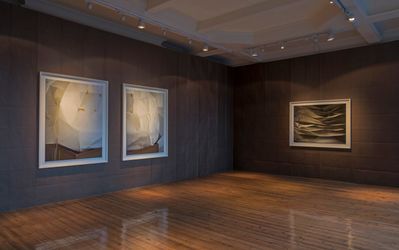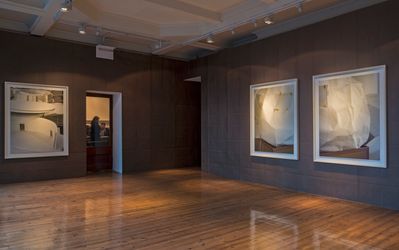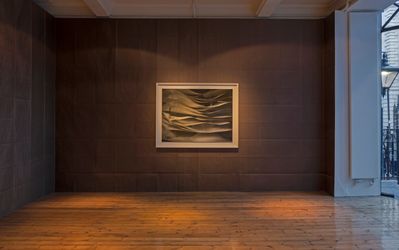
Over the past two years, Thomas Demand has spent many hours in the Tokyo offices of renowned architects Kazuyo Sejima and Ryue Nishizawa, or SANAA, observing their working processes. The result is a new series of large-scale close-up photographs that has its origins in 2011, when Demand came across the models of architect John Lautner, stored in the Getty Archive, Los Angeles. The series that emerged from that process, Model Studies, was the first time Demand photographed subjects other than his own life-sized reconstructions in paper. Made as impermanent sketches for potential buildings, and in storage for many years, Lautner’s models showed all the careworn textures and patina of age. Yet Demand found in their angles and shadows a renewed formal intensity, lending the Model Studies photographs powerful affinities with modernist abstraction.
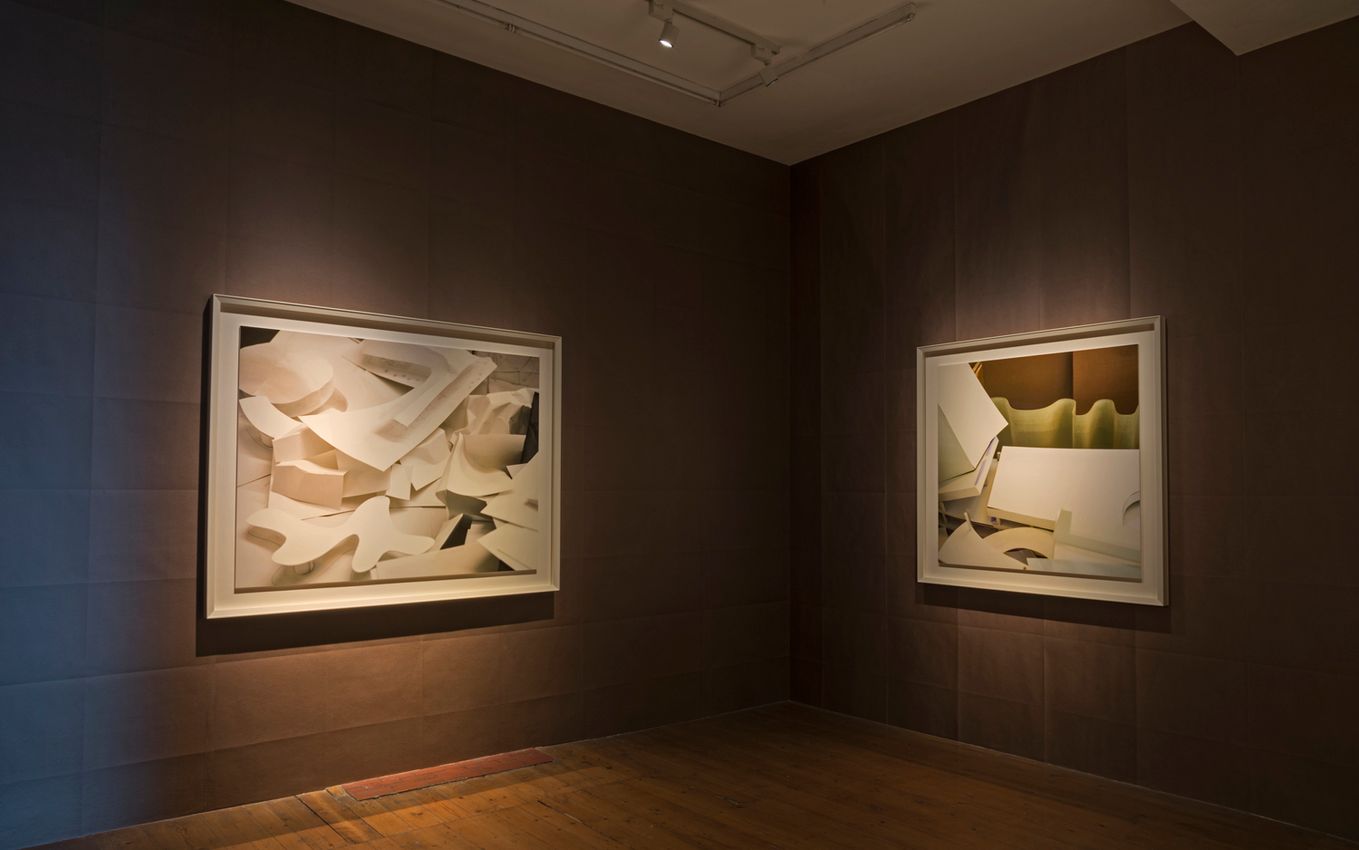
For the new series, Demand focussed on details: lines, curves and portals are foregrounded, intensifying their abstract potential. The models were originally built to convey ideas in concrete form, to provide the architects a target image of a given proposal. Some of the photographs in Latent Forms express serene elegance, suggesting a utopian space for human habitation, while others have a more cluttered, disposable atmosphere – we might detect the remnants of an object or idea that the architects put aside or rejected for good. Yet through the use of crops, shadows and sharp angles, Demand’s photographs transform these architectural concepts into a distinct pictorial realm. About the process, Demand writes that ‘looking at the details and the little pockets, edges, and coincidental collocation of the objects in front of me allowed me to emphasise their sculptural potential in abstracted composition, instead of reading them as identifiable renderings of buildings.’
Demand’s approach gives the SANAA photographs a particular set of formal qualities, divergent from those of the models. As abstractions, each picture delivers a visceral effect, while also opening up a virtual space in which the viewer’s imagination can play. This pictorial space is paralleled in the studio, and the title of the show, Latent Forms, alludes to the nascent ideas that emerge during the working process. For the London exhibition, Demand has added yet another layer on the theme of surface and abstraction: he has covered the gallery’s walls with wallpaper that brings to mind everyday brown wrapping or packing paper. This trompe-l’oeil game expands the questions raised not only by the photographs in Latent Forms but the history of abstraction itself: how we navigate surface and depth, exterior and interior, illusion and experience, depiction and interpretation.
Thomas Demand (born 1964, Munich) lives in Los Angeles and Berlin. Solo exhibitions include Stiftung Insel Hombroich, Neuss, The Common Guild, Glasgow, Los Angeles County Museum of Art (all 2015), Museum of Contemporary Art, Tokyo, Kaldor Public Art Project #25, Sydney (both 2012), National Gallery of Victoria, Melbourne (2013), Boijmans van Beuningen, Rotterdam (2010), Neue Nationalgalerie, Berlin (2009-10), MUMOK, Vienna (2009), Hamburger Kunsthalle (2008), Fondazione Prada, Venice (2007), Serpentine Gallery, London, and Lenbachhaus, Munich (both 2006), MoMA, New York (2005), Kunsthaus Bregenz, Austria (2004),Louisiana Museum of Modern Art, Humlebæk, Denmark (2003), and Castello di Rivoli, Turin, Italy (2002). He represented Germany at the 26th São Paulo Biennale, Brazil (2004).
© Thomas Demand, VG Bild-Kunst, Bonn / DACS, London, Courtesy Sprueth Magers. Photography © Kris Emmerson© Thomas Demand, VG Bild-Kunst, Bonn / DACS, LondonCourtesy Sprueth MagersPhotography © Kris Emmerson.


Sprüth Magers has expanded from its roots in Cologne (Germany) to become an international gallery dedicated to exhibiting the very best in groundbreaking modern and contemporary art. With galleries located in Berlin Mitte, London’s Mayfair and the Miracle Mile in Los Angeles–as well as an office in Cologne and an outpost in Hong Kong–Sprüth Magers retains close ties with the studios and communities of the German and American artists who form the core of its roster.

A respected voice in contemporary art discourse.
Focusing on ambitious storytelling and insightful art-world commentary. Ocula Magazine publishes in-depth interviews, critical essays and timely analysis on the artists, exhibitions and ideas driving the global art world.
Learn more about Ocula Magazine
Showcasing the best of the art world.
Ocula partners with galleries from around the world to highlight their artists, artworks and exhibitions. Gallery membership is by application and invitation, with each member vetted by an independent panel.
Learn more about Ocula Membership

Specialises in the sale of major artworks.
Led by a team with deep ties to the world’s leading auction houses, galleries and collectors. Ocula’s advisory team offers bespoke services to high-net-worth clients from around the world who are looking to acquire the best of contemporary and modern art.
Learn more about our team and services