‘I wanted to examine the human perception of time and space, earth and sky.’ –Nancy Holt
Nancy Holt’s work addresses the consistent examination of how we attempt to understand our place in the world. The artist is one of the most important figures of earth, land, and conceptual art movements. An innovator of site-specific installation and the moving image, she recalibrated the limits of art, expanding the places where art could be found and embracing the new media of her time. Across five decades she investigated perception, systems and place.
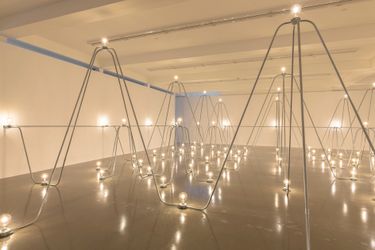
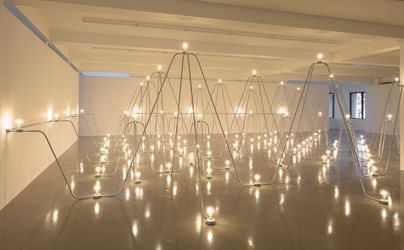
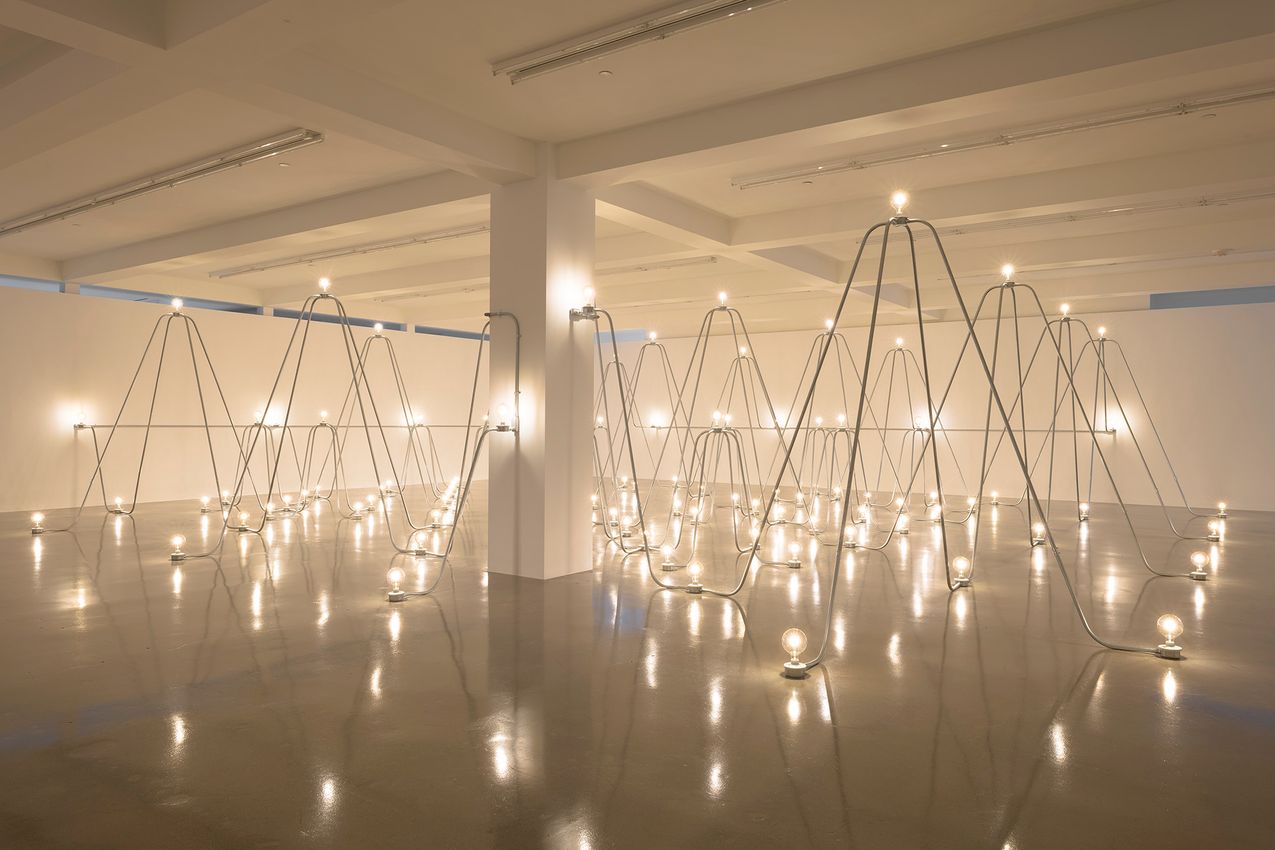
Electrical System exposes resources so common to contemporary life that their visual, tangible existence often goes forgotten. It consists of lightbulbs connected by a long metal conduit that curves and winds, inviting viewers to meander through arches of light. The System Works, like her formative text, audio and light investigations, make use of found systems to reveal what is unseen. They are formed from standard industrial materials designed for introducing heating, ventilation, lighting and drainage into the built environment—as Holt noted, they expose ‘fragments of vast, hidden networks’ that are ‘part of vast open-ended systems, part of the world.’
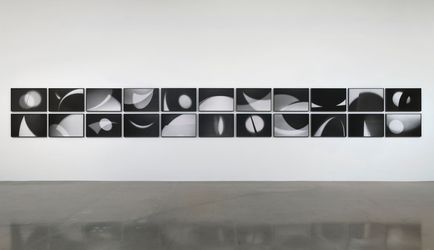
Holt’s works—be they materialised in sound, on paper, as an object, a moving image, an earthwork, an extension of architectural systems, a sculpture to look through or a single sentence—are invitations to stop, to look, to think, to pay attention, to observe the world as it changes, and with this to recognise the systems that structure and locate perception. Photography for Holt was a language, as well as a medium.
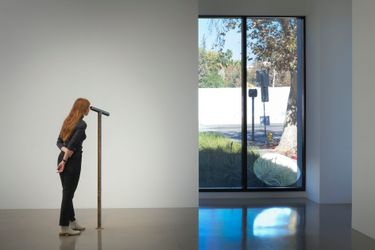
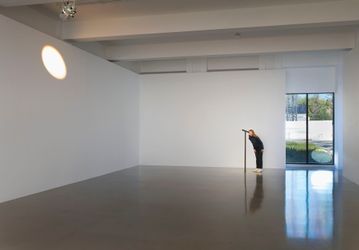
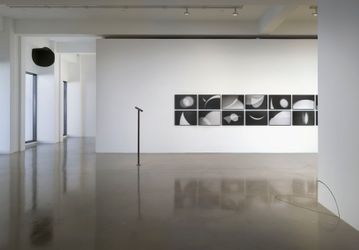
In 1971 she created her first sculptures, ‘seeing devices,’ as she called them, drawing attention to visual perception and place. The Locators comprise industrial piping welded into a T-shape and are to be looked through with one eye. They direct attention to the time-bound processes of vision. In 1992, she recalled: ‘I woke up one morning, I went to a welding place, made some of these Locator pieces, and overnight I had produced physical objects. They weren’t things that you looked at, but they were things you looked through. I would zero in on something you wouldn’t notice at all until you looked through my Locator, and then you would be kind of startled.’
The first Locators looked out from the windows of her studio in the West Village neighbourhood of New York on details, such as a cracked window or a ventilation pipe. She soon became more interested in the process of seeing than in the subject of sight. Locator Spotlight with Sunlight (1972) explores the difference between light formed by the sun and electric light. Locator (PS1) (1980) looks up to an irregular shape that becomes a circle when viewed through the Locator, and down to an outline that likewise shifts to a circle. The Locators directly led to Holt’s landmark earthwork, Sun Tunnels (1973–1976)
Photography was an essential medium for Holt–it enabled ‘vision to be fixed,’ as she often said.
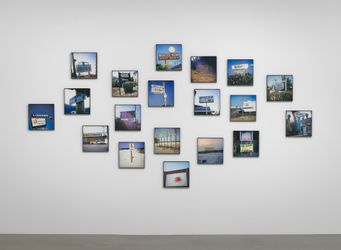
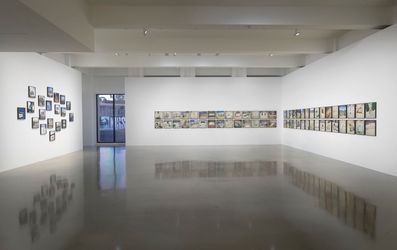
From 1968 she traveled through the US Interstate Highway System to create visual poems from repeating observed occurrences of human marks in the landscape. California Sun Signs (1972) is a visual poem collecting the word ‘sun’ as it appears in nineteen commercial and infrastructural contexts throughout the state of California. Uniting disparate sites into a solar-ordered system in vibrant images, she reveals common inferences and conceptions of the sun.
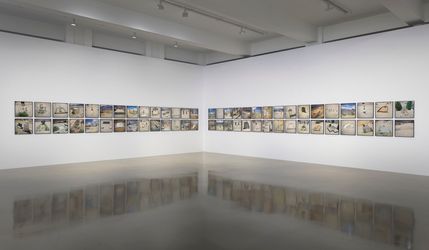
Through her work Western Graveyards (1968) Holt brings together sixty pared-back gravesites in Lone Pine, California and Virginia City, Nevada—sites full of enduring sculptural concerns with memorial and material encounters. Some graves are marked with names to be remembered: mother, father, Baby Baxter. Some map out a space for rest in stone, shells and fences. A few rise into ruin, headstones slipping to the ground, protective railings buckled, flower bushes dried out.


Nancy Holt was a pioneering American artist whose site-specific installations, earthworks, and explorations of perception helped redefine contemporary sculpture across five decades.
Sprüth Magers has expanded from its roots in Cologne (Germany) to become an international gallery dedicated to exhibiting the very best in groundbreaking modern and contemporary art. With galleries located in Berlin Mitte, London’s Mayfair and the Miracle Mile in Los Angeles–as well as an office in Cologne and an outpost in Hong Kong–Sprüth Magers retains close ties with the studios and communities of the German and American artists who form the core of its roster.

A respected voice in contemporary art discourse.
Focusing on ambitious storytelling and insightful art-world commentary. Ocula Magazine publishes in-depth interviews, critical essays and timely analysis on the artists, exhibitions and ideas driving the global art world.
Learn more about Ocula Magazine
Showcasing the best of the art world.
Ocula partners with galleries from around the world to highlight their artists, artworks and exhibitions. Gallery membership is by application and invitation, with each member vetted by an independent panel.
Learn more about Ocula Membership

Specialises in the sale of major artworks.
Led by a team with deep ties to the world’s leading auction houses, galleries and collectors. Ocula’s advisory team offers bespoke services to high-net-worth clients from around the world who are looking to acquire the best of contemporary and modern art.
Learn more about our team and services