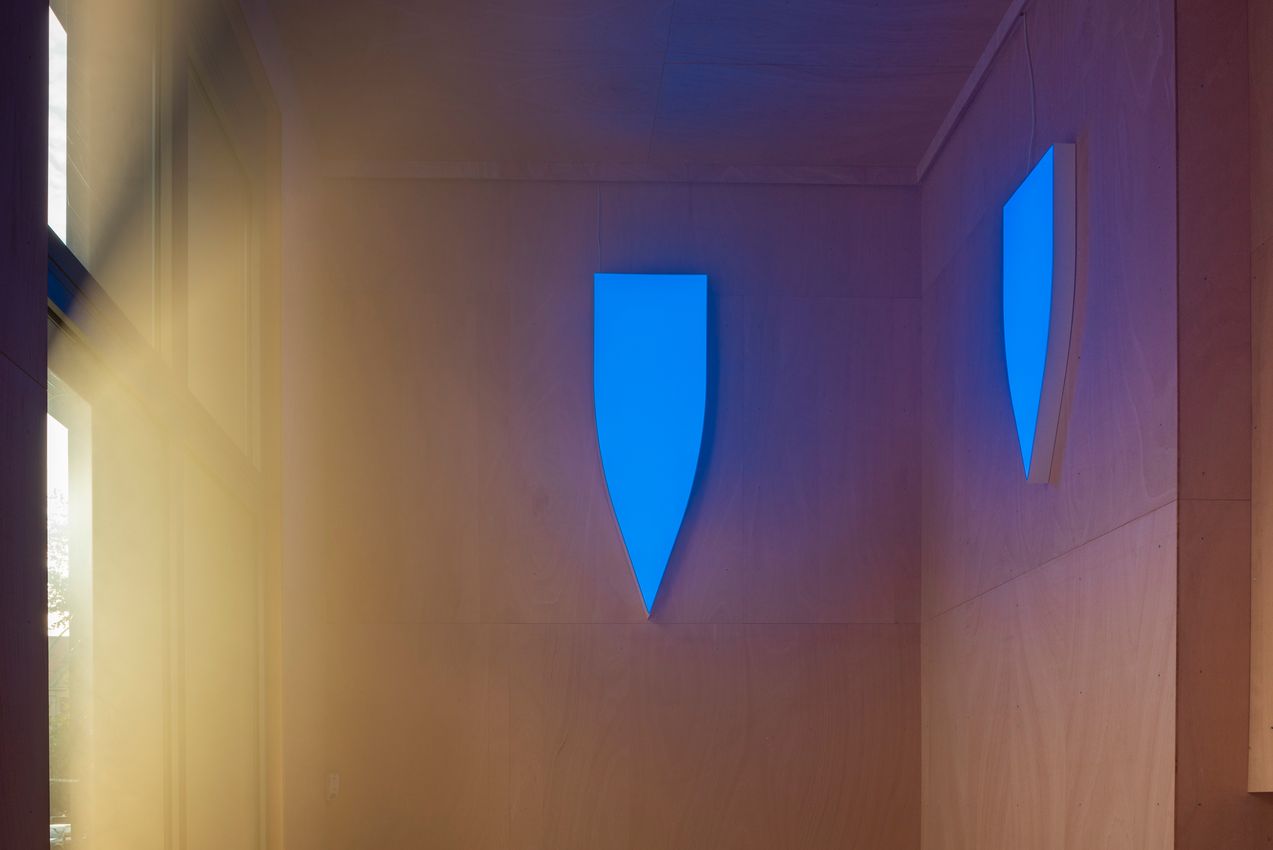




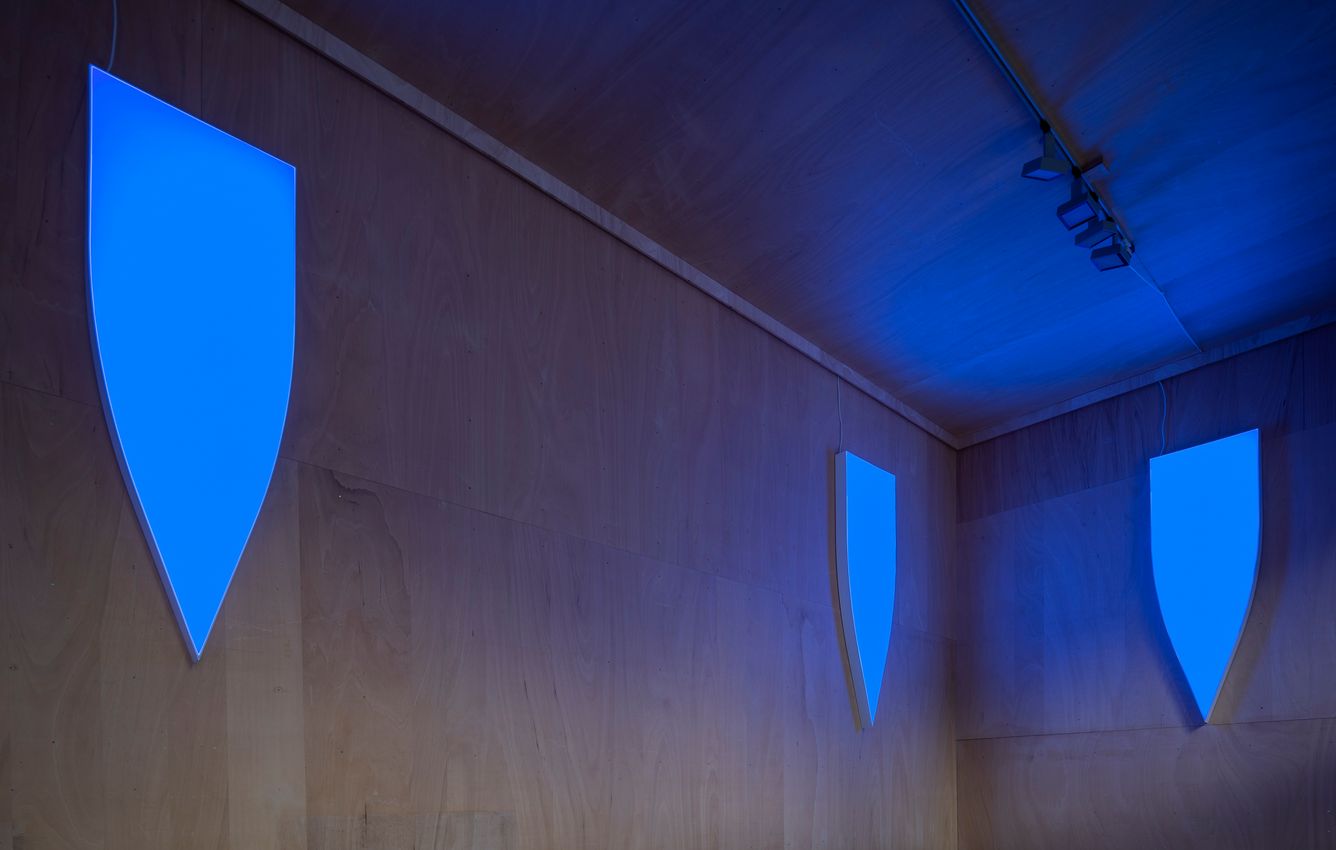
An alluring and extramundane blue light emanates from the Window, Sprüth Magers’ Berlin storefront exhibition space that is sunken and high-ceilinged, allowing visitors to view displayed works from the street around the clock. The spectacular color or, to be precise, the wavelengths emitted by Pamela Rosenkranz’s Alien Blue Windows permeate the entire room and pour out of the building. Monika Sprüth and Philomene Magers are pleased to announce a solo exhibition by the artist, showcasing five unique pieces from her enticing series alongside a selection of intricate kirigami works on paper_._
Four large and one smaller luminous work line the wood-paneled wall. From a distance, they seem to sink into the gallery’s architecture, while at close range, it becomes apparent they protrude into the space. Reminiscent of upside-down lancet windows found in Gothic churches, the shapes always correspond to an actual window in a building – modern or historical – somewhere in the world. The light works possess an unusual density of luminance, infusing the room and its exterior with an alien atmosphere.
Evoking many narratives, the color blue has a storied history in the arts, from the lapis lazuli used in Renaissance paintings to postmodernist Yves Klein’s International Klein Blue. It surrounds us in the sky and the oceans; it was the first synthetically produced pigment. Here, Rosenkranz references the blue light that technical devices produce, which has become omnipresent in our lives, deregulating the body’s melatonin levels and disrupting our circadian rhythm. The Alien Blue Windows are backlit – similar to most digital screens – using energy-efficient LEDs. Installed behind a stretch canvas, the LEDs lend the artworks an incandescent skin, recalling the familiar, absorbing glow radiating from the flat surfaces that light our faces most hours of the day and draw us into the internet’s innumerable digital windows.
Based on the evolution of our vision, our attraction to blue stems from the aquatic species that were the earliest to develop photosensitivity. Blue’s short wavelength range of electromagnetic radiation penetrates water, making it the color with the largest range of tones perceptible to the human eye. In Rosenkranz’s works, a purely synthetic blue collides with and adapts to the surrounding natural light circumstances. While exploring the intersections and interplays of the natural with the artificial, the pieces blur these distinctions, creating a fascinating sensory experience.
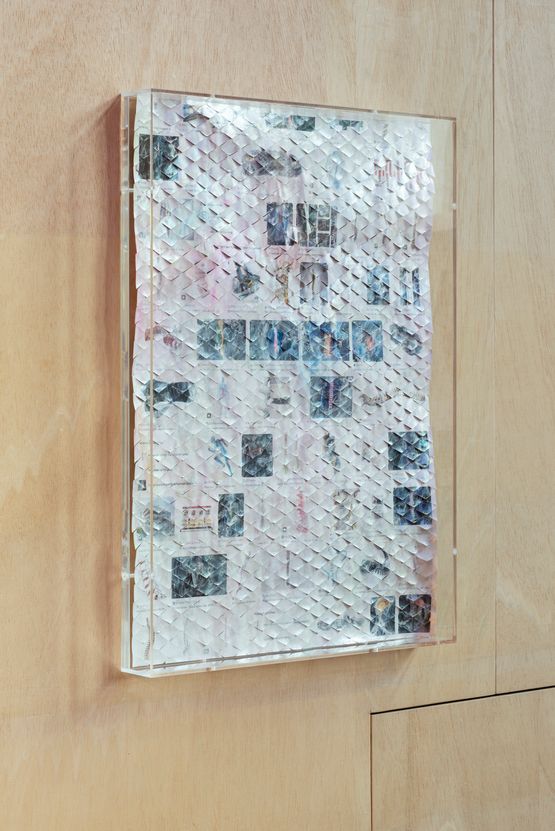
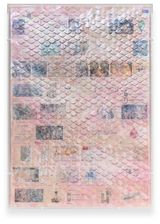
When the first animals transitioned from water to land, their sinuous swimming movements translated into the winding locomotion of their terrestrial descendants – both marine and land-dwelling animals’ gaits are supported by their scaly bodies. Recalling Rosenkranz’s Healer – a robotic snake with reflective kirigami skin – the artist’s new series Healer Scrolls continues her inquiry into the archaic image of the serpent. Endowed with the power to heal, the animal has come to represent the thin line between life and death; its venom is considered a powerful medicine, which is as useful as it is dangerous. Drawing on ancient kirigami cuts and folds, the works on paper display a pattern resembling the scales of a snake, playing with age-old assumptions and deep-seated evolutionary fears. Adding another layer of intrigue, they reference both the historic rolls of paper used to store information and the movement needed to navigate the internet’s sheer endless wealth of knowledge.
Together, the pieces on show are an exploration into perception – from our distant evolutionary past to our current digital age. Rosenkranz’s multilayered works reflect the role architecture inhabits in her practice by playing with placement, perspective, and spatial depth whilst delving into complex questions surrounding human existence.
Rosenkranz’s monumental sculpture Old Tree, which examines the human desire to anthropomorphize our surroundings in order to comprehend them, was selected for the third High Line Plinth commission and is on view through fall 2024.
Pamela Rosenkranz (*1979, Uri, Switzerland) lives and works in Zurich. Selected solo exhibitions include Kunsthaus Bregenz (2021), Kreuzgang Fraumünster, Zurich (2018), GAMeC, Bergamo (2017), Fondazione Prada, Milan (2017), Kunsthalle Basel (2012), Centre d’Art Contemporain, Geneva (2010) and the Swiss Institute, Venice (2009). Pamela Rosenkranz participated in several major international group exhibitions, including the Okayama Art Summit (2019) and the 15th Biennale de Lyon (2019). Her project Our Product was selected for the Swiss Pavilion at the 56th International Art Exhibition, Venice Biennale in 2015. Recent group shows were held at Kunstmuseum Winterthur and MIT List Visual Arts Center, Cambridge (both 2022), Schinkel Pavillon, Berlin (2021), Institute of Contemporary Art, Los Angeles (2021), Sharjah Art Foundation, Sharjah (2020), MMK - Museum für Moderne Kunst, Frankfurt (2019), Garage Museum for Contemporary Culture Moscow (2019), Musée National d’Art Moderne - Centre Georges Pompidou, Paris (2019), Institute of Contemporary Art, Boston (2018), Louisiana Museum of Modern Art, Humlebæk (2017) and Museo Espacio, Aguascalientes (2016).
Pamela Rosenkranz (Uri, Switzerland) lives and works in Zurich. She has held solo exhibitions at institutions including GAMeC, Bergamo (upcoming); Cisterna, Fondazione Prada, Milan (both 2017); the Swiss Pavilion at 56th International Art Exhibition, Venice Biennale (2015); Kunsthalle Basel (2012); Centre d’Art Contemporain, Geneva (2010); Swiss Institute, Venice (2009). Selected group exhibitions include The Garden, Aros Museum of Modern Art, Aarhus, (2017); Wirkuta (Mexican Time-Slip), Museo Espacio, Aguascalientes, Mexico; Dreaming Mirrors Dreaming Screens, Sprüth Magers, Berlin (all 2016); No Man’s Land: Women Artists from the Rubell Family Collection, Rubell Family Collection, Miami (2015); Inhuman, Fridericianum, Kassel (2014); Think First, Shoot Later: Photograhy from the MCA Collection, Museum of Contemporary Art, Chicago; and EXPO1: New York, MOMA PS1, New York, (both 2013).
Sprüth Magers has expanded from its roots in Cologne (Germany) to become an international gallery dedicated to exhibiting the very best in groundbreaking modern and contemporary art. With galleries located in Berlin Mitte, London’s Mayfair and the Miracle Mile in Los Angeles–as well as an office in Cologne and an outpost in Hong Kong–Sprüth Magers retains close ties with the studios and communities of the German and American artists who form the core of its roster.

A respected voice in contemporary art discourse.
Focusing on ambitious storytelling and insightful art-world commentary. Ocula Magazine publishes in-depth interviews, critical essays and timely analysis on the artists, exhibitions and ideas driving the global art world.
Learn more about Ocula Magazine
Showcasing the best of the art world.
Ocula partners with galleries from around the world to highlight their artists, artworks and exhibitions. Gallery membership is by application and invitation, with each member vetted by an independent panel.
Learn more about Ocula Membership

Specialises in the sale of major artworks.
Led by a team with deep ties to the world’s leading auction houses, galleries and collectors. Ocula’s advisory team offers bespoke services to high-net-worth clients from around the world who are looking to acquire the best of contemporary and modern art.
Learn more about our team and services