


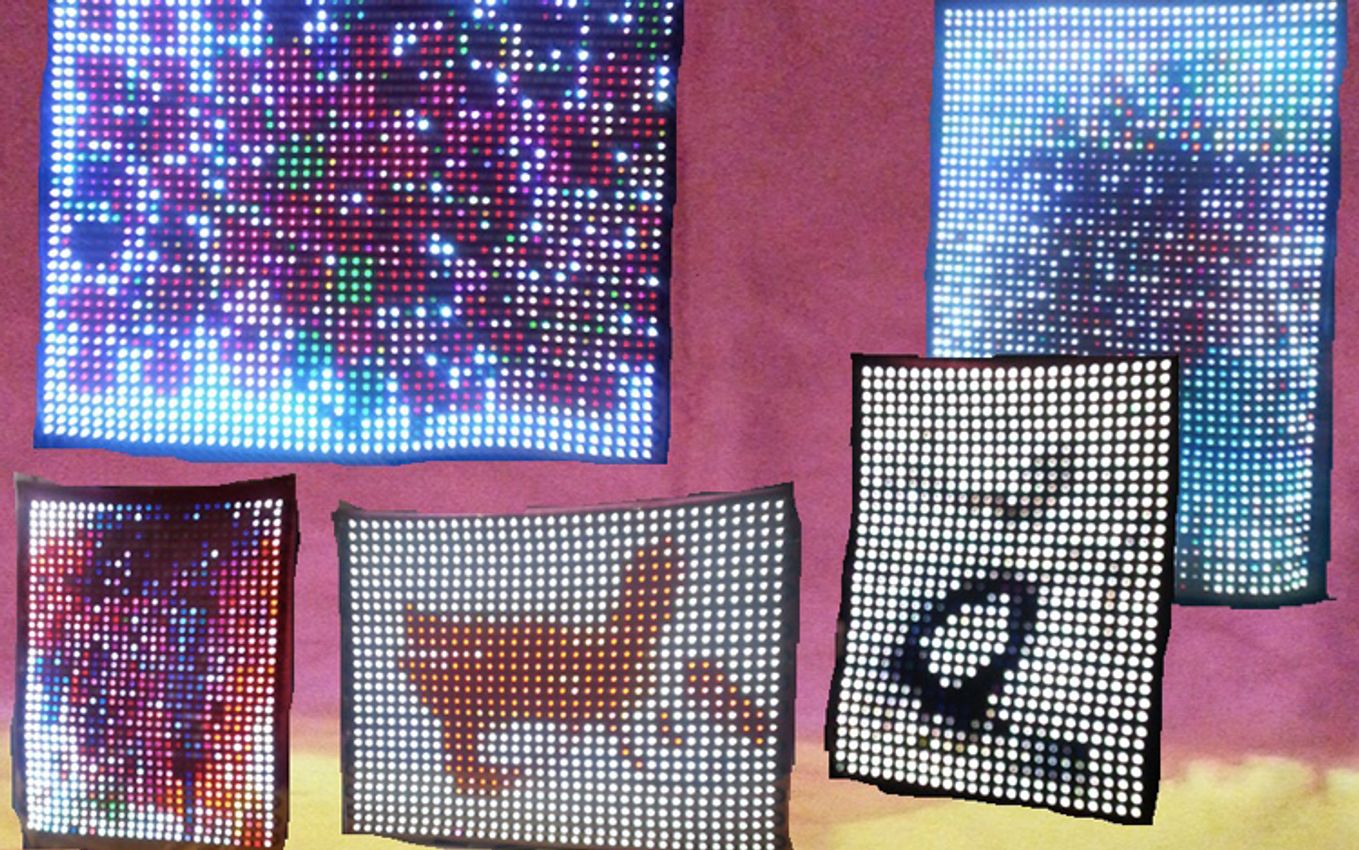
Taka Ishii Gallery Tokyo is pleased to present a solo exhibition of works by Ei Arakawa from February 10 to March 11. The exhibition marks Arakawa’s third solo presentation at Taka Ishii Gallery since his previous gallery showing five years ago, and will feature a musical style installation performed by paintings by five Gutai artists that are each shown through a hand-made LED screen.
Various songs in the new work, Tryst, captures the relationship between painting and performance from a critical perspective, something that Arakawa has continued to pursue throughout his artistic practice. Paintings by members of the Gutai that Arakawa had used in his 2011 performance See Weeds is respectively shown on each screen, with songs and conversations between them serving to develop a story. All the paintings that are referenced were produced around 1959, and thus represent a selection from a significant turning point in Gutai’s history when artworks had been gradually exported to nations such as France as examples of Art Informel in Japan. Through his latest work Arakawa forms a connection between the Gutai’s strategy for global success and Art Basel that represents the current art market, which he investigates and recontextualizes within the framework of a musical. Furthermore, the digitalized and re-appropriated paintings question how our current digital condition and networked society influences the state of painting, and manifests as Arakawa’s contextualization of post-war Japanese art within larger Modern art history. This work invites Dan Poston as co-songwriter, David Zuckerman as composer, and Sergei Tcherepnin as arranger.
Arakawa has previously collaborated with Aki Takahashi (pianist) and Sergei Tcherepnin (artist) to create Shiro no me / Blue Hood / Environmental Mechanical Orchestra – Imagining Kuniharu Akiyama (2013), a work comprising of poetry, objects, and music pertaining to the poet and composer Kuniharu Akiyama who had been a member of Jikken Kobo (Experimental Workshop). Furthermore he has created the work See Weeds (2011), a performance in which actual paintings by Gutai artists installed on wheels dance along to background music of audio that is based on interview texts of Gutai members discussing the human relationships within their group. In this way, Arakawa has appropriated numerous avant-garde artists from Japanese art history as the subject of his works, centering on predecessors such as Jikken Kobo, Gutai, and Fluxus members who served as pioneers in collaborating with others and developing interactive relationships with the audience. In recent years he has created a number of performative works that center on issues facing contemporary society such as How to DISappear in America (2016). The work depicts our social conditions which have been reformed through the Internet, and references Seth Price’s work that in itself is based on an actual underground manual from the 1970s that outlined means for concealing one’s personal information.
Ei Arakawa is based in New York since 1998. Selected performances and exhibitions include, Sculpture Project Münster (June, 2017), Museum Ludwig, Cologne (2017), The 9th Berlin Biennale (2016), Museum Brandhorst, Munich (2015), Gwangju Biennial (2014), Whitney Biennial, New York (2014), Carnegie International, Pittsburgh (2013), Pavilion of Georgia at the 55th International Art Exhibition, la Biennale di Venezia (2013), Tate Modern, London (2012), 30th São Paulo Biennial (2012), and The Museum of Modern Art, New York (2012).
Ei Arakawa Nash is a performance artist who frequently collaborates with artists (and sometimes their artworks). They encourage viewers to become collaborators, too, blurring the lines between consumer and creator while always considering the specific contexts of the people for which the artwork is created.

Since its opening in 1994, Taka Ishii Gallery has continued to maintain and develop an exhibition program based on the goals of introducing international contemporary artists within Japan and acting as an international platform for emerging Japanese artists as well as contemporary masters.

A respected voice in contemporary art discourse.
Focusing on ambitious storytelling and insightful art-world commentary. Ocula Magazine publishes in-depth interviews, critical essays and timely analysis on the artists, exhibitions and ideas driving the global art world.
Learn more about Ocula Magazine
Showcasing the best of the art world.
Ocula partners with galleries from around the world to highlight their artists, artworks and exhibitions. Gallery membership is by application and invitation, with each member vetted by an independent panel.
Learn more about Ocula Membership

Specialises in the sale of major artworks.
Led by a team with deep ties to the world’s leading auction houses, galleries and collectors. Ocula’s advisory team offers bespoke services to high-net-worth clients from around the world who are looking to acquire the best of contemporary and modern art.
Learn more about our team and services
