


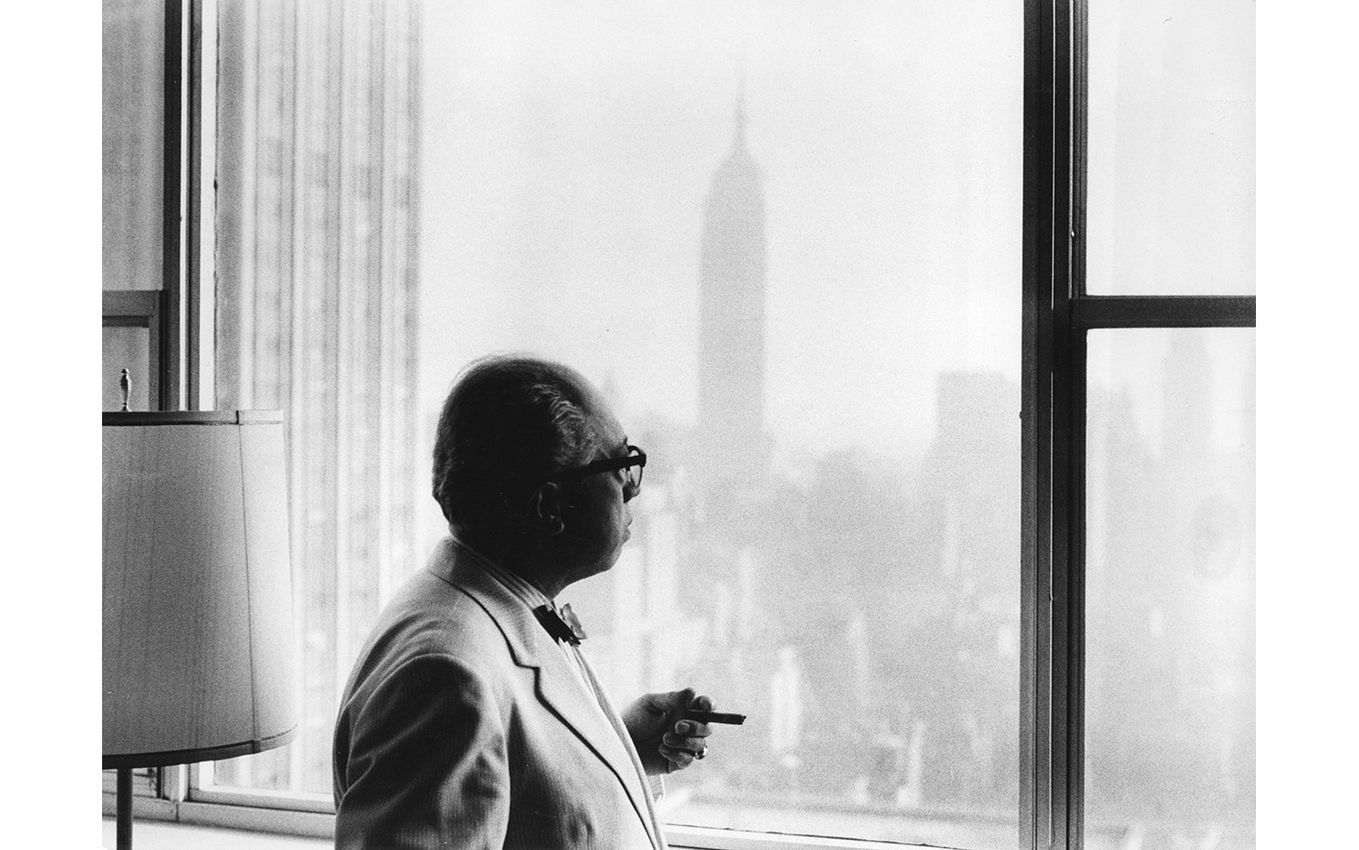
Taka Ishii Gallery is pleased to present a solo exhibition of works by Sofu Teshigahara (1900-1979), founder of the Sogetsu School of Ikebana, which is recognized as having made a significant mark on history of postwar Japanese art. Together with valuable documents and reference materials, the exhibition introduces a selection of sculptures and calligraphy works produced from the 1950s to the 1970s, centering on one of his early important work Kikansha [Locomotive] (1951).
Sofu Teshigahara was born in 1900 as the eldest son of Ikebana artist Wafu Teshigahara. Starting to take lessons in Ikebana from childhood, he gradually began to attract attention for his outstanding talent however, in questioning the formalistic traditions of Ikebana, he broke away from his father to establish the Sogetsu School of Ikebana in 1927. Together with Houun Ohara and Yukio Nakagawa, he eventually came to lead the postwar ‘avant-garde Ikebana movement,’ which deviated from conventional practices of Ikebana, and resulted in its unprecedented and thriving popularity.
Teshigahara, who continued to express a strong interest in European art trends since prior to the war, had engaged in attempts to incorporate the experimental spirit of modern art into the context of Ikebana. During the postwar reconstruction period, he created works such as Sanpo [Walk] (1951) and Kikansha [Locomotive] (1951) combining vases crafted from iron with plants, later presenting the iron-based sculptural work Mure [Flock] (1953) that had dismissed the use of flowers entirely. In producing this work, Teshigahara had left a note that stated, ‘I hope to demonstrate that it is possible to create expressions using anything.’ Through treating materials such as iron, stone, and wood as equivalent to flowers, he served to liberate Ikebana from its framework that had been reduced to a mere formality.
After his first visits to the United States in 1952 and Europe in 1955 where he had the opportunity to encounter numerous works of modern art, Teshigahara presented his wood sculpture Jujū [Tree Beast] (1955), which made use of the natural organic forms of pine tree roots. Since producing this work, the materials he used shifted to trees such as roots and lumps of bark, their scale also gradually increasing. Thereafter he continued to produce a succession of sculptural works of unprecedented scales that reflected the overwhelming vitality of plants, such as Inochi [Life] (1956) which appropriated three tons of thousand-year old wisteria vines; a 30-meter tall Ikebana work titled Maten [Babel] (1958), produced as a symbol for the Ise Grand Shrine Expo; as well as his representative works from the 1960s Yakumo (1962) and Chikara [Enerby] (1953) whose titles drew inspiration from the Kojiki [Records of Ancient Matters] –an early chronicle of myths, legends, songs, genealogies, and semi-historical accounts concerning the origins of Japan, its gods, and the imperial line.
The works of Teshigahara that had instilled Ikebana with a new modern figurativeness, had attracted the attention of art historians and artists from an early stage. From the early 1950s, he participated in group exhibitions in museums both in Japan and abroad, also presenting solo exhibitions in numerous museums and galleries such as the National Museum of Kyoto (1967) and the Palais Galliera (Paris, 1971). Michel Tapié, a theoretical promoter of Art Informel who made his first visit to Japan in 1957, had highly praised Teshigahara as one of the best avant-garde sculptors, and featured his works in many of the exhibitions he curated. Teshigahara had also significantly influenced Japanese art history as mentor and patron of avant-garde art, hosting the events by John Cage and David Tudor (1962) and Merce Cunningham Dance Company’s Japan performance (1964) at the Sogetsu Art Center under the direction of his son Hiroshi.
Teshigahara’s main exhibitions include, Sofu Teshigahara in the Postwar Avant-Garde Era, the Setagaya Art Museum, Tokyo (2001); Sogetsu and Its Contemporaries, the Ashiya City Museum of Art and History, and the Chiba City Museum of Art (1998-99); Haus Mei, Cologne (1972); the Palais Galliera, Paris (1971); the Middelheim Museum, Antwerp (1971); The Sculpture of Sofu Teshigahara, The National Museum of Modern Art, Kyoto (1967); the Royal Museums of Fine Arts of Belgium, Brussels (1966); Lincoln Center, New York (1964); Sala Gaspar, Barcelona (1959); Stadler Gallery, Paris (1959 and 1961); Martha Jackson Gallery, New York (1959); and the Château de Bagatelle, Paris (1955). He has participated in group exhibitions such as Art Contemporain, Grand Palais, Paris (1963); Dalla natura all’arte, Palazzo Grassi, Venice (1960); International Art of a New Era: Informel and Gutai, Takashimaya Department Store, Osaka (1958); International Contemporary Art Exhibition of the World, the Bridgestone Museum of Art, Tokyo (1957); and Abstract Art and Surrealism, The National Museum of Modern Art, Tokyo (1953). In 1962 Teshigahara received The Minister of Education, Science and Culture’s Art Encouragement Prize, as well as the Legion of Honor Knight’s cordon and the insignia of Officer of the Order of Arts and Letters by the French Government in 1961 and 1960 respectively.
Since its opening in 1994, Taka Ishii Gallery has continued to maintain and develop an exhibition program based on the goals of introducing international contemporary artists within Japan and acting as an international platform for emerging Japanese artists as well as contemporary masters.

A respected voice in contemporary art discourse.
Focusing on ambitious storytelling and insightful art-world commentary. Ocula Magazine publishes in-depth interviews, critical essays and timely analysis on the artists, exhibitions and ideas driving the global art world.
Learn more about Ocula Magazine
Showcasing the best of the art world.
Ocula partners with galleries from around the world to highlight their artists, artworks and exhibitions. Gallery membership is by application and invitation, with each member vetted by an independent panel.
Learn more about Ocula Membership

Specialises in the sale of major artworks.
Led by a team with deep ties to the world’s leading auction houses, galleries and collectors. Ocula’s advisory team offers bespoke services to high-net-worth clients from around the world who are looking to acquire the best of contemporary and modern art.
Learn more about our team and services
