Taka Ishii Gallery is pleased to present our third exhibition with Los Angeles based artist Silke Otto-Knapp.
Violets
Oral tradition describes violets as those whose blossoms are hidden and smell fragrant.
Some are alpine violets because they were potted in Zurich near the Alps.
But most are just ordinary violets, the blue ones that grow near hedges and beneath trees and that flower in the fall.
As children, we even had such small violet bushes in our garden and often smelled them.
Oh, that smells good! And now, as a grownup, I have got used to looking for little violets and finding them, always and everywhere,
in summer, winter, fall and spring.
Do they not greet us everywhere, the little violets that look at us so sweetly and faithfully
with their childlike blue eyes? Quietly fragrant, do they not lead their violet life full of
fragrant modesty in this world of spring, those lovely violets?
I know all of this very well and therefore I picked
and picked more. Some I also dug out with the roots,
they continue to grow.
Most violets flower in March. In April, they are mostly called Anemones.
In May, they are called Lilies of the Valley and in June Maybug.
In December, however, they bloom
on cold windowpanes and are called frost flowers.
Read, dear sir, dear madam, dear miss—please cross out the address that doesn’t apply
and write to me in full confidence, which violet has smelled the most fragrant.
That would be a festival for me!
KURT SCHWITTERS, HANNOVER,
WALDHAUSENSTR. 5 *
The title of the exhibition refers to a journal of poetry Kurt Schwitters published in 1931 in Hannover. The journal brought together a selection of poems by his peers. Schwitters’ own poem Veilchen (Violets) was printed on the cover as both an address to the reader and a statement of intent from the artist, who likens the small and beautiful flowers that have the strength to grow under almost any conditions, to the poems presented in the journal.
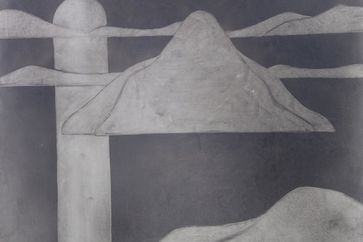
The group of paintings in the exhibition take their starting point from the Schwitters journal. They range from landscapes to paintings based on historical documentation of stage design and performance. By transforming the space with her painting process of building and removing layers of watercolour, Otto-Knapp creates degrees of transparency and opacity with layers of movement in one uninterrupted surface. Herpaintings could be compared to looking at a photographic negative where there is a constant play of negative and positive, producing an unstable space that nevertheless has a distinct physical presence.
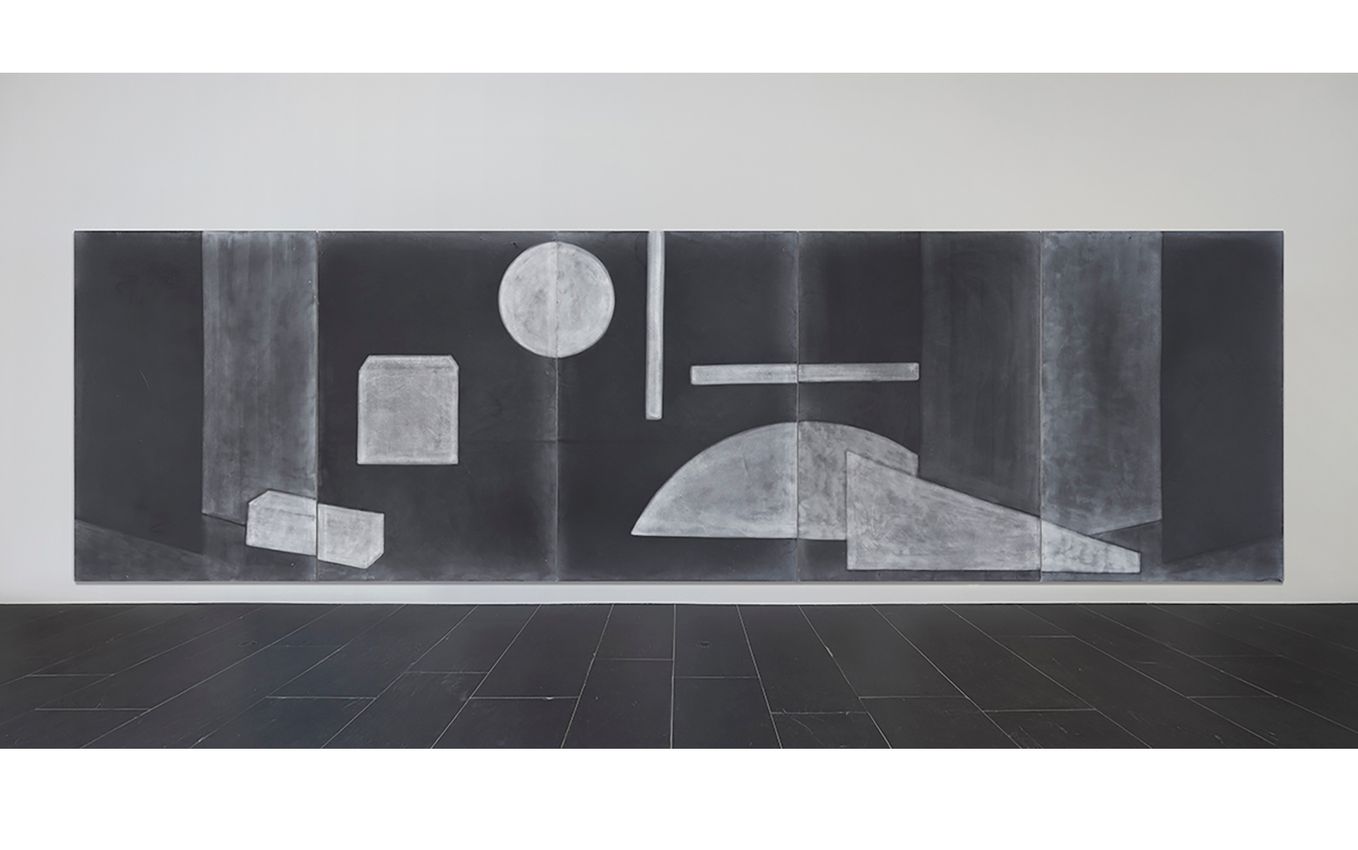
For this exhibition, a group of smaller paintings are shown with one large multi-panel painting. The large painting Stage (After Schwitters) introduces both architectural and theatrical space.
In the mid 1920s, Schwitters developed a concept for theatres he called Normalbühne [Standard (orNormal) Stage]. Influenced by the economy and pragmatism of Constructivism, he wanted to design elements for a stage that would work with any text or form of production. He imagined every theatre would have a set of the props and the technical instructions necessary to operate them. His design makes use of abstract shapes such as the cube, sphere, circle, steps, rectangles, squares, etc. that can be used to construct a theatrical space that plays with depth and illusion.
Otto-Knapp’s painting imagines a stage set that uses these instructions, while also anticipating the many possible new combinations and constellations they allow.
Born in 1970 in Osnabrück, Silke Otto-Knapp majored in cultural studies at the University of Hildesheim and received her MFA from Chelsea College of Art and Design in London. She has held solo exhibitions at Midway Contemporary, Minneapolis (2017); The Art Gallery of Ontario, Toronto (2015); Kunsthalle Wien and Camden Art Center, London (2014); Kunsthal Charlottenborg, Copenhagen (2013); Kunstverein Munich (2010); and Tate Britain, London (2005). She has also participated in many group exhibitions, including a, the, though, only. Made in LA, Hammer Museum, Los Angeles (2016); Sacré 101 — An Exhibition Based on the Rite of Spring, Migros Museum, Zurich (2014); Dance/Draw, ICA, Boston, MA (2011); and the 9th International Istanbul Biennial (2005).
Otto-Knapp will be participating in the upcoming Liverpool Biennal 2018 Beautiful world where are you?.
Silke Otto-Knapp was born in Osnabrück, Germany, and lived in Los Angeles, where she served as professor of painting and drawing at the UCLA School of the Arts and Architecture. She earned an MA from Chelsea College of Art and Design, London, in 1996, and a Degree in Cultural Studies at the University of Hildesheim, Germany, in 1997.

Since its opening in 1994, Taka Ishii Gallery has continued to maintain and develop an exhibition program based on the goals of introducing international contemporary artists within Japan and acting as an international platform for emerging Japanese artists as well as contemporary masters.

A respected voice in contemporary art discourse.
Focusing on ambitious storytelling and insightful art-world commentary. Ocula Magazine publishes in-depth interviews, critical essays and timely analysis on the artists, exhibitions and ideas driving the global art world.
Learn more about Ocula Magazine
Showcasing the best of the art world.
Ocula partners with galleries from around the world to highlight their artists, artworks and exhibitions. Gallery membership is by application and invitation, with each member vetted by an independent panel.
Learn more about Ocula Membership

Specialises in the sale of major artworks.
Led by a team with deep ties to the world’s leading auction houses, galleries and collectors. Ocula’s advisory team offers bespoke services to high-net-worth clients from around the world who are looking to acquire the best of contemporary and modern art.
Learn more about our team and services