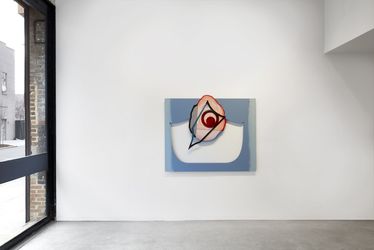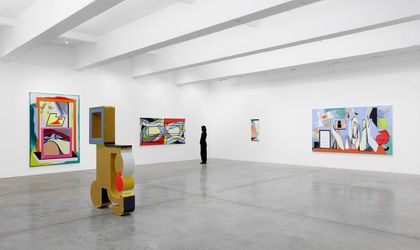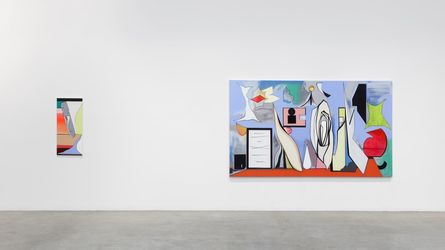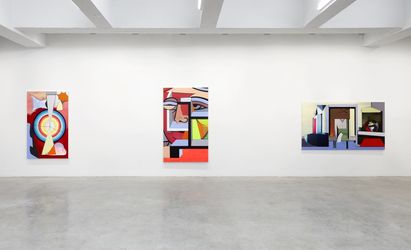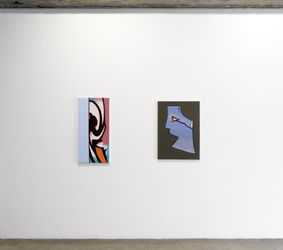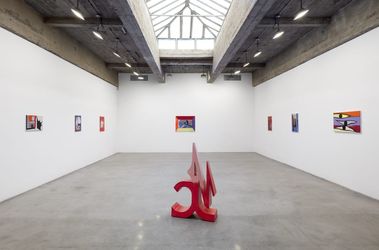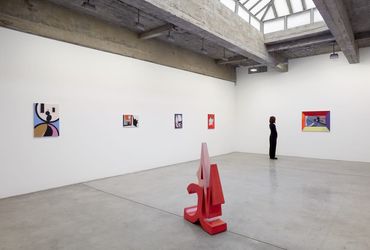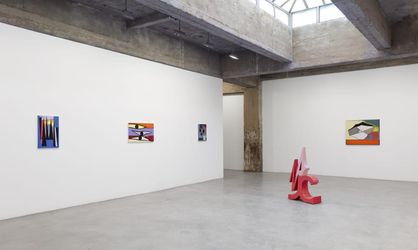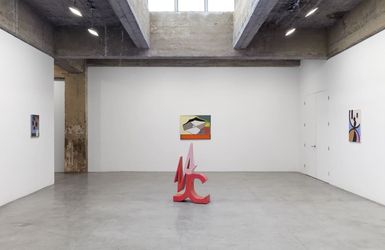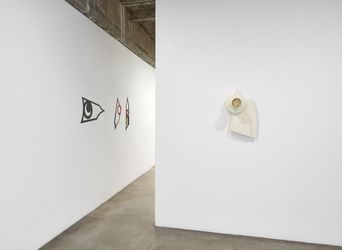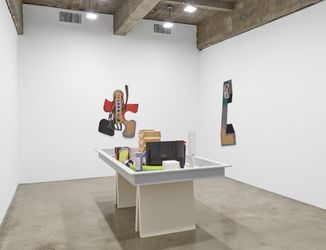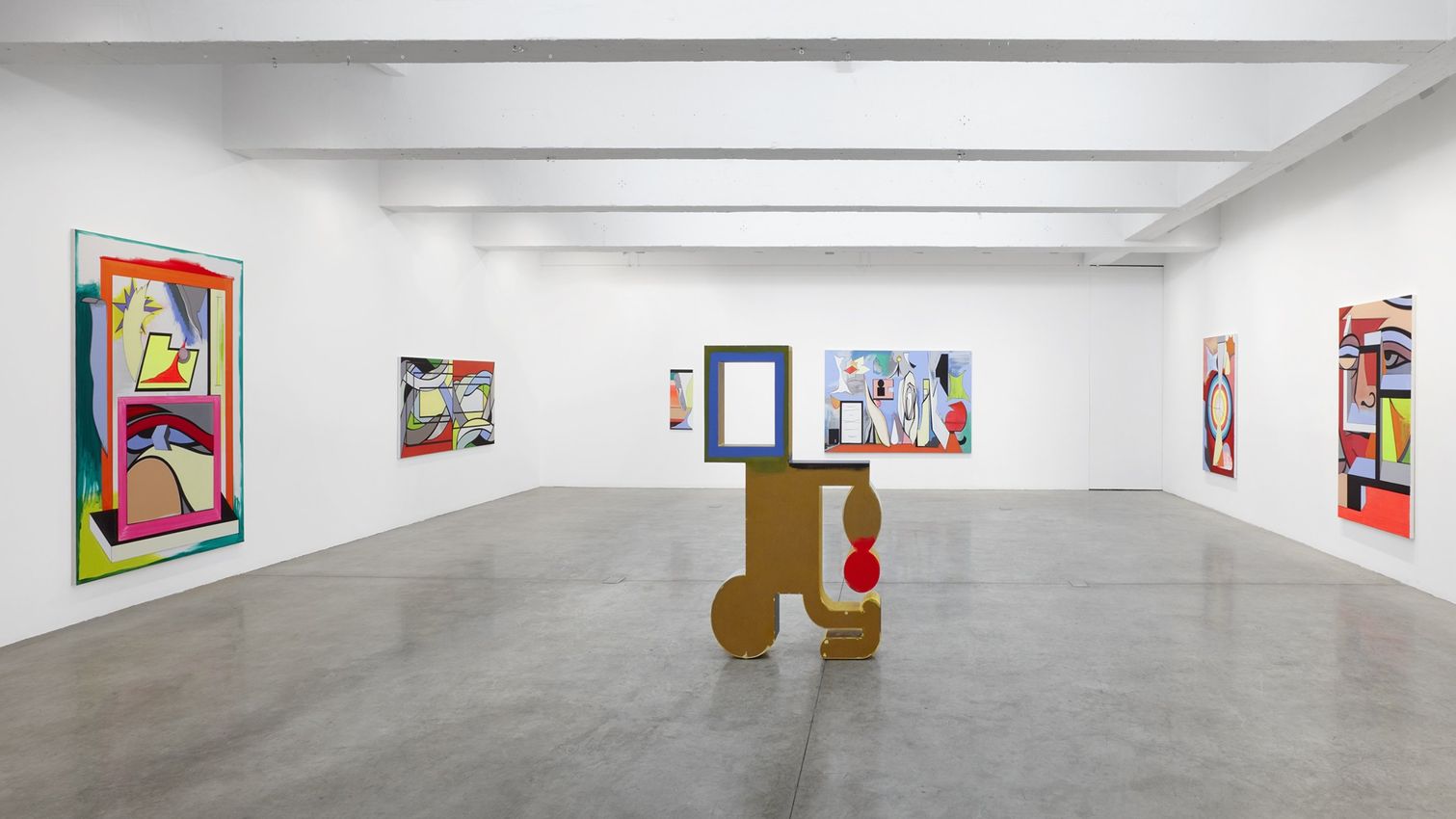
Tanya Bonakdar Gallery is very pleased to announce Thomas Scheibitz: Argos Eyes, the gallery’s eleventh solo exhibition with the artist since 1998, and his first show in the United States in nearly five years.
Internationally renowned for his mastery of painting, Scheibitz subverts traditional notions of the medium with radical juxtapositions of color and a unique formal language that lands ambiguously between abstraction and representation. Drawing from classical painting and architecture, the contemporary urban landscape, and popular culture, Scheibitz deconstructs and recombines signs, images, shapes, and architectural fragments in ways that challenge expected contexts and interpretations.
Scheibitz’s practice has been at the center of contemporary artmaking since the late 1990s with early solo exhibitions at the ICA London, the Stedelijk Museum, Amsterdam, and the Berkeley Art Museum, University of California, Berkeley, as well as breakthrough presentations at the German pavilion of the 51st Venice Biennial, MUDAM Luxembourg, Centre d’Art Contemporain Geneva, Neue Nationalgalerie Berlin, and more recent major shows at Kunstmuseum Bonn, MMK Frankfurt, and Pablo Picasso x Thomas Scheibitz at the Museum Berggruen, Berlin.
In an age of infinite images and visual information, Argos, the multi-eyed, all-seeing guardian giant of Greek mythology, serves as a kind of avatar for Scheibitz. Like the panopticon-esque figure, the artist’s painting and sculpture absorb and dissolve visual material, encoding and decoding, mapping, measuring, penetrating and exploring a pictorial inventory. For Scheibitz, Argos Eyes are the observers of events and circumstances; that which we see directly, or indirectly via our ubiquitous technological devices, lenses, and screens. For the artist, a picture has always been a summary of different sources of observations and experiences which remain in the mind’s eye like “double exposures”. The eye, or by proxy the lens, is the entrance to the conscious or unconscious processing of what we see or do not see. A fundamental question for the artist remains the philosophical question: do we only see what we already know?
In the main ground floor gallery, Scheibitz presents a dynamic range of painterly compositions and a sculpture. Bringing together selections from his vast lexicon of images, Scheibitz builds up these compositions meticulously yet intuitively, using maquettes, drawings, collage, photography, and sketches. Recognizable forms such as eyes, cubes, droplets, and pyramids are translated into multilayered and complex pictorial structures that urge the viewer to consider multiple perspectives.
In the upstairs galleries, more intimately scaled paintings encircle the room, in addition to an Atlas-like master table filled with models, stencils, and other tools representative of the repeated motifs found in the artist’s studio. This conceptual landscape illustrates the core nature of the work, offering interrelated exercises in form, color, and material.
Scheibitz is currently based in Berlin. His work is well represented in private and public collections worldwide, including those of the Museum of Modern Art in New York, Carnegie Museum of Art in Pittsburgh, Tate Modern in London, Hamburger Bahnhof Museum für Gegenwart in Berlin, Musée d’Art Moderne Grand-Duc Jean in Luxembourg, Museum of Contemporary Art in Los Angeles, Museum of Contemporary Art in Chicago, Pinakothek der Modern in Munich, Sammlung Goetz, Munich, San Francisco Museum of Modern Art, and the Stedelijk Museum in Amsterdam, among others.


Born in 1968 in Radeberg, Thomas Scheibitz is a German painter and sculptor, working in this practice since the early 1990s. He attended the Hochschule fur Bildende Kunste from 1991 to 1996 and later was a Masters scholar under Prof. Kerbach. His work explores the boundaries between figuration and abstraction as he uses large blocks of dense colour, sharp unforgiving black lines, and layering of objects to play with the viewer’s perception of depth and three-dimensionality. The resulting works allude to cubist traditions, yet make use of regular everday items, made recognizable to the viewer.


A respected voice in contemporary art discourse.
Focusing on ambitious storytelling and insightful art-world commentary. Ocula Magazine publishes in-depth interviews, critical essays and timely analysis on the artists, exhibitions and ideas driving the global art world.
Learn more about Ocula Magazine
Showcasing the best of the art world.
Ocula partners with galleries from around the world to highlight their artists, artworks and exhibitions. Gallery membership is by application and invitation, with each member vetted by an independent panel.
Learn more about Ocula Membership

Specialises in the sale of major artworks.
Led by a team with deep ties to the world’s leading auction houses, galleries and collectors. Ocula’s advisory team offers bespoke services to high-net-worth clients from around the world who are looking to acquire the best of contemporary and modern art.
Learn more about our team and services