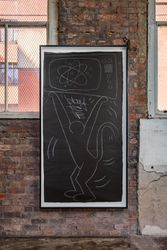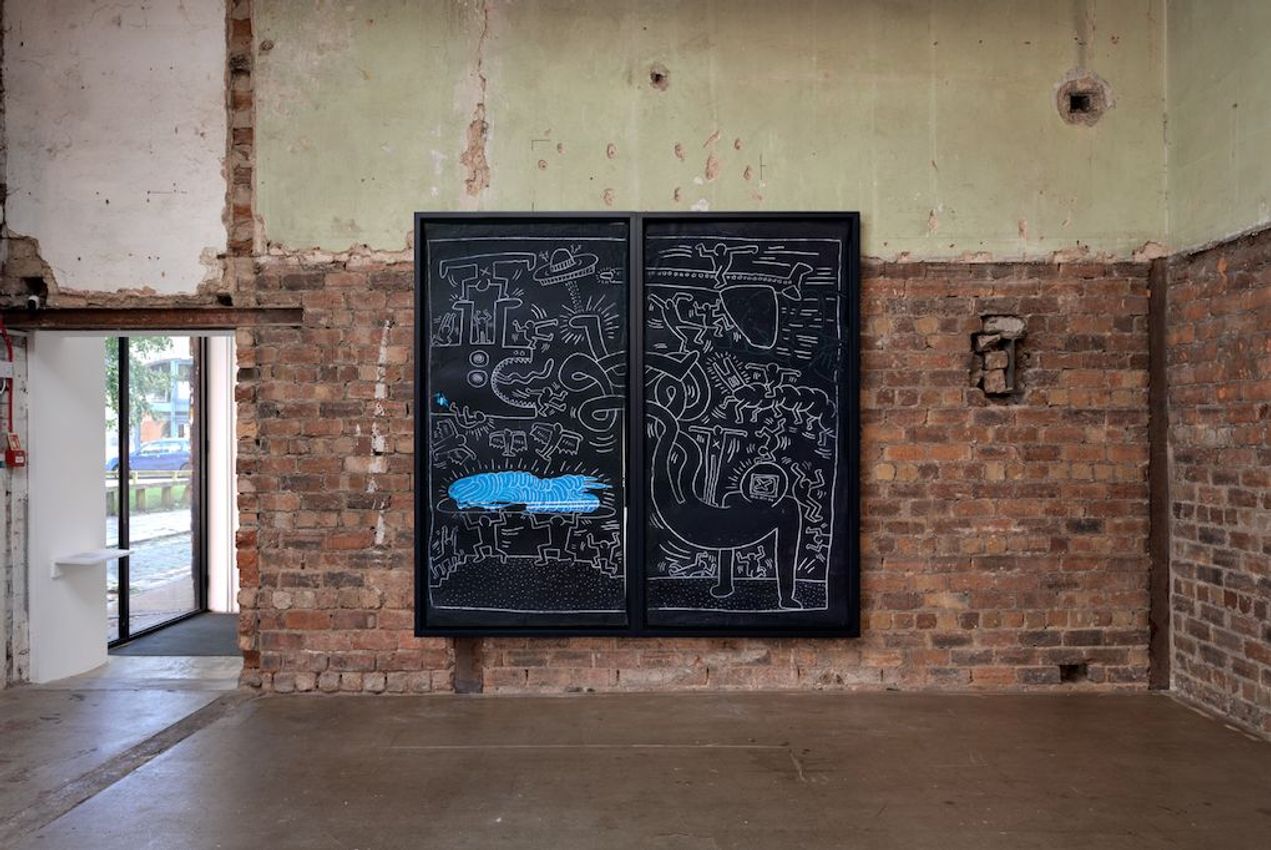
I remember noticing a panel in the Times Square station and immediately going aboveground and buying chalk. After the first drawing things just fell into place. I began drawing on the subways as a hobby on my way to work. I had to ride the subways often and would do a drawing while waiting for a train.
Keith Haring left for New York in 1978 to study at the School of Visual Art (SVA), the calligraphic line of Pierre Alechinsky still fresh in his mind from an exhibition he had seen at the Carnegie Institute Museum of Art, Pittsburgh, the year before. During his short period of study at SVA – he left in 1980 – Haring became interested in Umberto Eco and the study of semiotics, in particular ‘the way symbols are given meaning by language’. And amongst other artists of the counterculture, his new life in New York introduced him to Brion Gysin and William S. Burroughs – their concept of the cut-up as outlined in their influential book The Third Mind, 1978. In 1980, Haring found the perfect stage for this diverse set of influences to play themselves out – the New York City Subway.
Dynamic forms of graffiti dominated the tunnels and carriages of the subway in the 1980s even as a more affluent, mostly white, white-collar population (or ‘yuppies’) began to return to Manhattan following the election of Ronald Reagan and the city’s gradual recovery from a destructive fiscal crisis which emerged in the mid-1970s. The appearance of graffiti or ‘writing’ at this time and the semiotic intensity of the subway proved influential for Haring, and others of his generation, from Jean-Michel Basquiat to Jenny Holzer and David Wojnarowicz. The material transience or vulnerability of Haring’s drawings defined them against these more permanent writings and artworks.
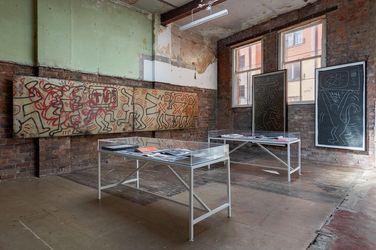
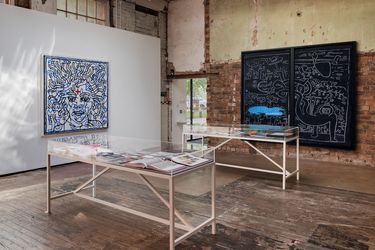
Haring made hundreds, if not thousands, of subway drawings between 1980 and 1985. They were executed illegally with white chalk on the black paper panels that the Metropolitan Transit authority used to cover advertisements between rentals. Haring was arrested many times while engaging in this activity though he reported that many cops were also fans. Constantly changing networks of commercial space resulted in the continual erasure of his work as new advertisements were posted. While this forced Haring to develop new ideas and imagery it also means that very few of these subterranean chalk frescoes now survive.
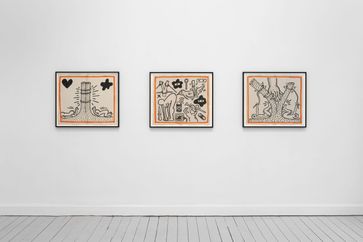
Haring’s highly legible visual language developed through his pressured and recurrent performance of drawing in the depths of the city. He reacted to the flux of urban life, his immediate surroundings but more generally to the concerns of the day – forms of sexuality regarded as taboo, commercial television, fraught politics, and atomic fear. Haring explored the city’s subconscious, its various repressions and fantasies, and outlined them in his underground work. The exhibition also comprises a section of Haring’s Untitled (FDR NY) mural from 1984. Untitled (FDR NY) was a 100-metre-long panel work which sat parallel to a section of New York City’s Franklin D. Roosevelt East River Drive, on Manhattan’s East Side. Like the subway drawings, this piece depicts images that existed outside of the space of mass culture and the crush of the commercial which defined the advertisements for magazines, films and other products that surrounded them. As they did when first produced, these works continue to provide room to breathe, a space for the imagination.
Press release courtesy The Modern Institute


Keith Haring was an influential American Pop artist known for cartoon-like paintings, drawings, and murals typified by bold lines and direct messages. His short-lived career spanned just the 1980s but has a far-reaching legacy.


The Modern Institute was founded in Glasgow in 1997. The gallery works with 45 internationally established and emerging artists including Martin Boyce, Jim Lambie, Richard Wright, Anne Collier, Cathy Wilkes, Simon Starling, Urs Fischer, Luke Fowler and Nicolas Party.

A respected voice in contemporary art discourse.
Focusing on ambitious storytelling and insightful art-world commentary. Ocula Magazine publishes in-depth interviews, critical essays and timely analysis on the artists, exhibitions and ideas driving the global art world.
Learn more about Ocula Magazine
Showcasing the best of the art world.
Ocula partners with galleries from around the world to highlight their artists, artworks and exhibitions. Gallery membership is by application and invitation, with each member vetted by an independent panel.
Learn more about Ocula Membership

Specialises in the sale of major artworks.
Led by a team with deep ties to the world’s leading auction houses, galleries and collectors. Ocula’s advisory team offers bespoke services to high-net-worth clients from around the world who are looking to acquire the best of contemporary and modern art.
Learn more about our team and services