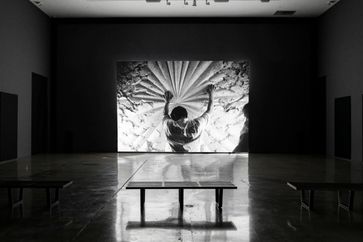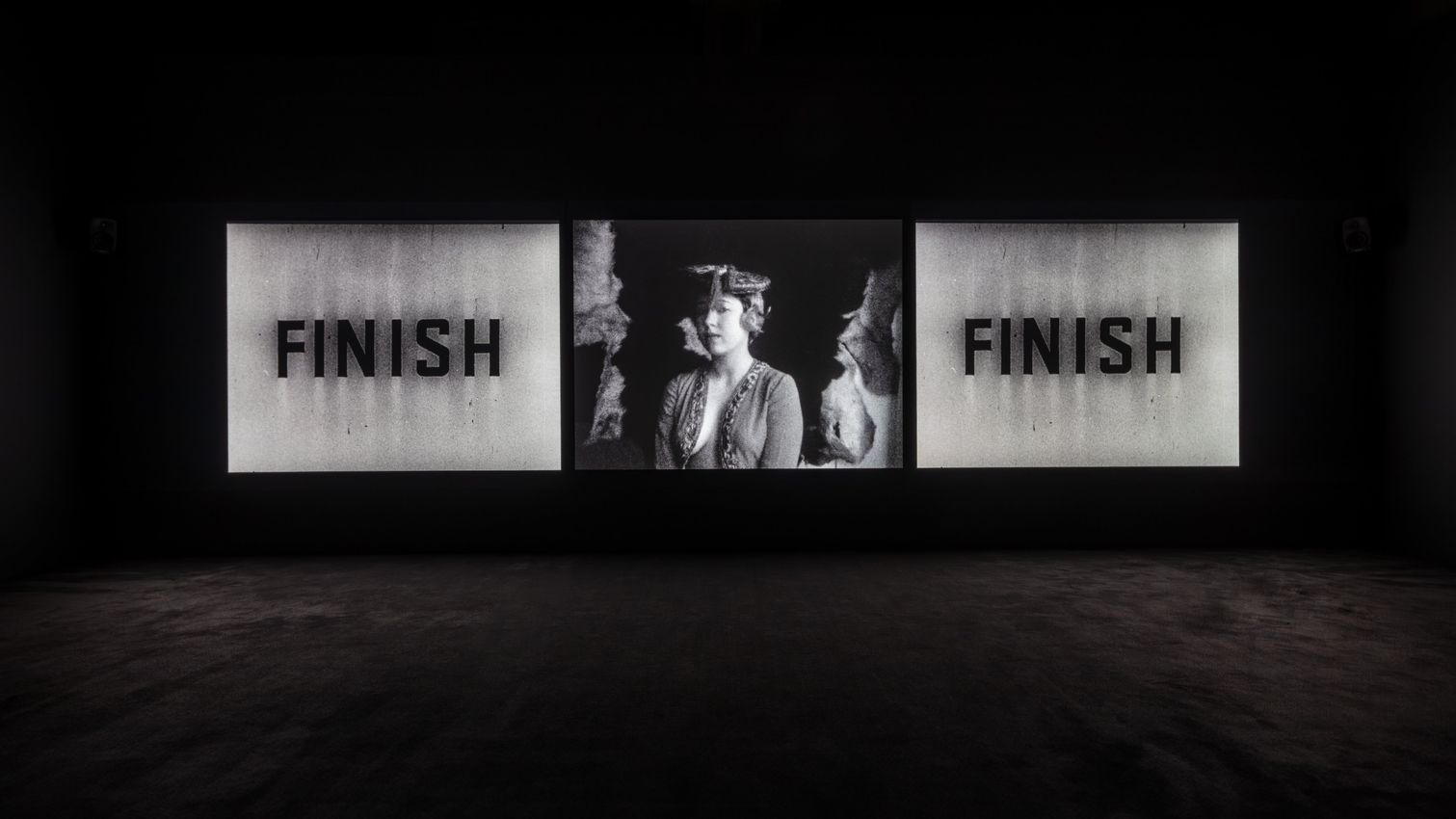
Thomas Dane Gallery is pleased to announce the first UK exhibition of Bruce Conner’s THREE SCREEN RAY (2006), following on from the Gallery’s presentations of THE WHITE ROSE in 2022, BREAKAWAY in 2019–2020, A MOVIE in 2017 and CROSSROADS in 2015.
Before music videos and rapid-fire editing pervaded popular culture, Conner pioneered techniques of vertical montage and subliminal messaging with his 16mm film, COSMIC RAY (1961). While Conner first gained attention for his film work with found footage, COSMIC RAY incorporated both found material and footage he shot himself after he relocated to San Francisco, including shots of the Bay Area artist Beth Pewther (1938–2024) dancing, the painter Joan Brown (1938–1990) in costume, and a fireworks display. Conner then meticulously spliced together this collection of varied imagery to a live recording of Ray Charles’ hit rhythm and blues song, What’d I Say (1959), creating an explosive homage to the blind musician. The work’s pioneering approach to moving image and montage, with its frenzied visual pace rhythmically doubling and amplifying the exuberant soundtrack, would later influence the first generation of music videos being produced for MTV in the 1980s.
Four years after the completion of COSMIC RAY, for the artist’s first solo museum exhibition, held at the Rose Art Museum in Massachusetts in 1965, Conner reformatted the piece from a single projection to a silent, three-screen installation using three unsynchronised 8mm films of different lengths, opening up the possibility for constant reconfiguration. Decades later Conner revisited this concept of mutability, which first led to the silent three-channel installation, EVE-RAY-FOREVER (1965/2006), and then the final iteration – set once again to Charles’ song – THREE SCREEN RAY. Conner’s repeated re-editing and reformatting of existing work mirrored the constant fragmentation and reconfiguration of imagery in his approach to found footage and montage, in which material is continually broken up, spliced and reactivated, in a kind of metaphor for the operations of memory and creativity.
THREE SCREEN RAY (2006) replaces its predecessors with three newly edited films projected side-by-side. Notably, this iteration was created digitally and represents a number of existing works that Conner revisited and reconstructed from film to digital format during this late period, including HIS EYE IS ON THE SPARROW (2006) and EASTER MORNING (2008), in collaboration with editor Michelle Silva. This process presented an opportunity to explore editing options opened up by digital technology, as well as to experiment on his own oeuvre as a veritable readymade archive, in a subversive nod to his reputation as a pioneer in found footage.
THREE SCREEN RAY realises the visual equivalent of a cinematic slot machine: images meet, diverge and meet again, continuous yet non-linear. The quick-cut mash-up of imagery of war, commercials, and the female body reveals a common sexual subtext among disparate images that probes the drives underlying consumerism and martial aggression. In an earlier interview in 1974, Conner remarked that the visual elements of the work were, at their essence, pulling at the constant tension between ‘the creative process’ and ‘destructive forces’.
Created toward the end of the artist’s life, THREE SCREEN RAY is a summation of Conner’s decades-long experimentation with moving image both conceptually and technically, in steadfast dedication to, as MoMA curator Stuart Comer put it, ‘interrogating the conventions and possibilities of cinema in all its mutability’.1 Conner’s work found technically audacious and wholly unique means to connect the impulses of the individual and society, in a magisterial confluence of idiosyncratic lived experience and the collective psyche.
Bruce Conner (b. 1933 McPherson, KS, d. San Francisco, CA, 2008) was one of the foremost American artists of the twentieth century, whose transformative work touched on themes of post-war American society, from a rising consumer culture to the dread of nuclear apocalypse. Working in a range of mediums, Conner created hybrids of painting and sculpture, film and performance, drawing and printing, including works on paper utilising drawing and collage. Conner came to San Francisco on the wave of the Beat Generation of the late 1950s, becoming an active member of the music scene during the late 1960s. In San Francisco, Conner became a singular practitioner within the underground film community and the flourishing San Francisco art world, achieving international status early in his career. Conner received his BFA from Nebraska University before studying at the Brooklyn Museum Art School and the University of Colorado.
Recent solo exhibitions include: Bruce Conner: Light Out Of Darkness, Museum Tinguely, Basel (2021); Please Enjoy and Return: Bruce Conner Films from the Sixties, University of New Mexico Art Museum, Albuquerque NM (2018); Bruce Conner: Untitled Prints, Henry Art Gallery, Seattle WA (2018); Forever and Ever, Speed Art Museum, Louisville KT (2017); A MOVIE, Thomas Dane Gallery, London, England (2017); Bruce Conner: It’s All True, Museum of Modern Art, New York NY; travelled to: San Francisco Museum of Modern Art, San Francisco CA, Museo Nacional Centro de Arte Reina Sofía, Madrid, Spain (2016/17), among many others.
Selected public collections include: Art Institute of Chicago, Chicago IL; National Gallery of Art, Washington DC; Los Angeles County Museum of Art, Los Angeles CA; Museum of Modern Art, New York NY; San Francisco Museum of Modern Art, San Francisco CA; Walker Art Center, Minneapolis MN; The Metropolitan Museum of Art, New York NY; Glenstone Museum, Potomac MD.
Bruce Conner was an experimental filmmaker, sculptor, drawer, and collagist whose practice explored different facets of American modernism, from nuclear warfare to consumer culture. He received his BA from the University of Nebraska in 1955 before studying at the Brooklyn Museum Art School for six months on a Max Beckmann Memorial Scholarship. He then transferred to the University of Colorado Boulder, but eventually dropped out and relocated to San Francisco, where he formed the Rat Bastard Protective Association in the late 1950s.

Thomas Dane Gallery was established in 2004 and currently exists in two London gallery spaces at 3 and 11 Duke Street St. James’s, with a third space in Naples on Via Francesco Crispi which opened in 2018. A feature of the gallery is its commitment to the moving image, supporting the production and exhibition of works by Steve McQueen, John Gerrard, Akram Zaatari, Paul Pfeiffer and Bruce Conner.

A respected voice in contemporary art discourse.
Focusing on ambitious storytelling and insightful art-world commentary. Ocula Magazine publishes in-depth interviews, critical essays and timely analysis on the artists, exhibitions and ideas driving the global art world.
Learn more about Ocula Magazine
Showcasing the best of the art world.
Ocula partners with galleries from around the world to highlight their artists, artworks and exhibitions. Gallery membership is by application and invitation, with each member vetted by an independent panel.
Learn more about Ocula Membership

Specialises in the sale of major artworks.
Led by a team with deep ties to the world’s leading auction houses, galleries and collectors. Ocula’s advisory team offers bespoke services to high-net-worth clients from around the world who are looking to acquire the best of contemporary and modern art.
Learn more about our team and services