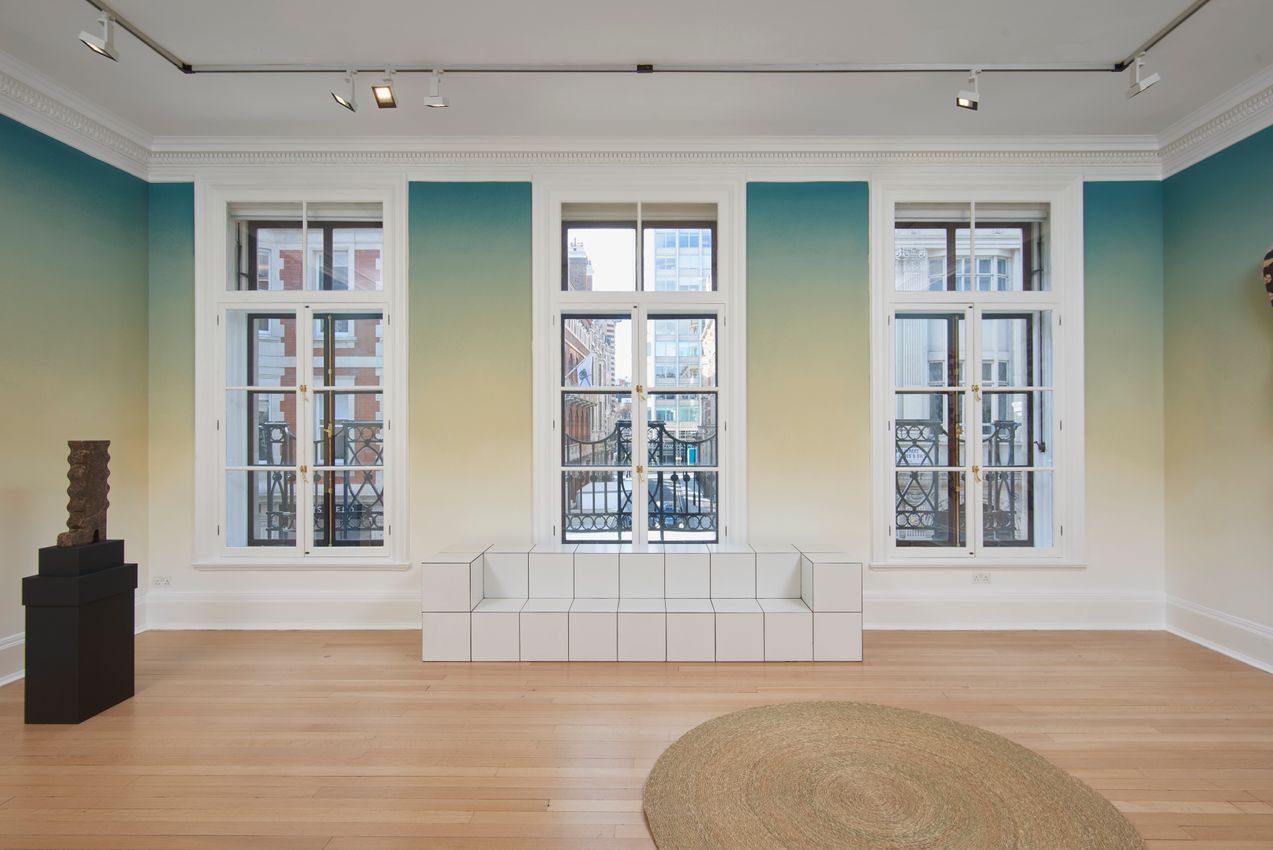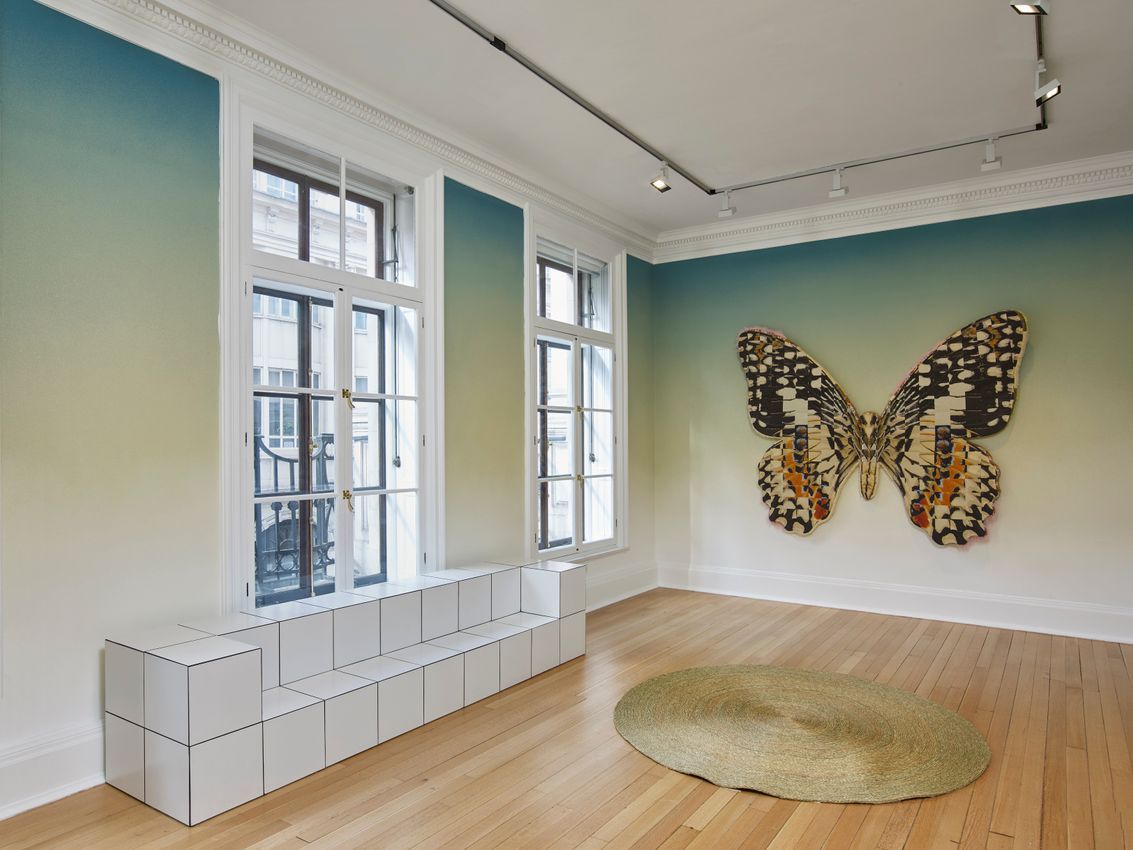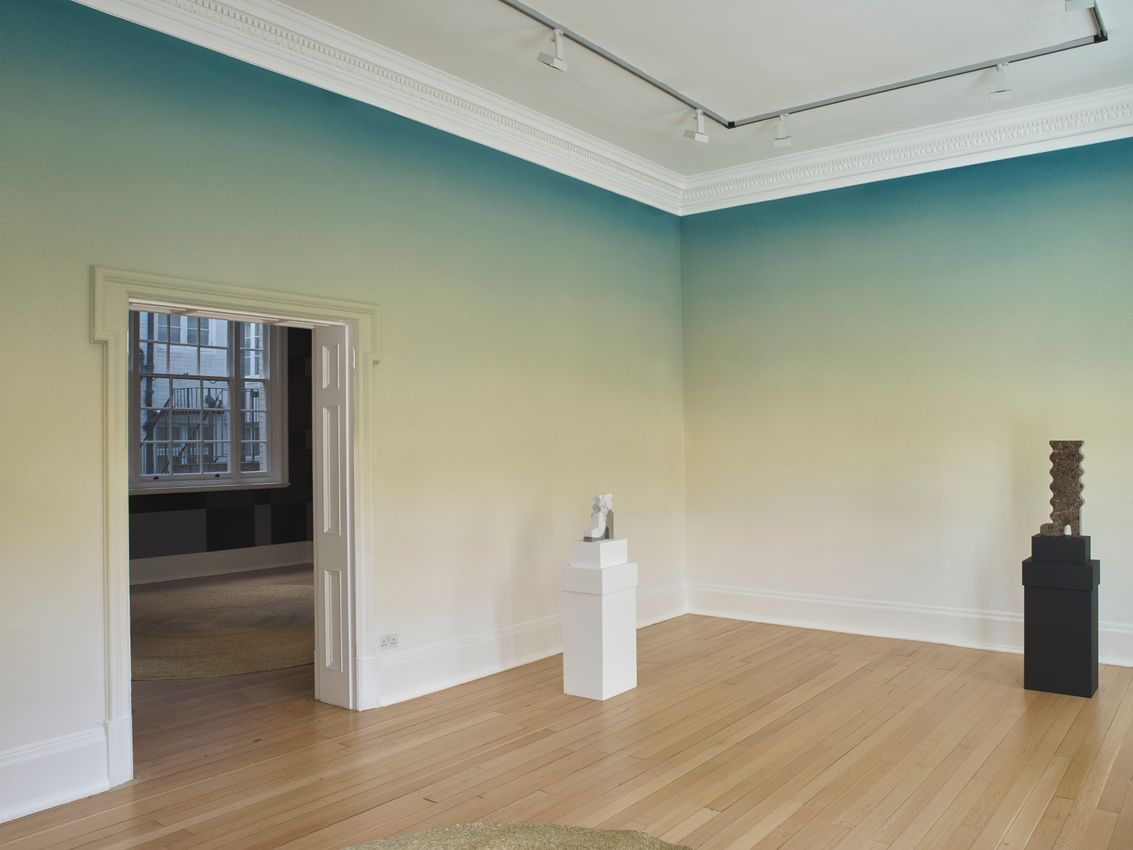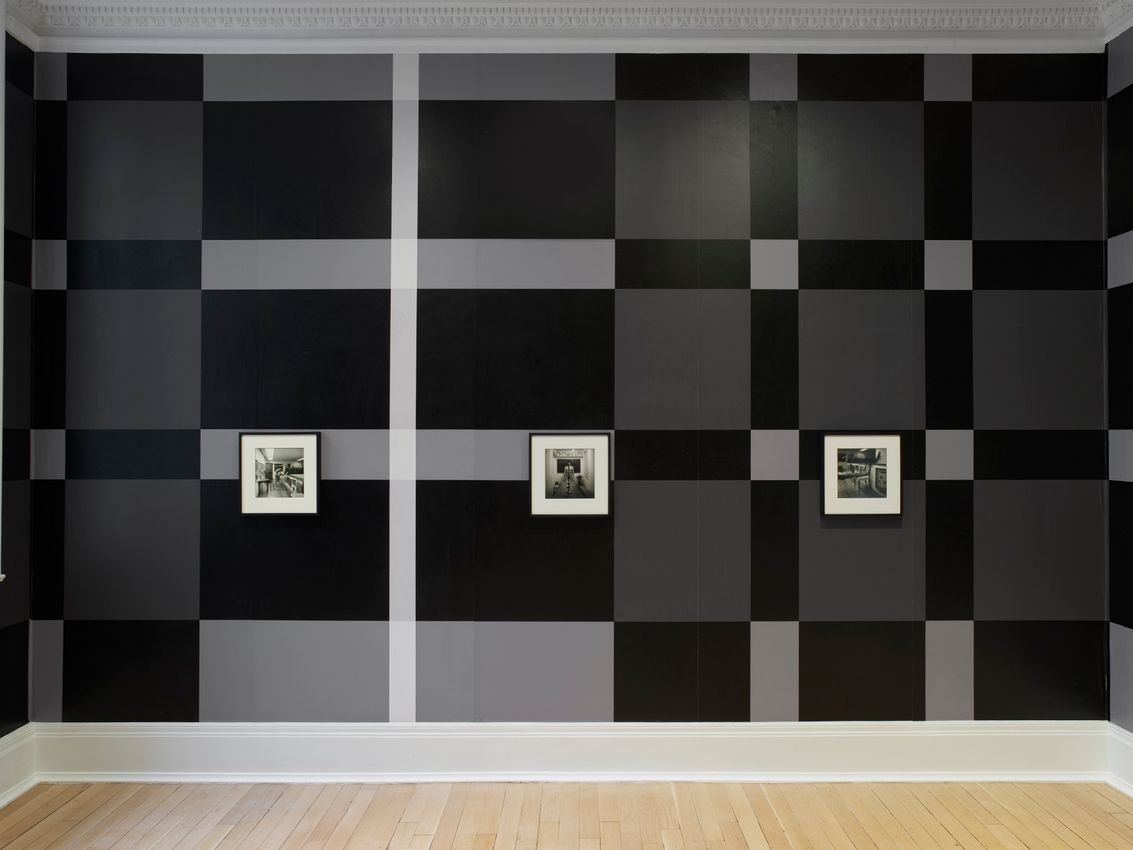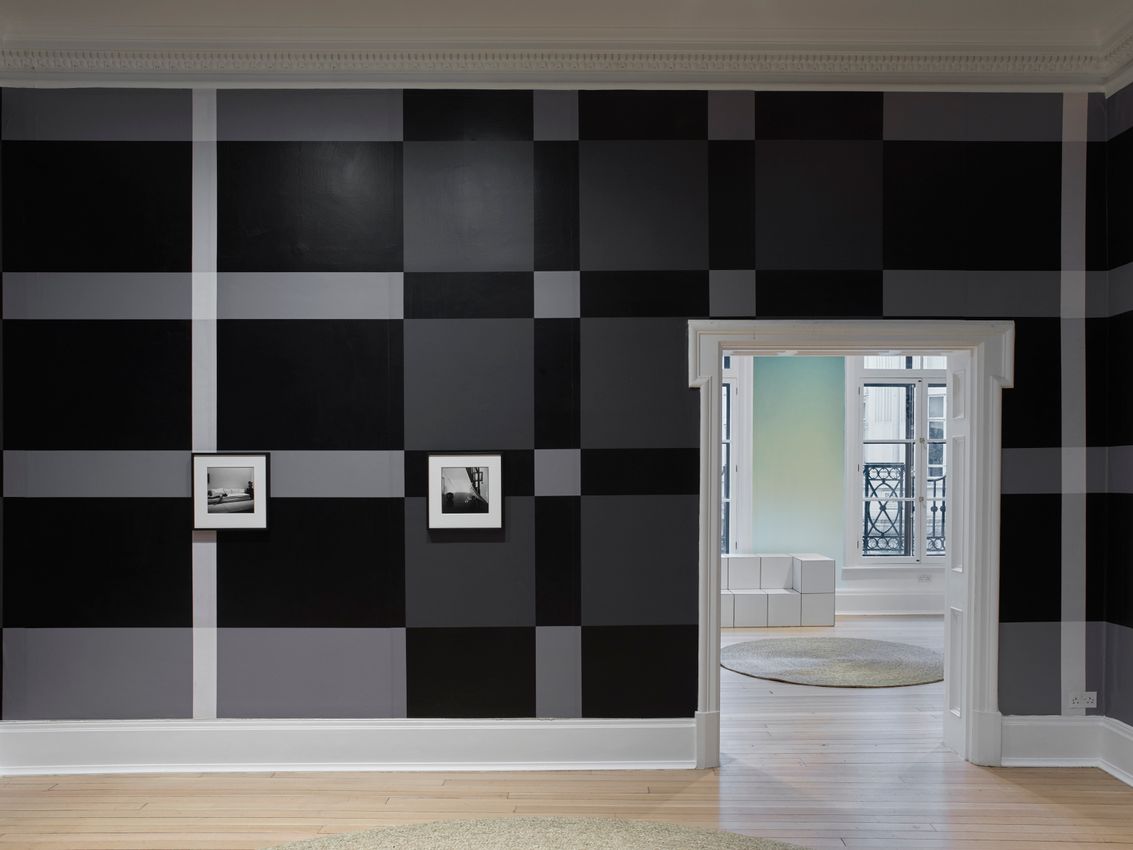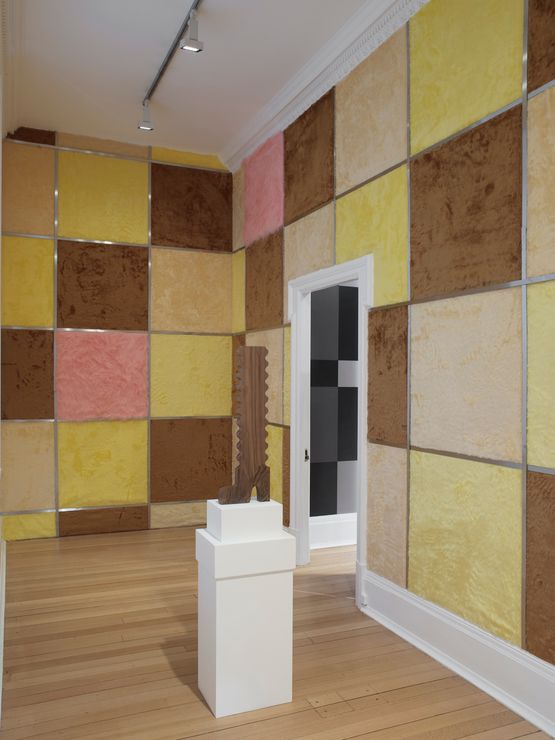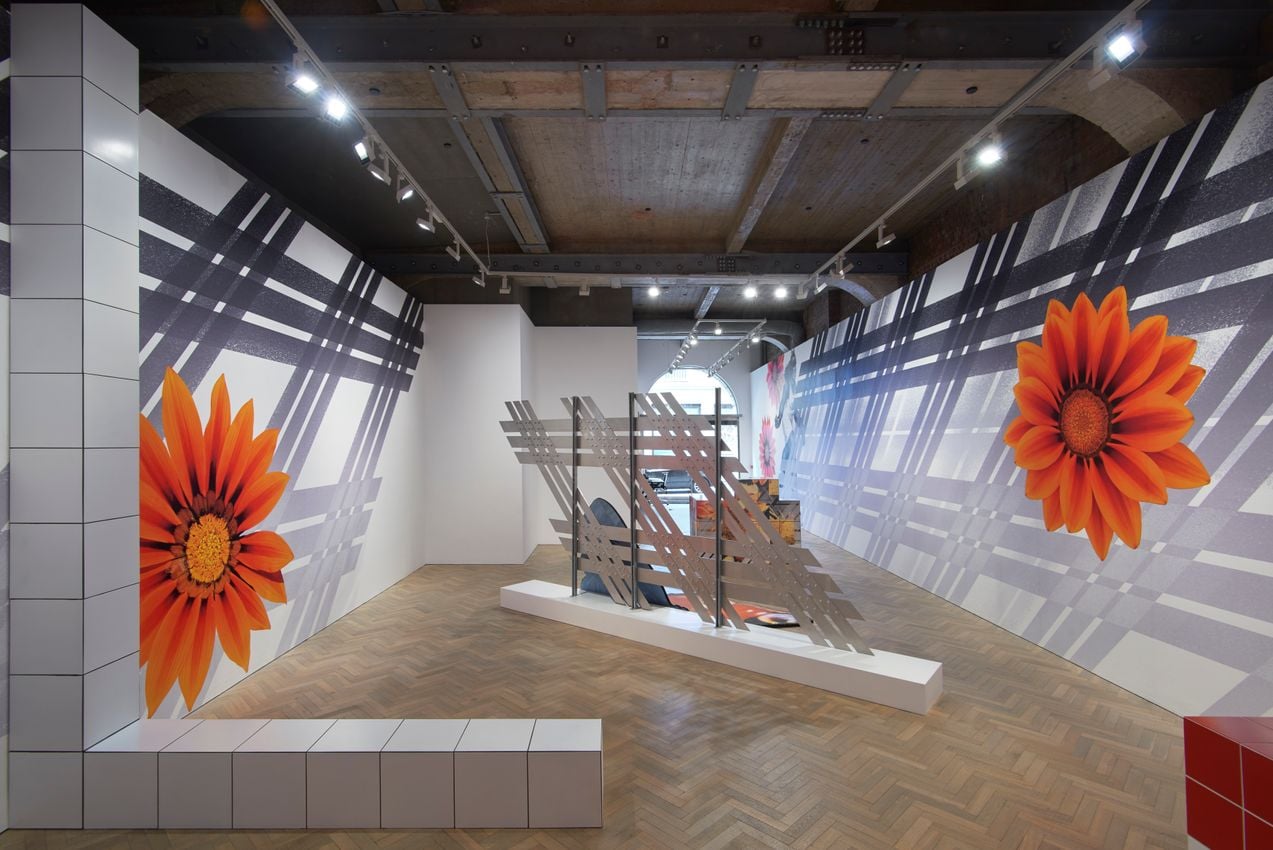
The arrangement of objects, sculpture, and images into immersive installation has become a constant for Anthea Hamilton, whose work frequently mines heterogeneous image sources. This includes The Prude, her first exhibition at both London locations of Thomas Dane Gallery.
For the prude, modesty becomes extreme. The prude will not permit themselves, or others, sensuous enjoyment in life. Hamilton’s interest in the literary figure of ‘the prude’ in part, references Cecil Vyse—the aloof character of E.M Forster’s A Room with a View (1908). Perceiving himself a sensitive intellectual, Vyse in reality, remains detached from lived experience. This obstinate self-awareness is matched by a cultivated, exaggerated style. This skewed mode of being, the prude-as-persona, serves a framework for the exhibition, where the prude is put to use as a proxy for Hamilton, who performs a ‘hands off’ physicality.
The balance of materiality and economy is consistent with Hamilton’s practice, where tactile surfaces are often conceived through digital production. Suggestive of previous exhibitions and series, The Prude is largely a continuation of Hamilton’s The New Life at Secession, Vienna (2018). Four distinct interiors emphasise the confluence of domestic and gallery space through a number of wall treatments: airbrushed, textile clad and digitally printed wallpapers.
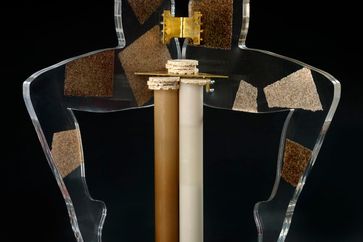
The Prude also challenges relationships of scale and content, with large soft sculptures of moths and butterflies, and extravagant stone, marble, and walnut wavy boots. The effect is less an analysis of artifice, more a consideration of the way objects and images may influence meaning when treated to different processes of realisation.
Though Hamilton’s use of material may appear mercurial, her approach to form remains acute. Hamilton’s interest in the reducibility and expansion of spaces—in meaning, and as objects—harmonises visual material to a level plane. Here, bodies of research co-exist in a manner that questions the remit of research itself. The recurrence of familiar forms composes this reflexivity: both the work and Hamilton’s original interests are situated under renewed scrutiny. Here, the works behave twofold: they are objects as receivers of ideas, while appearing to emit ideas themselves.
Hamilton’s work holds an internal logic based on the cultural connections of things: the implicit subtext of an idea, the lineage and physical sensibilities of images, or the curiosity and adaptability of an object’s ontology. Tracing the shifting usages and sensitivities of an image, Hamilton brings the frequencies of authenticity and artifice into plain relief—their competing status collapsing. Multiple images or materials may extrapolate from one nucleus: a moth species, an Ed Ruscha gradient, a Robert Crumb figure, a Hamilton tartan swatch. The fundamental economy of Hamilton’s choice however, allows the obvious to be both simple and complex; the permutations are high, though the ‘origin’ is concentrated and transformational.
Anthea Hamilton was born in London in 1978, where she lives and works. She was one of four shortlisted artists for the 2016 Turner Prize. Recent solo exhibitions include: The New Life, Secession, Vienna, Austria (2018); The Squash, Tate Britain, London (2018); Anthea Hamilton Reimagines Kettle’s Yard, Hepworth Wakefield, Wakefield, (2017); Lichen! Libido! Chastity!, SculptureCenter, Long Island City, New York (2015); Kabuki, The Tanks, Tate Modern, London (2012); Sorry I’m Late, Firstsite, Colchester (2012); Les Modules, Foundation Pierre Berge - Yves Saint Laurent, Palais de Tokyo, Paris, France (2012). Her work has been presented as part of the British Art Show 8 and in numerous international venues including: the Schinkel Pavilion, Berlin (with Nicholas Byrne), the 13th Lyon Biennale, and the 10th Gwangju Biennale.
Working across sculpture, installation, photography, video, and performance, contemporary artist Anthea Hamilton fuses images and materials in unexpected and playful ways, and employs the theatrical, comic, and monumental to create works that have a popular-culture or Surrealist look. Her artwork is often set in amusing scenes that are intended to engage the viewer with their combination of elements of design, fashion, nature, and oversized representation.

Thomas Dane Gallery was established in 2004 and currently exists in two London gallery spaces at 3 and 11 Duke Street St. James’s, with a third space in Naples on Via Francesco Crispi which opened in 2018. A feature of the gallery is its commitment to the moving image, supporting the production and exhibition of works by Steve McQueen, John Gerrard, Akram Zaatari, Paul Pfeiffer and Bruce Conner.

A respected voice in contemporary art discourse.
Focusing on ambitious storytelling and insightful art-world commentary. Ocula Magazine publishes in-depth interviews, critical essays and timely analysis on the artists, exhibitions and ideas driving the global art world.
Learn more about Ocula Magazine
Showcasing the best of the art world.
Ocula partners with galleries from around the world to highlight their artists, artworks and exhibitions. Gallery membership is by application and invitation, with each member vetted by an independent panel.
Learn more about Ocula Membership

Specialises in the sale of major artworks.
Led by a team with deep ties to the world’s leading auction houses, galleries and collectors. Ocula’s advisory team offers bespoke services to high-net-worth clients from around the world who are looking to acquire the best of contemporary and modern art.
Learn more about our team and services