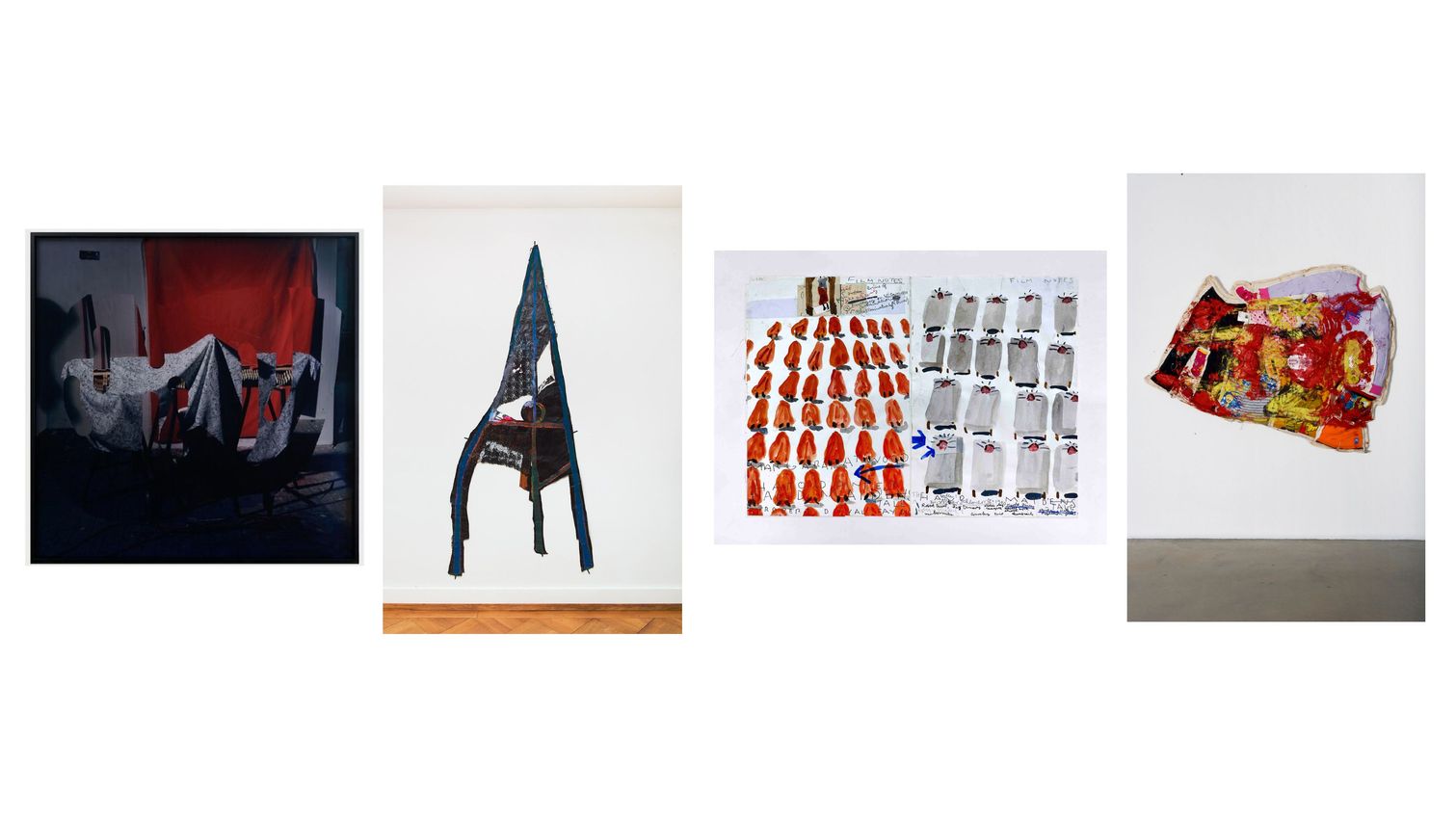

Thomas Erben Gallery is pleased to announce Garden Coup, a solo exhibition by Bahar Behbahani, an Iranian artist living and working in New York. The exhibition comprises paintings and an installation structured around the conflictedfigure of Donald Wilber. Wilber is marked by duality: his writings on Persian gardens distinguish him as a well-respected Middle Eastern architectural scholar, one whose research the artist studied in college.However, Wilber was also a CIA secret agent, responsible for orchestrating the 1953 military coup in Iran.
In August 1953, to prevent the nationalisation of the Iranian oil industry, and to increase the power of their ally the Shah, the British and United Statesgovernments instigated a rebellion to oust the democratically elected Prime Minister Mohammad Mosaddegh. In 2013, the United States government declassified a report of the coup written by Donald Wilber. The document, strewn with black bars redacting its content, regards Wilber’s involvement in planning the coup for the CIA. However, Wilber’s autobiography published in 1986 had already implicated the CIA in the coup, even after being ‘sanitised’ for publication by the CIA’s editors. The question of why the CIA allowed their involvement to be publicly disclosed at this earlier date was a subject of inquiry for Dr. Shiva Balaghi–a scholar, writer, and curator focused on the Middle East, whose research on Wilber has been influential for the artist. Balaghi argues that by only releasing narratives from the perspective of Wilber, both in the autobiography and in the later report, the CIA ’[acknowledges its] involvement in the overthrow of the Iranian government while not allowing the factual history of the event to be written.’
For Garden Coup, Behbahani installs a broad table within the gallery, upon which pages of the report are stacked andonly partly revealed. Some are hidden beneath watermarked papers, others have been covered in drawings. One stack is topped by a plate of zinc, another by an architectural etching. At the centre of the table isa reproduction of the cover of The Persian Garden, an exhibition organised by Wilber in 1940 for the Iranian Institute in New York. Behbahani’s interests in duality and duplicity become clear through her research process, by which she investigates the interlinked aspects of Wilber’s interest in Persian gardens and his role as the architect of the coup. Persian gardens, after all, exist within an arid environment where water is scarce, making the richness of their greeneryand fountains all the more impressive. These gardens, like the installation itself, are centered around process. While aesthetic objects themselves, the gardens also privilege experience, being able tosit and contemplate, listen to water, and hear nightingales.
The exhibition also contains a suite of paintings that contain finely articulated motifs, drawing from site plans of gardens, floral paintingsof 19th century illuminated books, the ritual geometry of architecturalpatterns, and inscrutable characters. Behbahani plays off the idea of secrecy in her paintings, combining her imagery with washes of colour that simultaneously illuminate the field of the painting and obscure what is contained beneath. She transposes the redaction bars from pages of the Wilber report onto her own works, suppressing information about the paintings. The beauty, detail, and labor of the work is permeated with secret codes and poetic withholding. Behbahani plays with coding and decoding this repressed history, making visual poetry out of its redactions.
Multimedia artist Bahar Behbahani (b. 1973, Tehran, Iran) lives and works in New York City. Since 2000, her work has been featured internationally in institutions and biennials including the Biennial of Contemporary Painting of the Islamic World (2002) and The Painting Biennial (2004), both Tehran Museum of Contemporary Art, Iran; National Museum of Women in the Arts, Washington D.C. (2007); Tribeca Film Festival, New York (2008, Official Selection); Queens Museum of Art, NY (2010); Sharjah Biennial, UAE, and MACRO Museum of Contemporary Art, Rome (both 2011); Biennale of Sydney, Australia (2012); and the Honolulu Biennial, Hawaii (2014, Prologue Exhibition). Solo exhibitions include such venues as the Eli and Edythe Broad Art Museum, East Lansing, MI; Etemad Gallery, Tehran, Iran, and New York University Abu Dhabi. Behbahani’s work was first shown in the gallery in 2011 as part of Iran Via Video Current.


Established in 1996, Thomas Erben Gallery focuses on rediscovering and introducing artworks that expand or deviate from the media usually associated with an artist.

A respected voice in contemporary art discourse.
Focusing on ambitious storytelling and insightful art-world commentary. Ocula Magazine publishes in-depth interviews, critical essays and timely analysis on the artists, exhibitions and ideas driving the global art world.
Learn more about Ocula Magazine
Showcasing the best of the art world.
Ocula partners with galleries from around the world to highlight their artists, artworks and exhibitions. Gallery membership is by application and invitation, with each member vetted by an independent panel.
Learn more about Ocula Membership

Specialises in the sale of major artworks.
Led by a team with deep ties to the world’s leading auction houses, galleries and collectors. Ocula’s advisory team offers bespoke services to high-net-worth clients from around the world who are looking to acquire the best of contemporary and modern art.
Learn more about our team and services