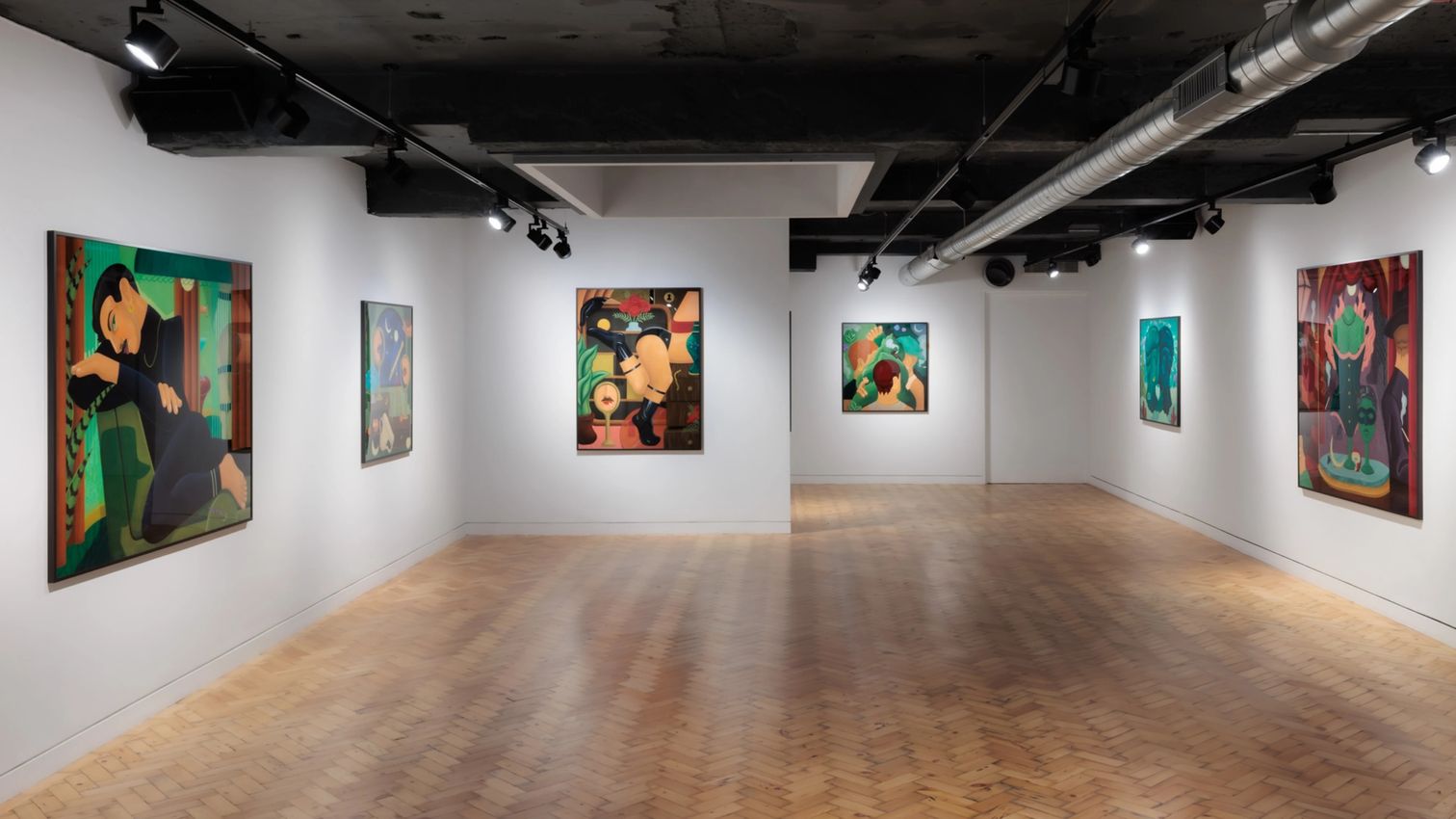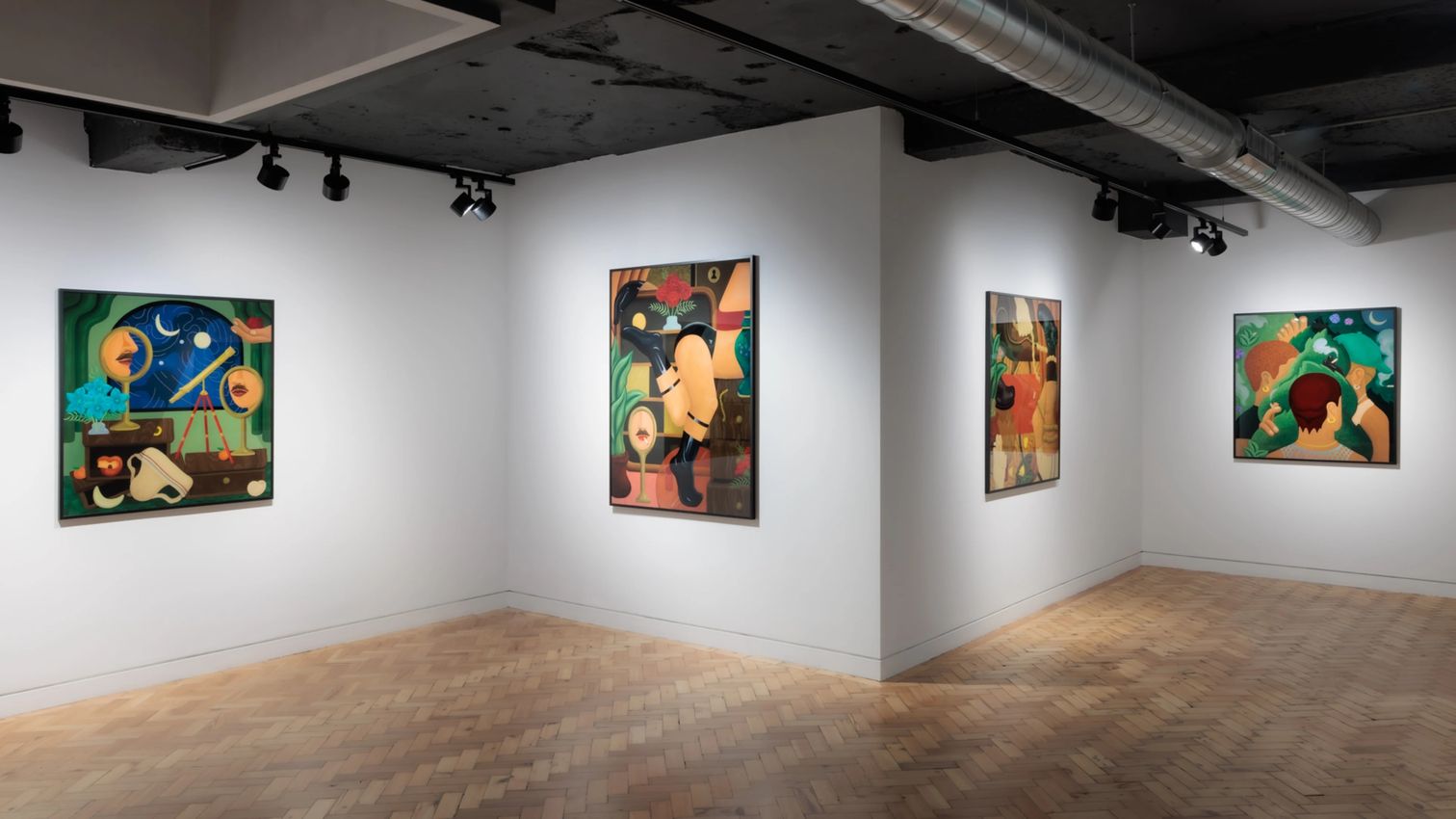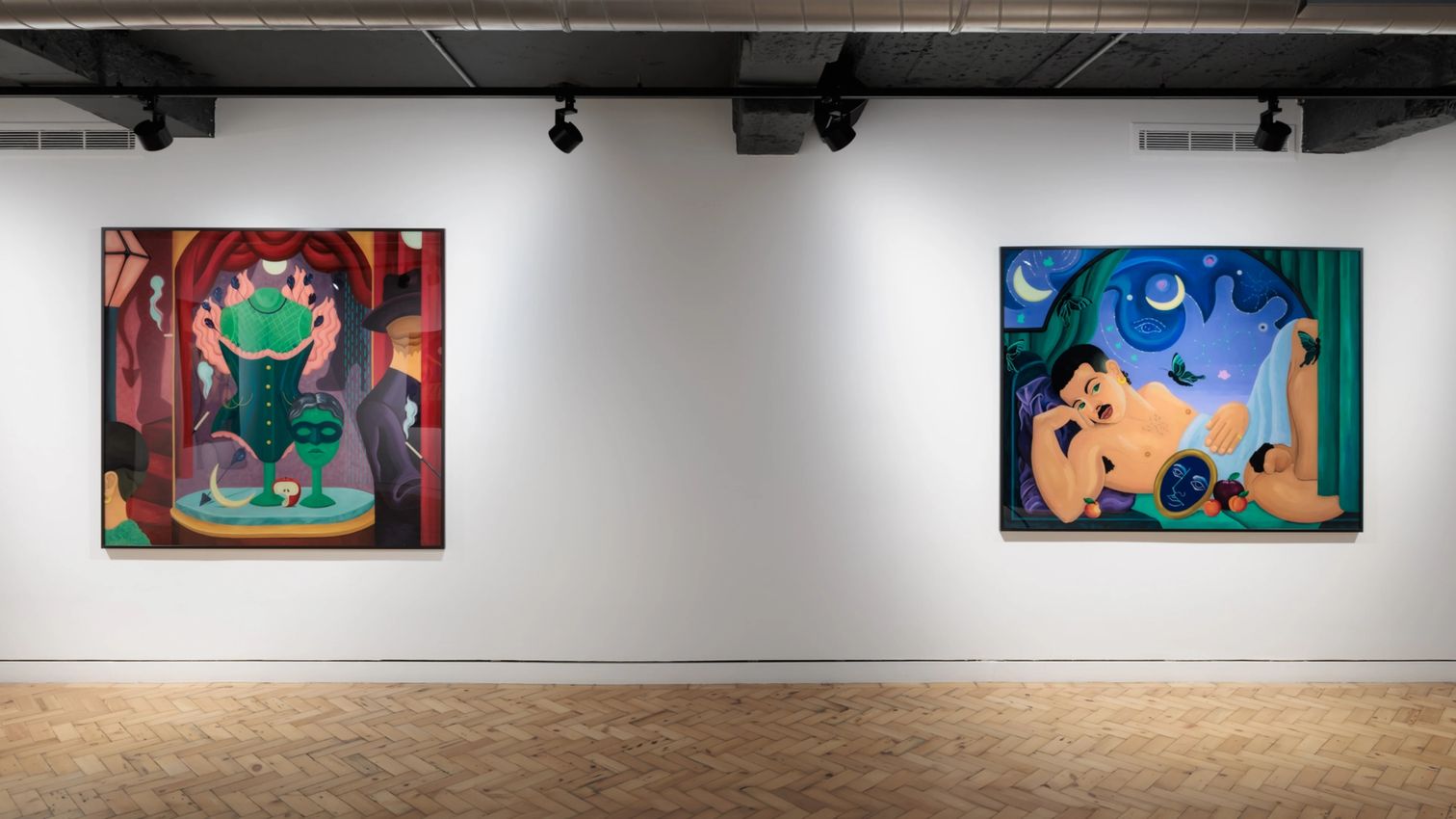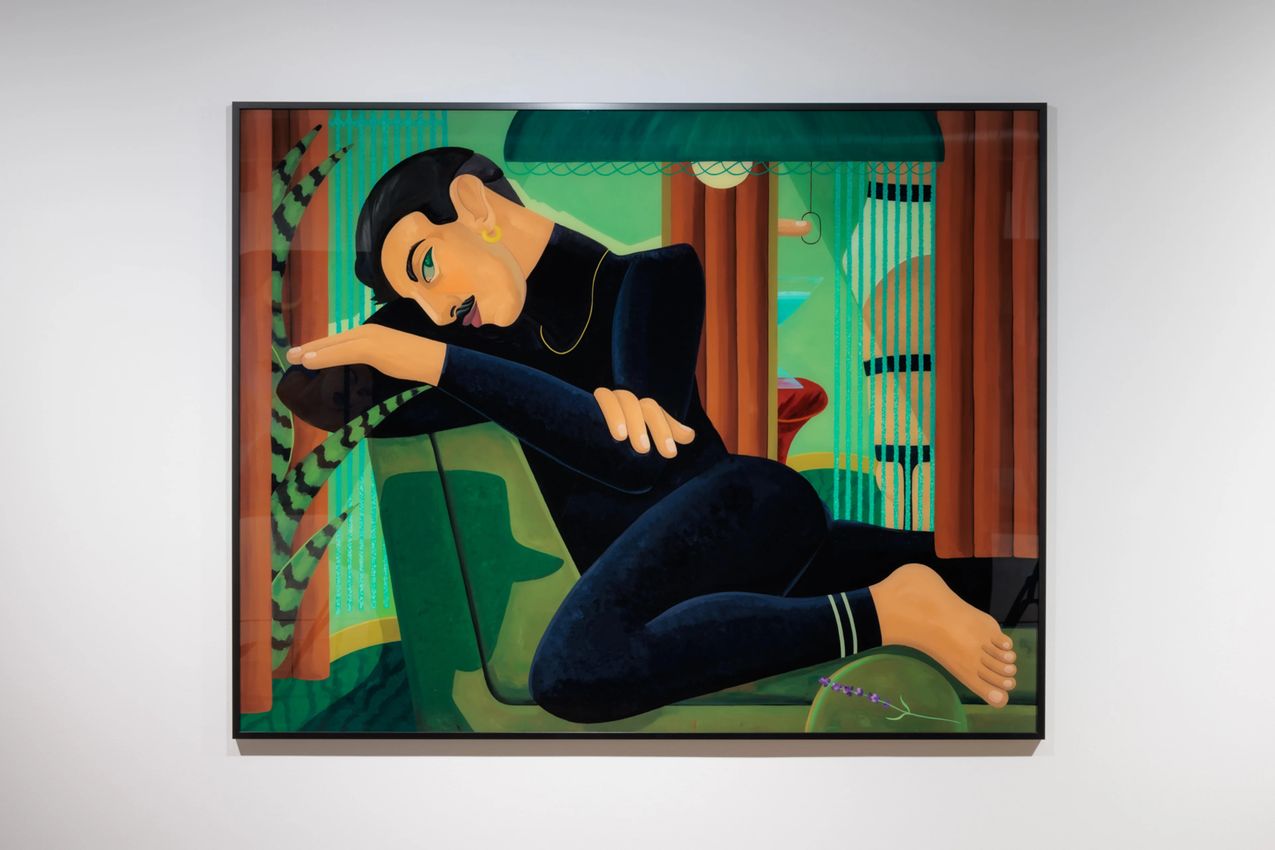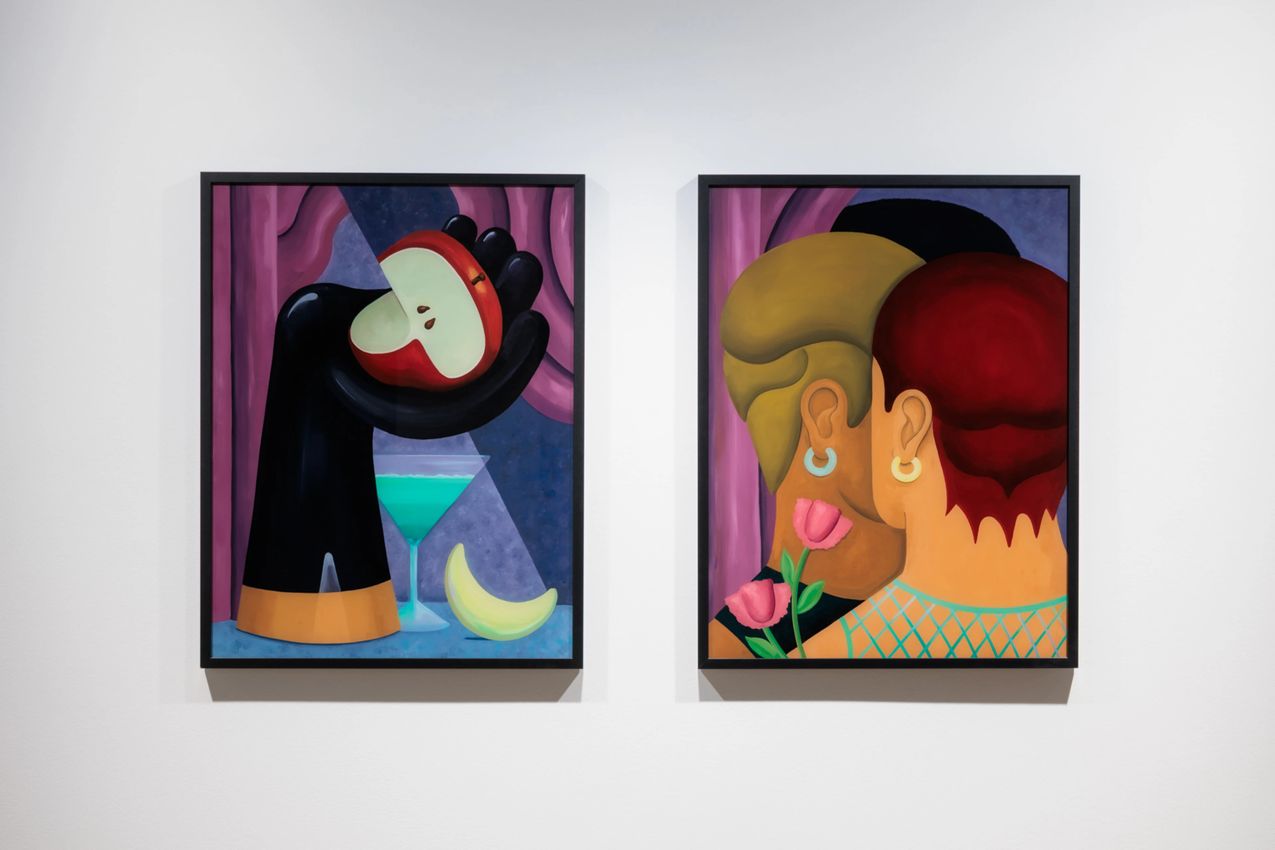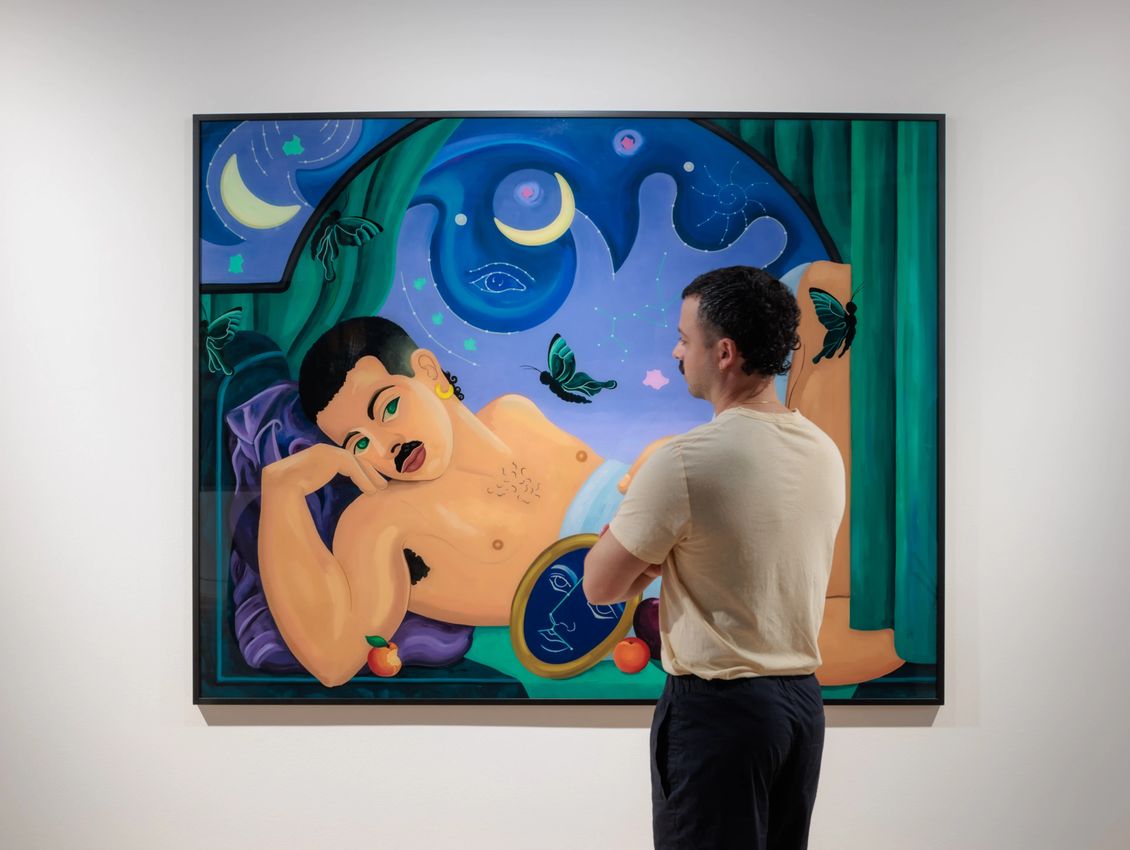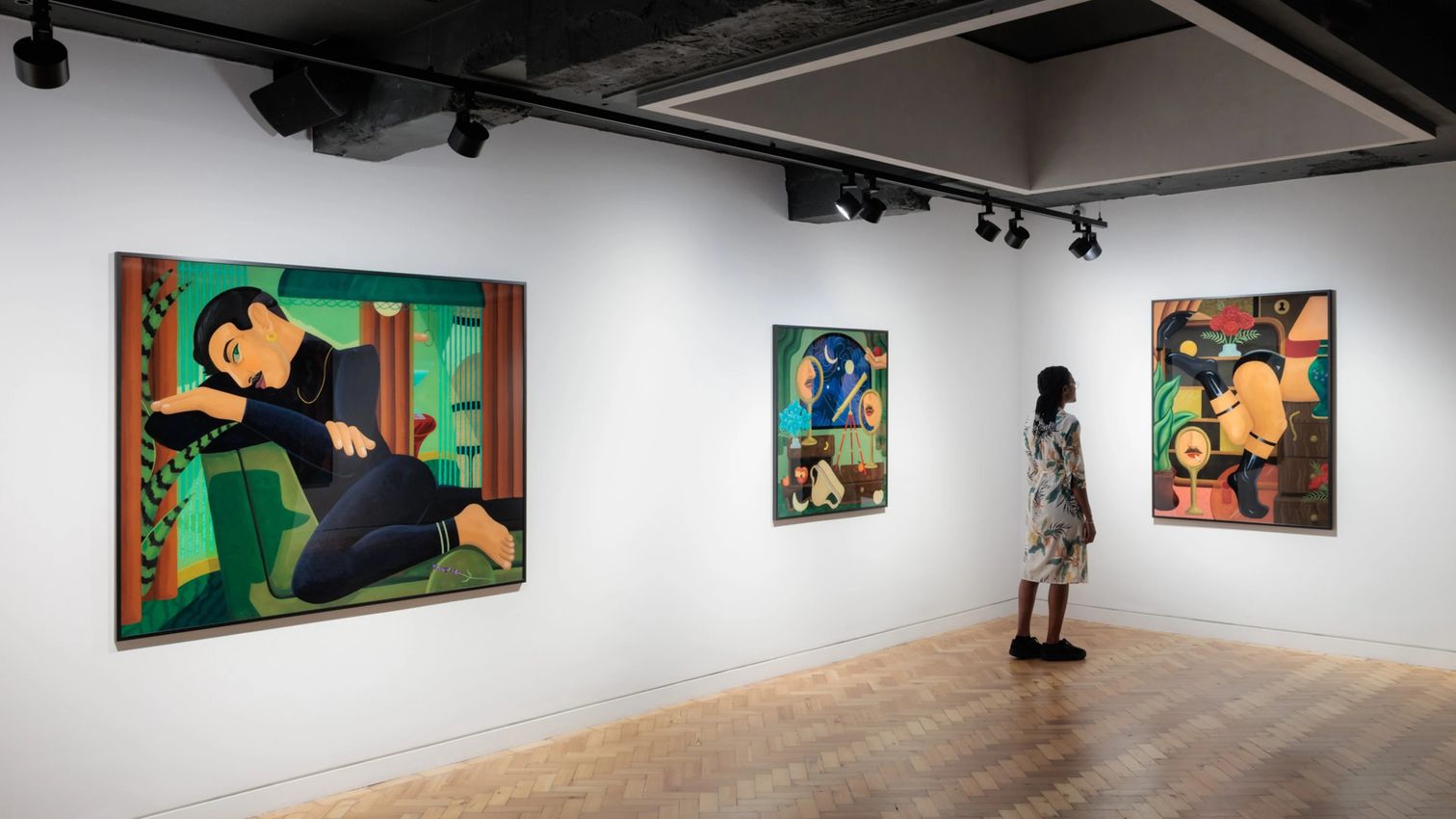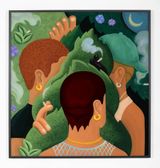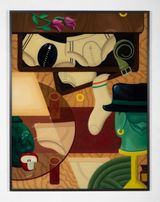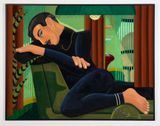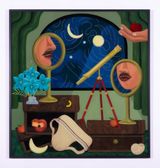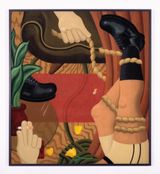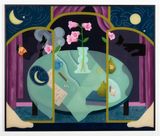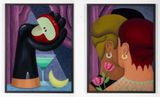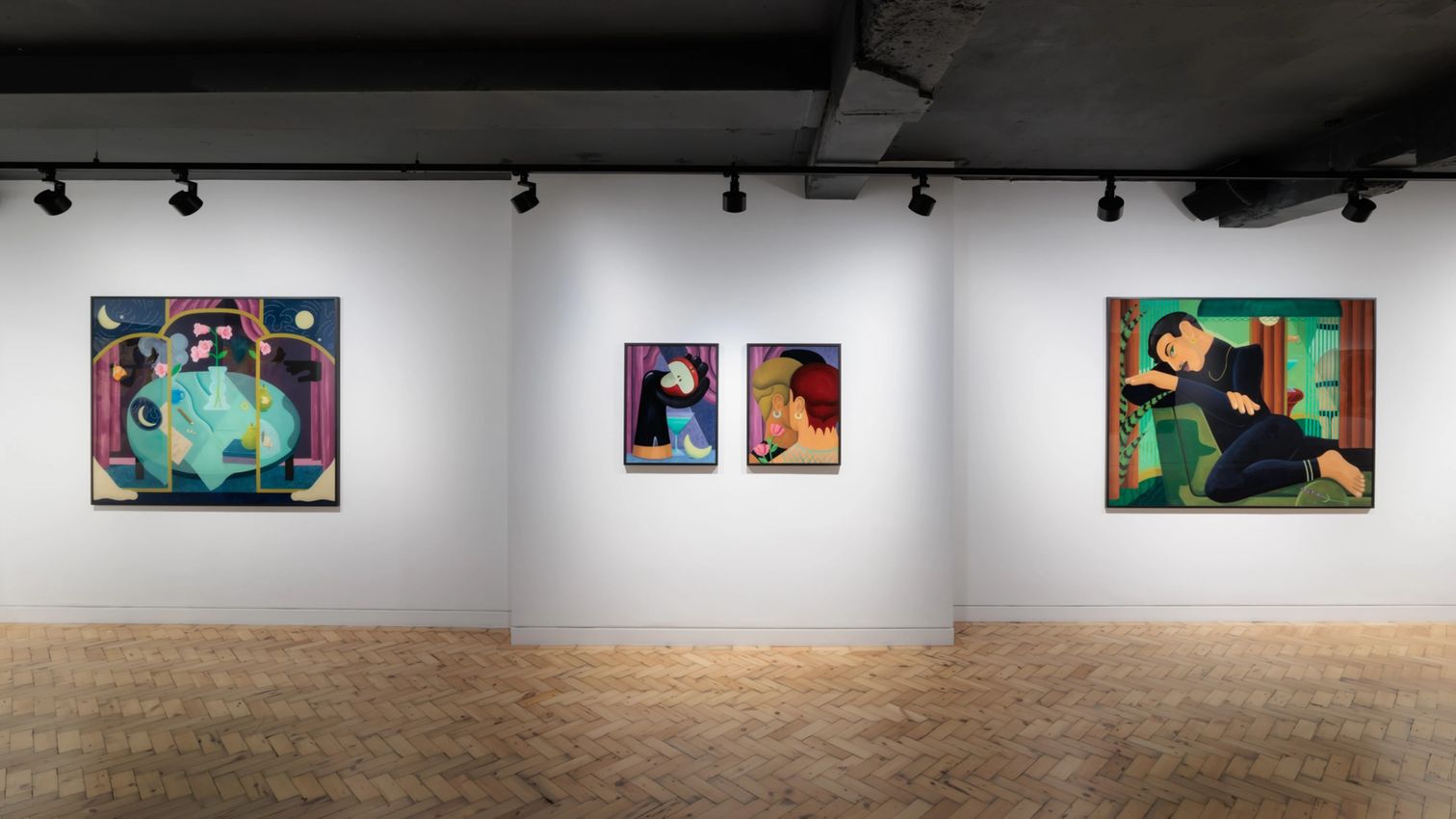
Gori Mora’s first solo exhibition with Unit opens a window into a world of queer identity, intimacy and belonging. Burning Desires overlaps cosy interiors and outdoor scenes to build “safe spaces” populated with the artist’s coded language of motifs including bitten apples, body parts, constellations, the Moon, and many objective indications of nightlife.
The majority of Mora’s works are set at nighttime to explore moments of romantic entanglement and mystique, whilst also referencing the nocturnal spaces that have long functioned as sanctuaries for queer people. Inspired by artists such as Leonora Carrington and Philip Guston, his surreal compositions invoke a sense of curiosity and introspection in the viewer.
The artist has developed the unique painting technique of using oil on perspex. Painting directly onto the transparent screens means he must carefully build his compositions in reverse, as his first brushstroke will also be the first seen by the viewer. Not only does the perspex provide a distinctive diffusion of light onto the surface of the artwork, it also envelops the work with an in-built protective cover, mirroring the sense of security that Mora intentionally explores.
Mora’s primary motivation is in helping an audience to better understand queer experiences of intimacy. For him, misunderstanding leads to fear, which ultimately lies at the core of inequality and injustice. Drawing inspiration from the secret meetings and assignations in both Carrington and Guston’s work, Mora applies a similar lens to the injustices faced by members of the queer community. The mysterious atmosphere of nighttime offers refuge for those who do not conform to societal norms and Mora imagines his figures plotting against the restrictive attitudes of patriarchal society or constructing spaces where they can be themselves.
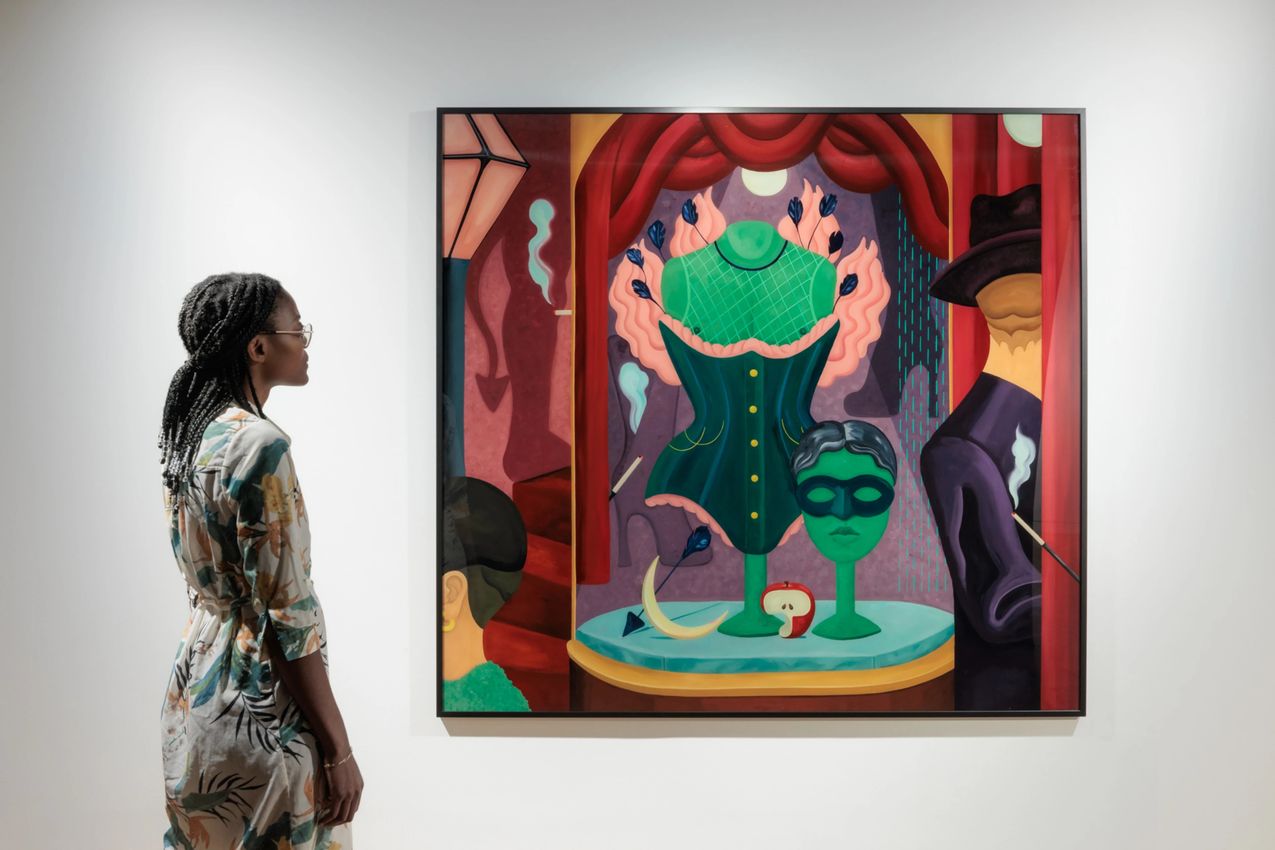
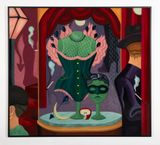
In one painting, entitled Inferno Boulevard, red velvet curtains and a glowing lamp post situate the work at a nighttime cabaret, where a shadowy devil-like figure with a pointed tail appears to the left of the scene. Reinforced by the half-eaten apple that references biblical notions of original sin, Mora reflects on ideas of desire and temptation. He wryly refers to Eve as the first non-conformist who was forever punished by the patriarchy. The artist correspondingly invokes holiness and transcendence in framing a corset-wearing mannequin with pink angelic wings. In its play between angels and demons, Inferno Boulevard encapsulates Mora’s project as a whole, considering the ways in which the sinful and the divine can exist on the same plane.
Mora’s fragmented compositions are built up from an instantly recognisable visual vocabulary of motifs, investigating how queer people have to specifically construct their environments in order to explore their identities in safety. These motifs include figures often seen only via individual body parts, or turned away from the viewer entirely – Mora has a particular fascination with the backs of heads, depicting the back of his own head several times throughout the series as an unconventional self-portrait – as well as objects including white underwear, gold earrings, socks, mirrors, flowers and fruit all floating across the picture plane. For him, these objects have intimate connotations able to take on multiple meanings depending on the viewer. He is influenced by Guston’s idea of an “alphabet”, in which even simple shapes and objects can convey meaning, sometimes becoming protagonists in their own right or stand-ins for the human form.
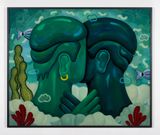
These ideas culminate with an underwater scene that marks a contrast to the cosy interior spaces. Union depicts an embracing couple surrounded by marine life. The underwater setting, although distinct from the other cabaret and domestic environments, mirrors their importance as another form of safe space in which life is quieter and further removed from tradition or convention. For the artist, these spaces remind us to breathe; they are secret places where exterior pressures do not take the same toll. Above all, Mora’s artworks are holistic celebrations of closeness and connection, reminding us to seek out safe spaces for ourselves and for our community.
Gori Mora (b. 1992, Mallorca, Spain) lives and works in Glasgow, where he graduated with an MA in Fine Art from the Glasgow School of Art in 2018.
Unit seeks to preserve the artist’s essential role as the flag-bearer of creativity in our future.

A respected voice in contemporary art discourse.
Focusing on ambitious storytelling and insightful art-world commentary. Ocula Magazine publishes in-depth interviews, critical essays and timely analysis on the artists, exhibitions and ideas driving the global art world.
Learn more about Ocula Magazine
Showcasing the best of the art world.
Ocula partners with galleries from around the world to highlight their artists, artworks and exhibitions. Gallery membership is by application and invitation, with each member vetted by an independent panel.
Learn more about Ocula Membership

Specialises in the sale of major artworks.
Led by a team with deep ties to the world’s leading auction houses, galleries and collectors. Ocula’s advisory team offers bespoke services to high-net-worth clients from around the world who are looking to acquire the best of contemporary and modern art.
Learn more about our team and services