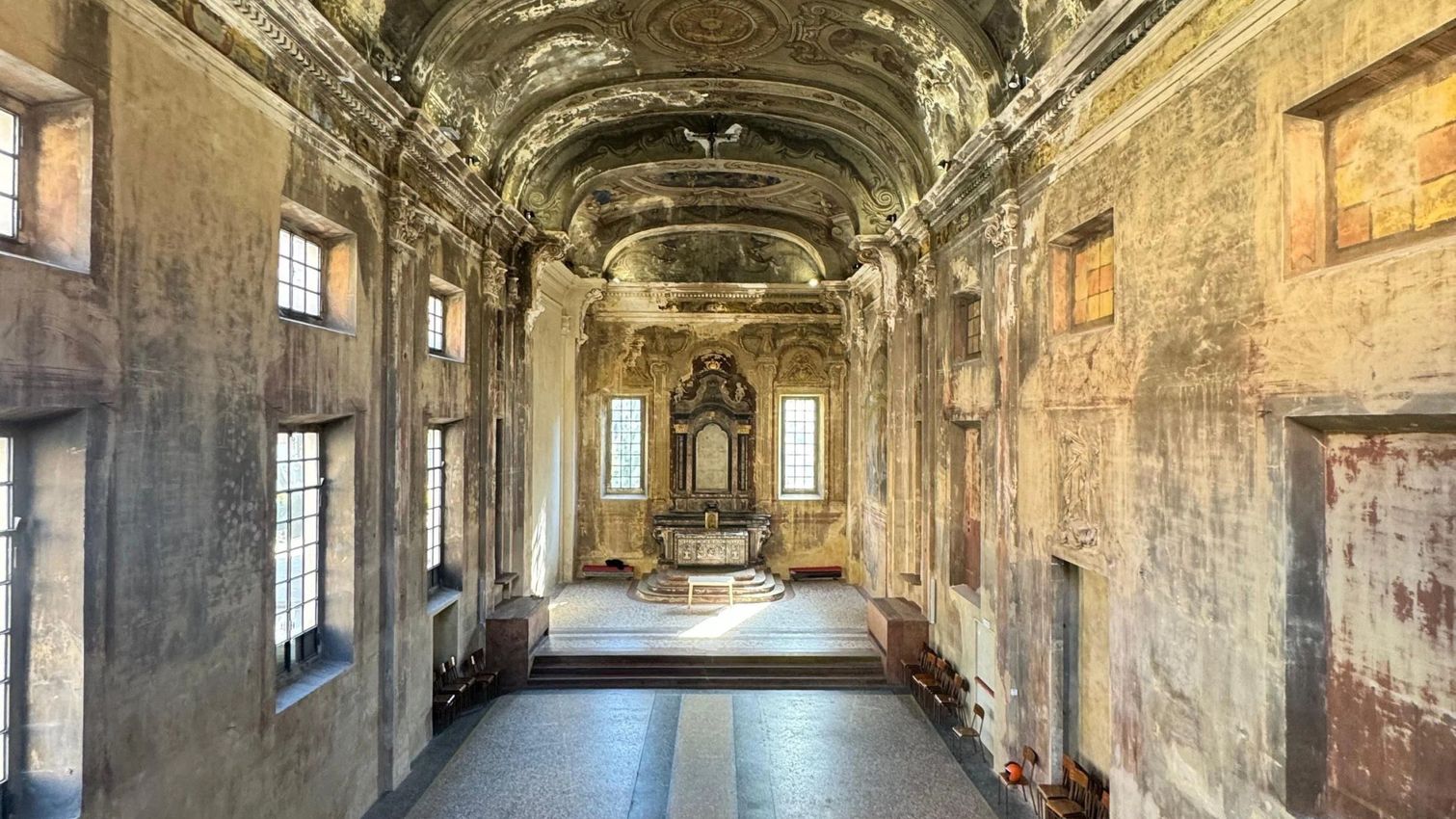
VILLEPIN is pleased to present White Noise, a major new exhibition by Marie de Villepin inaugurating the gallery’s long-term curatorial programme in Milan, unfolding through a series of exhibitions presented within the deconsecrated church of San Vittore. Conceived less as a conventional gallery than as a site for rare and immersive curatorial encounters, the programme invites artists to engage with the unique atmosphere, memory, and architectural presence of the space.
White noise is what remains when every voice speaks at once.
Within the faded walls of San Vittore, Marie de Villepin’s paintings emerge like unstable transmissions suspended between disappearance and persistence. They are fragments, afterimages, emotional frequencies lingering long after the original signal has faded.
Detached from its sacred function, the church remains inhabited by erosion, silence, and memory. The exhibition does not attempt to restore the sacred, but to explore what survives after collapse: traces of instinct, emotion, and human presence resisting erasure.
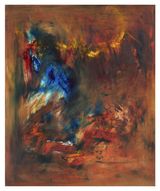
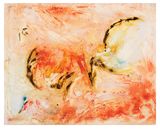
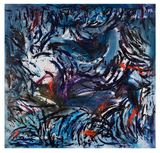
Monumental canvases unfold throughout the space like unstable emotional landscapes, oscillating between apparition and disappearance. Smoke, ash, spectral caves, scorched atmospheres, and dissolving forms recur throughout the works. Nothing fully settles into narrative. Images emerge only to disappear again.
New York inhabits these paintings like a hidden frequency. Marie de Villepin lived there for more than a decade, and the city left deep traces in her visual language: not simply through its architecture, but through its sound. Sirens cutting through the night, the metallic percussion of subway platforms, the electrical hum of delis and laundromats at 3 a.m., fragments of conversations dissolving into traffic noise, helicopters circling above the Hudson, jazz escaping through half-open doors in the Lower East Side, the static of summer heat rising between buildings. New York is never silent; it breathes through saturation. That density profoundly shaped her relationship to painting. Her canvases function like urban soundscapes translated into colour, gesture, and movement: layers of interruptions, accelerations, and collisions between solitude and collective energy. One senses the ghost of downtown rehearsal studios, late-night drives through Manhattan after rain, the grain of old cinema screens, the violence and tenderness of a city permanently on the verge of overload. In White Noise, New York reappears not as a place to depict, but as an atmosphere, a psychic weather, a restless pulse running beneath the paintings.
At the center of the exhibition appears a single figurative work: a feral, hallucinatory creature functioning as a fractured self portrait of the artist.
It is the only recognisable body in the exhibition.
Drawing from her parallel practice as both musician and painter, Marie approaches painting through rhythm, repetition, and tonal variation. Sound structures the works as much as image. The paintings are not only meant to be seen, but almost heard.
White noise is the hum of a world saturated beyond meaning.
Set in Milan, a city shaped by centuries of beauty, ruin, and reinvention, White Noise becomes a contemplation of what continues to resonate long after certainty has dissolved.
“I wanted the paintings to feel like signals still breathing long after the world that produced them had disappeared.”
— Marie de Villepin
Born in Washington, D.C., Marie de Villepin grew up in the United States and in India. Art was a constant feature in her upbringing as she began developing her musical and drawing skills throughout her frequent travels, filling dozens of notebooks, which allowed her to fix moments and emotions as a chronicle of her life. Growing up in a diplomatic household, Marie had the chance to surround herself with a prominent circle of poets, musicians, filmmakers, and painters including Zao Wou-Ki, a family friend. She was inspired by influential post-war American artists, including Willem de Kooning, Cy Twombly, Joan Mitchell, and Philip Guston. In particular, she admired the musicality, freedom, and capacity for transcendence in their works.


A respected voice in contemporary art discourse.
Focusing on ambitious storytelling and insightful art-world commentary. Ocula Magazine publishes in-depth interviews, critical essays and timely analysis on the artists, exhibitions and ideas driving the global art world.
Learn more about Ocula Magazine
Showcasing the best of the art world.
Ocula partners with galleries from around the world to highlight their artists, artworks and exhibitions. Gallery membership is by application and invitation, with each member vetted by an independent panel.
Learn more about Ocula Membership

Specialises in the sale of major artworks.
Led by a team with deep ties to the world’s leading auction houses, galleries and collectors. Ocula’s advisory team offers bespoke services to high-net-worth clients from around the world who are looking to acquire the best of contemporary and modern art.
Learn more about our team and services