On Tuesday 26th April, the gallery will host an online artist talk, Conversations: Ibrahim Mahama and Aaina Bhargava. Register here.
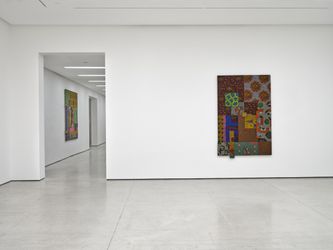
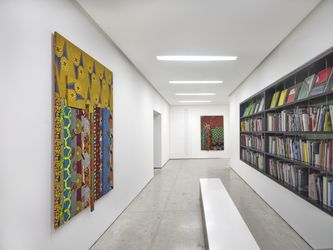
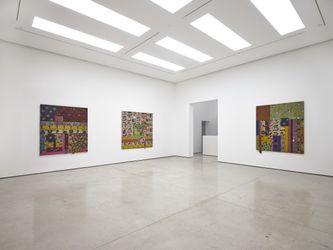
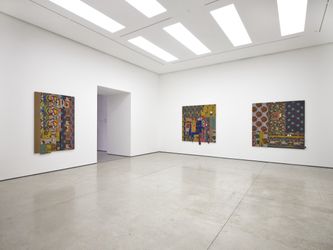
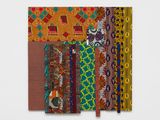
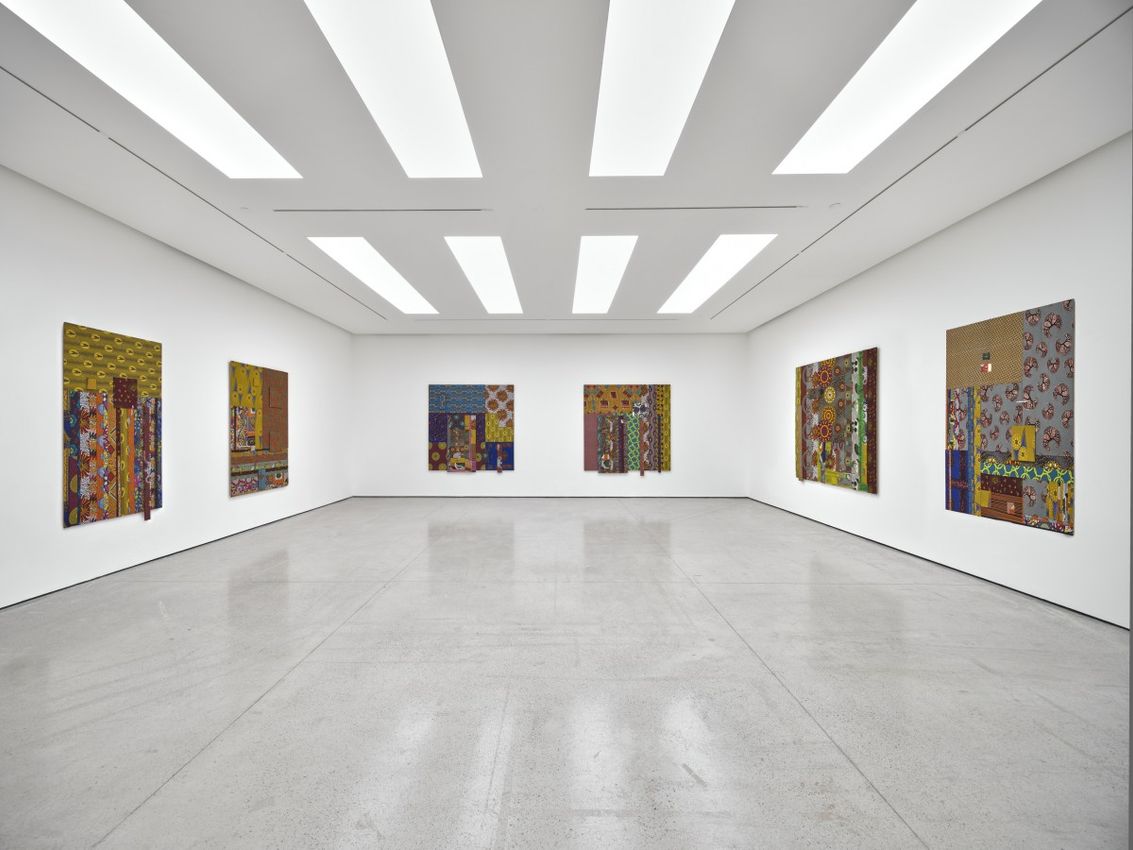
White Cube is pleased to present Half of a Yellow Sun by Ibrahim Mahama, his first exhibition in Hong Kong and Greater China. Featuring a selection of new fabric paintings, in these works Mahama explores the history of materials, commerce, and cultural identity.
The exhibition title is drawn from the novel of the same name by the Nigerian writer Chimamanda Ngozi Adichie, which focuses on the Nigerian-Biafran War in the late 1960s, while the individual works are inspired by the 1970s songs of Fela Kuti, the Pan-Africanist musician and political activist. For Mahama, this period of independence from colonial British rule across Africa has long been a source of inspiration. As the artist states: ‘this is an African story, with ideas of freedom beyond the chaos.’
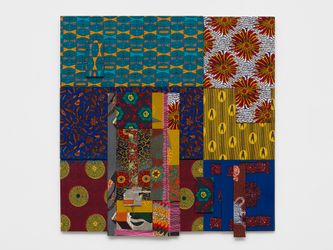
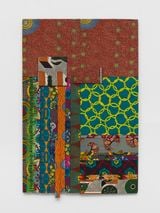
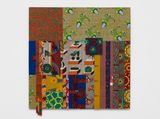
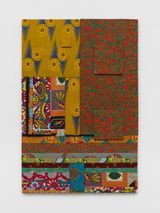
The collaged sections of material in these works have been collected by Mahama over several years, through a process of exchanging new cloth for old from traders, mainly women, working in markets across Ghana. Known as ‘Dutch wax’ cloth, these densely patterned, colourful cotton fabrics were originally made and traded by Dutch companies operating along the coastal routes around West Africa in the 19th century. Developed for export to the Dutch East Indian colonies, the fabrics, which incorporated traditional Indonesian batik design, were mass produced at a cheaper cost than authentic batik cloth; however, these products were shunned by customers in South East Asia, which led Dutch sellers to seek alternative markets. Stopping off for refuelling in West African port cities such as Accra, the Dutch trading vessels found a market for the imitation batik, which was soon modified to include African-inspired designs. Dutch wax cloth eventually became synonymous with African design and culture, often as a non-verbal means of communication within everyday wear, or to denote wealth, power, or influence in formal settings.
Many of the cloth swatches in Mahama’s paintings have names ascribed to their design, such as ‘Speed Bird’ (from the aphorism ‘rich today, poor tomorrow’, with reference to how money can easily ‘fly’ away), ‘Tortoise’ (to signify determination, strength, and patience) and ‘Eye’ (to mean that your wrongdoings will still be seen by Almighty God). Another common design features a series of trees arranged in a crescent, resembling the shape and texture of the brain. This print, known as ‘Kofi Annan’s Brains’, was launched commercially on the day the Ghanaian Secretary-General of the United Nations gave his final address in New York which made reference to Annan’s intellectual prowess. Mahama is interested in the political dimensions of the materials, and the forms of labour embedded within them. In post-colonial Africa, these fabrics represent a celebration of the diversity of national and pan-African identity; in bringing all these pieces together, Mahama is able to overlay different histories, cultural tropes, figurative and abstract forms as part of his ongoing investigation into the legacies of colonisation.
The development of this series is entwined with that of the jute sack works for which Mahama is best known. Gathering discarded fabric from various marketplaces in Ghana when he was an art student, Mahama began to build an extensive archive of materials. In the case of the jute, these eventually formed the basis for large-scale architectural interventions. This current series using wax print samples, which Mahama had incorporated into some of his earlier works including Kwaku Minoona (2019) and Chale Wote (2014), are the culmination of an approach in which multiple remnants are juxtaposed and overlaid to produce unique, single works. In some, brightly coloured stitching between the sections appears as if inscribed or scribbled across the surface, while in others, patterns push out beyond the limits of the canvas frame. Mahama originally trained as a painter and the decisions made in these works–including in the selection of the fabrics, predicated on pattern and colour–he sees as akin to using paint on canvas.
Ibrahim Mahama was born in 1987 in Tamale, Ghana. He lives and works in Accra, Kumasi, and Tamale. Recent group exhibitions include NIRIN 22nd Biennale of Sydney (2020); 58th and 56th Venice Biennale (2019 and 2015); and Documenta 14 (2015). Solo exhibitions include ‘Parliament of Ghosts’, The Whitworth/Manchester International Festival, UK (2019); ‘Labour of Many’, Norval Foundation, Cape Town (2019); and ‘Fracture’, Tel Aviv Art Museum (2016). In 2019, Mahama opened the artist-run exhibition space Savannah Centre for Contemporary Art (SCCA) in Tamale, followed by the launch of the studio/research facility Red Clay in 2020. In 2021, Mahama launched Nkrumah Volini, a cultural and educational institution housed in a converted grain silo which extends the activities of SCCA and Red Clay.


Ibrahim Mahama uses the transformation of materials to explore themes of commodity, migration, globalisation and economic exchange. Often made in collaboration with others, his large-scale installations employ materials gathered from urban environments, such as remnants of wood, or jute sacks which are stitched together and draped over architectural structures. Mahama’s interest in material, process and audience first led him to focus on jute sacks that are synonymous with the trade markets of Ghana where he lives and works. Fabricated in South East Asia, the sacks are imported by the Ghana Cocoa Boards to transport cocoa beans and eventually end up as multi-functional objects, used for the transportation of food, charcoal and other commodities. ‘You find different points of aesthetics within the surface of the sacks’ fabric’, Mahama has said. ‘I am interested in how crisis and failure are absorbed into this material with a strong reference to global transaction and how capitalist structures work.’


An international art powerhouse, White Cube was established in 1993 in London by art dealer Jay Jopling. In its space on Duke Street, it served as the early exhibition venue for many now internationally acclaimed British artists, including Tracey Emin, Gilbert & George, Rachel Kneebone and Antony Gormley, who still show with the gallery today.

A respected voice in contemporary art discourse.
Focusing on ambitious storytelling and insightful art-world commentary. Ocula Magazine publishes in-depth interviews, critical essays and timely analysis on the artists, exhibitions and ideas driving the global art world.
Learn more about Ocula Magazine
Showcasing the best of the art world.
Ocula partners with galleries from around the world to highlight their artists, artworks and exhibitions. Gallery membership is by application and invitation, with each member vetted by an independent panel.
Learn more about Ocula Membership

Specialises in the sale of major artworks.
Led by a team with deep ties to the world’s leading auction houses, galleries and collectors. Ocula’s advisory team offers bespoke services to high-net-worth clients from around the world who are looking to acquire the best of contemporary and modern art.
Learn more about our team and services