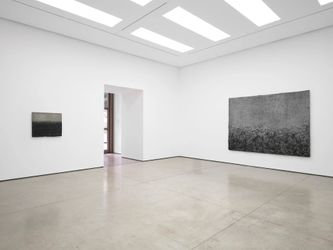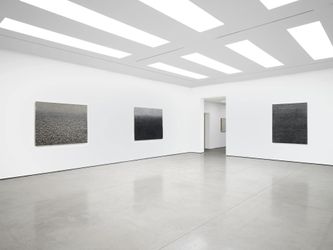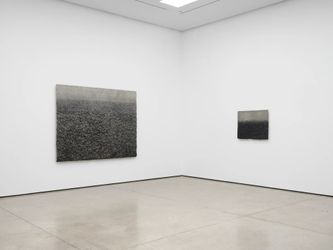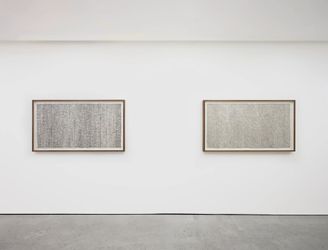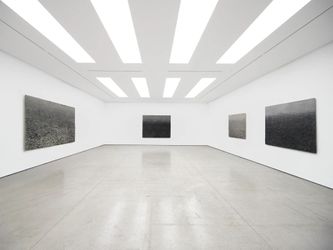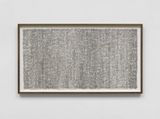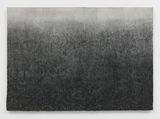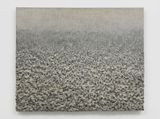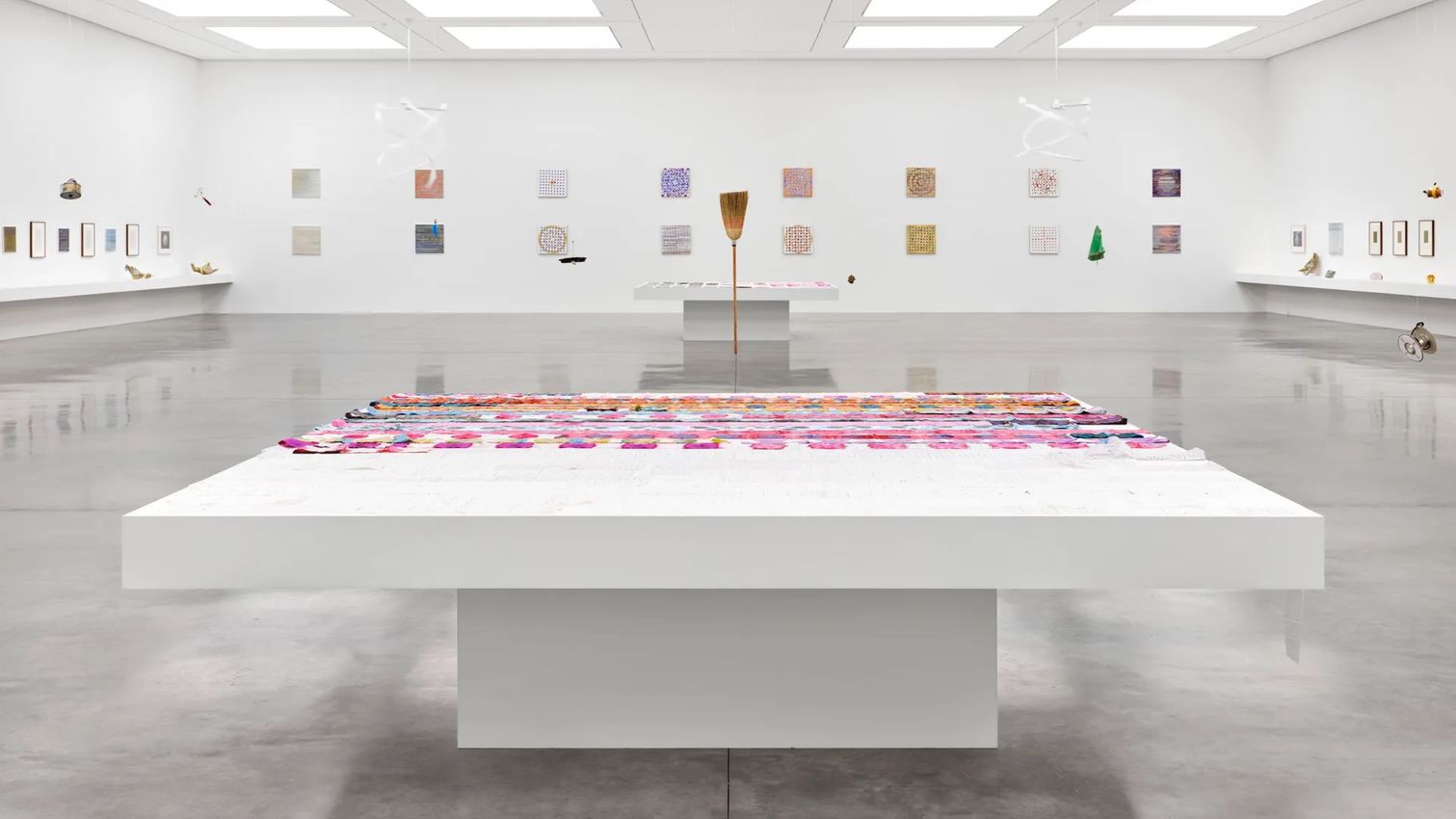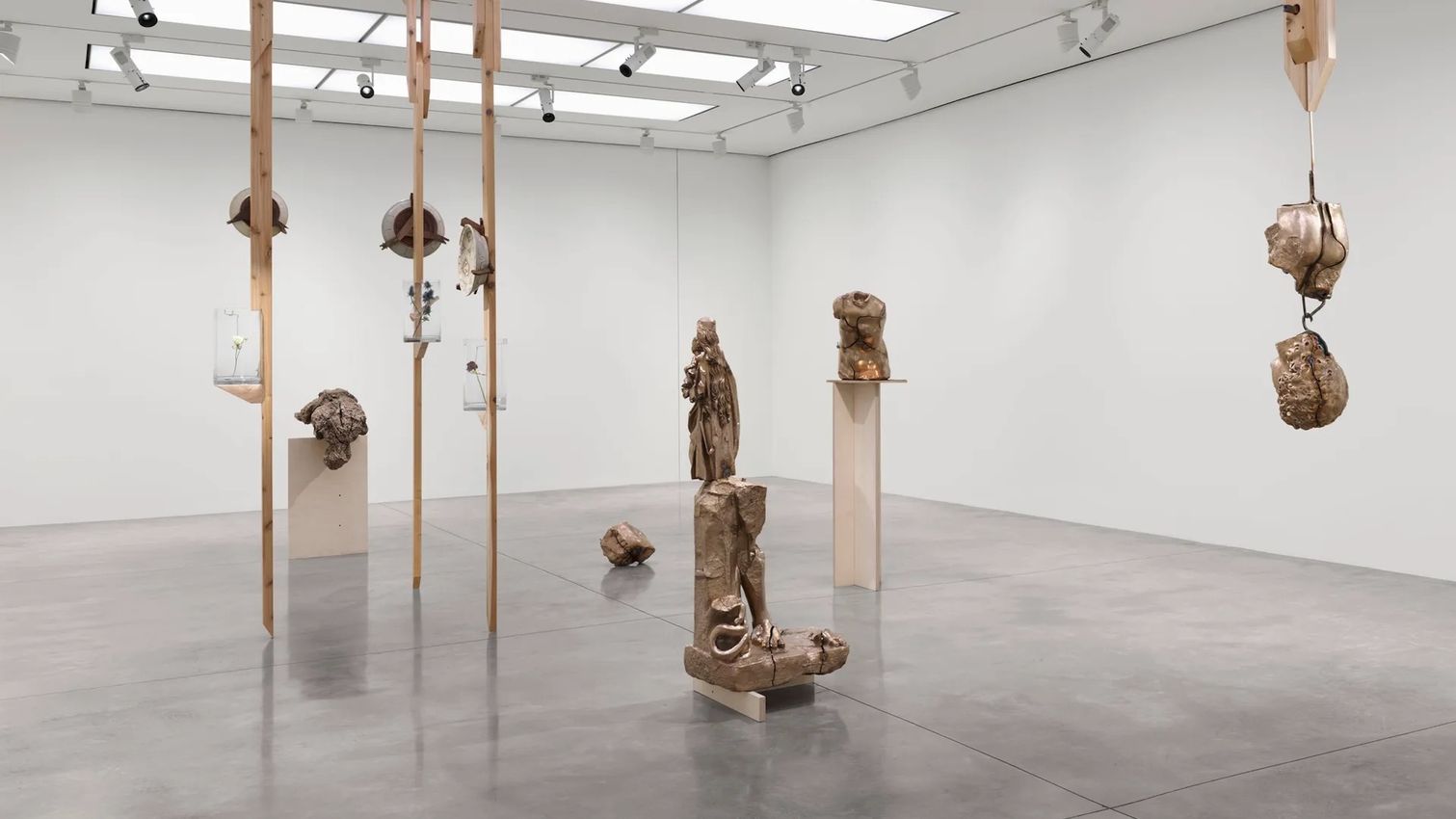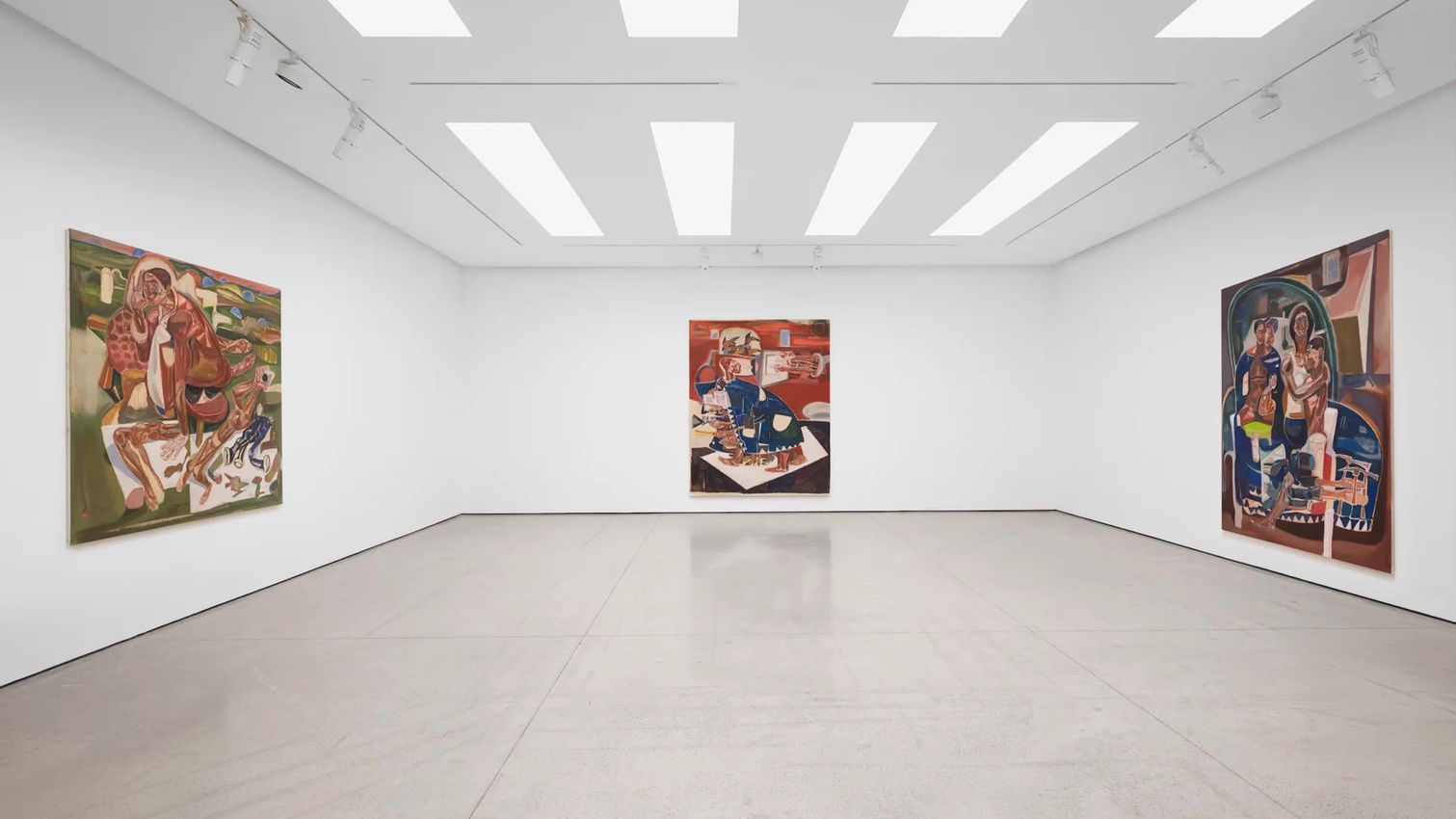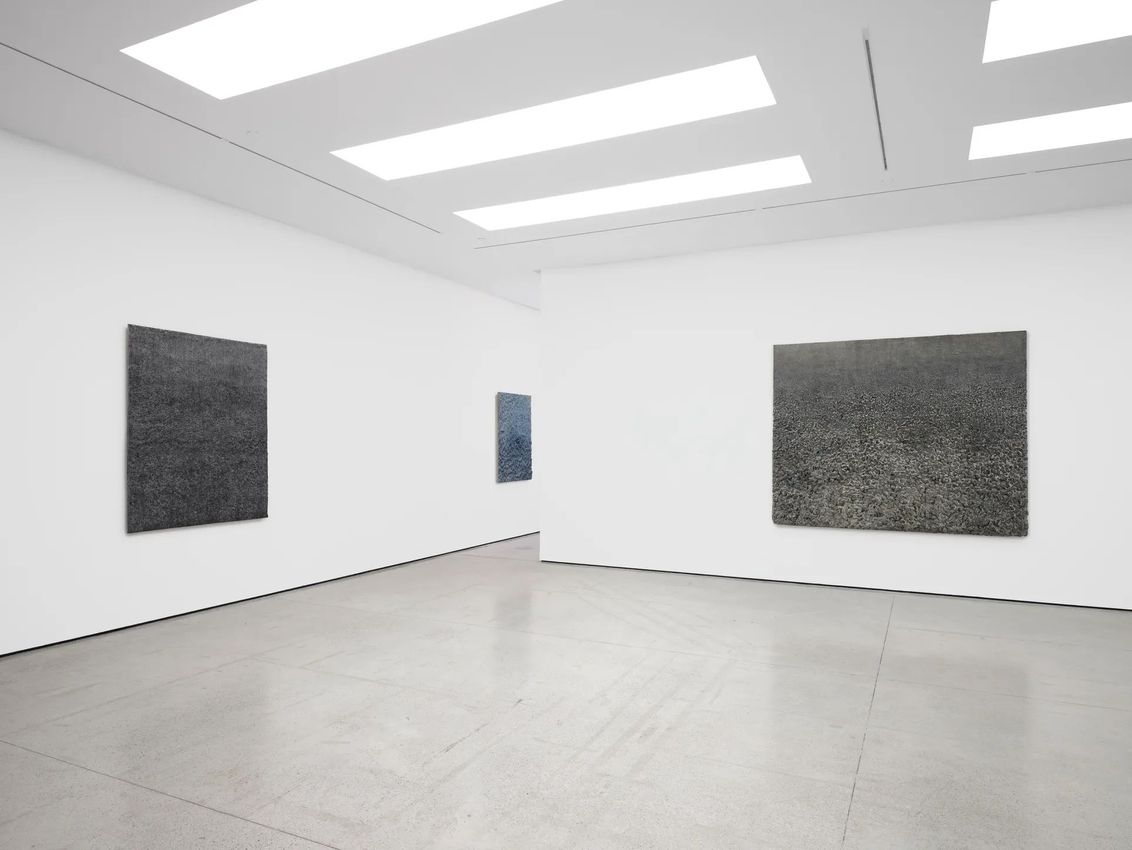
White Cube is pleased to present the first-ever solo exhibition in Hong Kong of Paris-based Korean artist Lee Jin Woo. Deeply immersed in traditional Korean aesthetics, Lee’s paintings and works on paper are framed by philosophical enquiry and driven by artistic intuition. Regarding abstraction as an entry point to the universal, the artist seeks to induce a state close to meditation in the consciousness of the viewer through his work. The result of total submission to an ascetic process engaging mind, body and spirit, the artworks engender a heightened physical awareness and are themselves an embodiment of a sentient, ‘breathing’ presence.
Adhering to the principles of minimal gesture, formal repetition and humbling physical labour, Lee’s art extends from Dansaekhwa, a movement involving a group of Korean painters who emerged during the 1970s and notably included Park Seo-Bo and Lee Ufan. Further to a conceptual exercise, Lee approaches his work materially by drawing his principal mediums from the earth and transforming these through ritualised repetition. Subjecting charcoal and hanji – a traditional Korean paper made from the bark of mulberry tree – to a painstaking process of transformation, abstract ‘landscapes’ emerge: mutable and profoundly contemplative, these paintings evoke a sense of endless space. As Lee has commented, ‘Once I am at my painting, I become an arm that paints. My hand is the extension of my brain and I stop thinking. My work is intuitive. I walk in imaginary landscapes, [and] move forward.’
Born in Seoul in 1959, Lee moved to Paris during the 1980s, studying for many years at the École des Beaux-Arts. He returned to Korea in 1993, building a studio on a mountainside outside Seoul in the late ‘90s in order to work in harmony with nature and to hone the methodological aspects of his practice. Finally returning to Paris in 2005, he has lived and worked in the city ever since. Though inspired by Korean master of the Joseon era Gyeomjae Jeong Seon (1676–1759) in particular, Lee’s work is equally informed by Western painting, in particular the ‘fundamental revelation’ of Claude Monet’s masterpieces, which Lee discovered at the Musée d’Orsay while still a student. The immediate, emotional reaction Lee had to Monet was of such profound impact that Lee would go on to create paintings in the hopes he could rally equally deep and instinctual responses in his viewers.
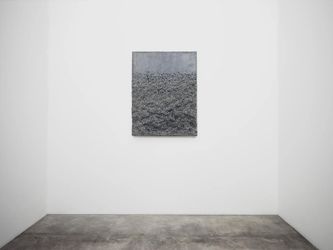
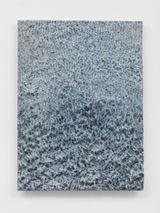
Lee has been experimenting with charcoal since the 1990s and using it on the entire surface of his paintings from around 2008 onwards. The artist’s work is the result of a labour-intensive process, which begins with the grinding of charcoal that is then filtered and mixed with adhesive. This mixture is used to coat a ground of linen that is then entirely covered with hanji, an act that the artist sees as a form of personal ‘invalidation’. Lee then rubs the surface down, scraping and beating it with an iron brush repeatedly, over a period of two to three months. Becoming gradually heavier over time, hanji and charcoal gradually merge, the result of at least ten – and sometimes as many as 20 to 30 – built-up layers until there is a pictorial resolution and a final work is created.Lee’s paintings comprise thickly accumulated material, applied in such a way that it renders rough surfaces with dimensional relief – raised mounds and embedded furrows – upon which light and shadow can play to infinite variation in tone and effect. Appearing geological rather than manmade, the accretions on the surface of his work are suggestive of glacial epochs and vast passages of time. Summoning equally the feelings of emptiness and presence through their marks and erasure, Lee’s serene compositions are grounded in a purity of form and a direct connection to the mineral world. As the artist has said, he does not want his paintings to be mere ‘visual images’, but more the product of a performance by ‘an artist who erases the “I’”’.
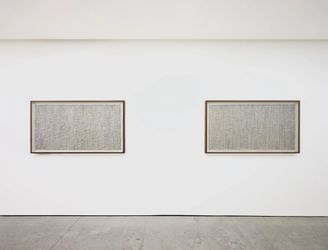
A similar loss of ‘self’ and being led by intuition informs his drawings, which begin with calligraphy – a form of mark-making that is the first thing the artist does in the studio each day. The six works on paper presented in the exhibition are also created with materials native to Korea and similarly explore the themes of concealment, temporal passage and authorial erasure integral to the paintings. Comprising repeated phrases in calligraphy drawn directly onto hanji, the works on paper are palimpsests that register a self-erasing script. ‘It is more like endless action and labour rather than simply covering up an image after it’s painted,’ Lee states. ‘I have been continuing this act of concealing and invalidating for over 30 years.’
Lee Jin Woo was born in Seoul in 1959 and lives and works in Paris. He graduated from Sejong University in Seoul in 1983, before moving to France in the same year where he attended Paris VIII University and the École Nationale Supérieure des Beaux-Arts. Selected solo exhibitions include Asia Society France, Paris (2022); Leeahn Gallery, Seoul (2021); and Tokyo Gallery + BTAP, Tokyo (2021). Recent group exhibitions include Long Museum, Shanghai, China (2022) and Daegu Art Museum, South Korea (2022). Lee’s work is held in numerous public collections including Daegu Art Museum, South Korea; Fondation Boghossian, Brussels; Long Museum, Shanghai, China; and Musée Cernuschi, Paris. In 2007, Lee was selected as the Winner of the Art Prize, Fondation de France – Fondation Charles Oulmont.The artist’s major solo exhibition opens this November at Powerlong Museum, Shanghai, China.


Born in Seoul in 1959, Lee Jin Woo studied at Sejong University before moving to Paris in 1986 where he attended the École Nationale Supérieure des Beaux-Arts.


An international art powerhouse, White Cube was established in 1993 in London by art dealer Jay Jopling. In its space on Duke Street, it served as the early exhibition venue for many now internationally acclaimed British artists, including Tracey Emin, Gilbert & George, Rachel Kneebone and Antony Gormley, who still show with the gallery today.

A respected voice in contemporary art discourse.
Focusing on ambitious storytelling and insightful art-world commentary. Ocula Magazine publishes in-depth interviews, critical essays and timely analysis on the artists, exhibitions and ideas driving the global art world.
Learn more about Ocula Magazine
Showcasing the best of the art world.
Ocula partners with galleries from around the world to highlight their artists, artworks and exhibitions. Gallery membership is by application and invitation, with each member vetted by an independent panel.
Learn more about Ocula Membership

Specialises in the sale of major artworks.
Led by a team with deep ties to the world’s leading auction houses, galleries and collectors. Ocula’s advisory team offers bespoke services to high-net-worth clients from around the world who are looking to acquire the best of contemporary and modern art.
Learn more about our team and services