Press Release

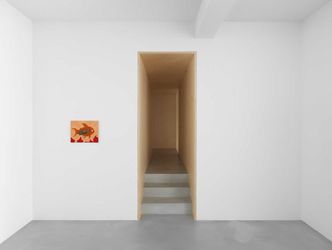
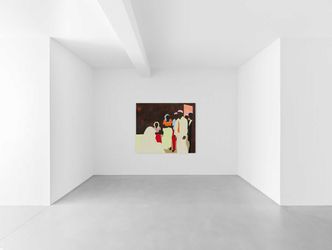
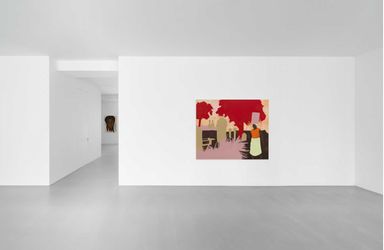
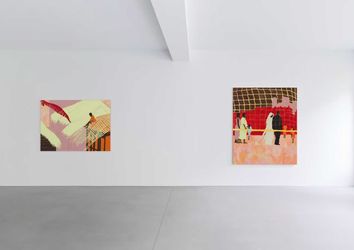
The works in The Equator’s Forfeit, Cassi Namoda‘s second exhibition with the gallery, were painted in two locations, Europe and America. Informed by Namoda’s frequent and long visits to her country of birth, Mozambique, the works are rooted in personal experience, while reflecting broader historical and contemporary truths. Namoda’s dream-like paintings unfurl across time, continents, traditions and cultures, depicting pictures of enchantment and disenchantment, as well as of loss and restitution, in the Equatorial regions.

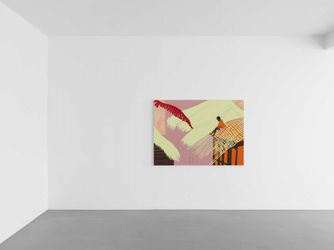
The title of the exhibition connects one of the most symbolic lines in the world, the notional division between the northern and southern hemispheres, to the idea of a forfeit: a penalty for wrongdoing; a price that has to be paid. It is a metaphorical allusion to the line no longer holding, and to the inescapable fact that patterns are changing. A shift set in motion by the repercussions of colonialism but exacerbated by the most urgent danger facing the global south today: climate change. Coastal cities, such as the Mozambican capital, Maputo, are especially vulnerable. The painting Mangito’s Way, which depicts a young boy repairing a traditional straw roof, reflects this theme. It is against this backdrop that the fourteen new paintings in The Equator’s Forfeit unfold.

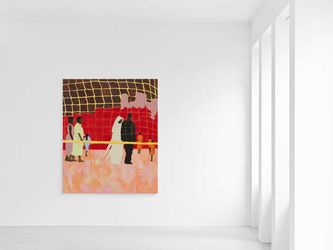
Weaving in and out of the exhibition is the subject of marriage, as a ritual, rite of passage, as a state with both positive and negative associations. It is a lens through which Namoda contemplates the polarities of love and tradition in Luso African culture. Philosopher and writer John S. Mbiti (1931-2019) wrote that marriage, from an African perspective, “is the focus of existence. It is the point where all members of a given community meet: the departed, the living and those yet to be born. All the dimensions of time meet here and the whole drama of history is repeated, renewed, and revitalised.” In the painting The Latitude of Longing, the artist depicts a young girl receiving traditional Mozambican face paint, mussiro—a sign that she has reached marriageable age. While in a counterpart, The Longitude of Love, a newly-wed couple stroll along the sandy shores of Maputo Bay. The figure of a bride, dressed in white, also appears in the works Equidistant Tragedy, Equator’s Forfeit and Maria’s Zenith.

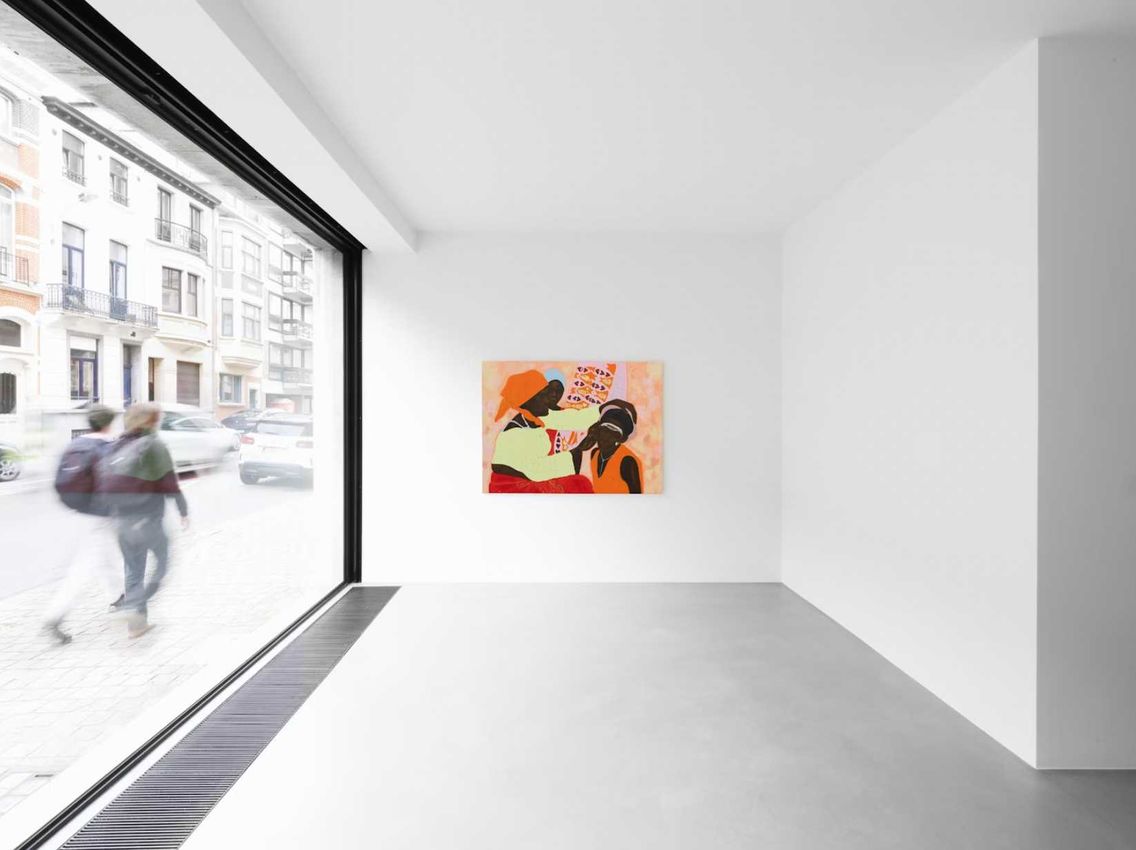
Maria is a familiar figure in Cassi Namoda’s work, both as a reference to the introduction of the Catholic faith to Mozambique by the Portuguese, but also as a metaphor for life in the post-colonial era. In her oeuvre, this recognisable figure, both real and other-worldly, expresses a range of emotions, from contentment to abhorrence and distress. For the artist, these feelings are all indicative of the aftermath of colonialism in Africa, as considered from a consciously female perspective. Namoda further extends the theme in When Will You Marry?, a reimagining of Paul Gauguin’s identically titled portrait of two Tahitian women, painted on the island in 1892. Over 130 years later, the artist recreates the scene with two African women as the subjects. The question hasn’t changed, but the context is a subversion of Gauguin’s exoticizing gaze. Works such as Arafah Gaza’s Arrival and Terrestrial Reckoning, with their references to birth and death respectively, complete the cycle of life.

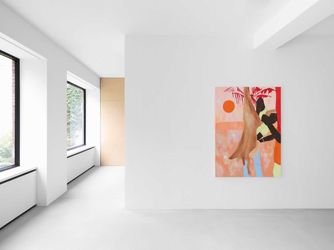
Namoda’s palette evokes the atmosphere of the tropics and has evolved, in part, from the research she conducted during her recent residency at the Josef and Anni Albers Foundation. In these new paintings, colour harmonies and contrasts, such as warm/cool or bright/soft, are suggestive of sensory experiences. Colour is seen as energy, possessing the capacity to evoke sensations ranging from disturbance to tranquillity. The recurring dappled, pinkish-yellow backgrounds and net motifs (a reminder that lines can also cross or entrap), augments the formal cohesion of the works.

The paintings in The Equator’s Forfeit are evocative of a romantic sense of impending loss and melancholy. Namoda’s imagery has a narrative quality, although the scenes are more like suspended moments in time; contemporary and recognisable, accessible and yet rooted in history and traditions. Moving beyond simple depictions of everyday life in rural and urban Mozambique, they bear witness to the emotional legacy of colonialism, to the myths and stories that shape her homeland, and its history and future in an increasingly globalised world.

Read More

Installation Views

About the Artist

Cassi Namoda is a painter whose work interweaves the personal with the historical. Born in Maputo and having lived in several different countries throughout her life, Namoda’s nomadic lifestyle and multicultural identity has long informed her work. She originally studied cinema and considers narrative frameworks, storytelling and the presence of imagined characters to be significant elements in her visual practice. Reference images often serve as a starting point for her painting process: she is drawn to photographs that recall film-stills, images that echo ordinary yet profound moments of everyday life. Combining personal memories with archival references, she creates works that attempt to access emotional interiority and communicate human experience in all its subtlety. The duality between past and present, colonialism and post-colonialism, Africa and Europe, spiritual traditions and a globalised world is a latent force in her most recent paintings. An engagement with—and probing of—art history is a way of confronting the nuances inherent in conflicting ideologies and mutable identities. Her works include frequent references to modern art history, at once challenging and venerating the canon. She relates expressionism to emotional intensity, dissonant tones and figural distortions, while surrealism manifests itself through an embrace of magical realism or through themes borrowed from tribal art. Cassi Namoda (b. 1988 in Maputo, Mozambique) lives and works in East Hampton, New York and Los Angeles, California. Namoda’s work has been included in exhibitions at Caribbean Cultural Center African Diaspora Institute, New York; Museum of Contemporary African Diasporan Arts, New York and Library Street Collective, Detroit. She is included in girls girls girls, currently on view at Lismore Castle, Lismore, Ireland. Namoda’s work is held in the collections of Pérez Art Museum, Miami; Studio Museum, Harlem; and the Baltimore Museum of Art.

View Artist Profile

Also Exhibiting at Xavier Hufkens

About the Gallery
Xavier Hufkens is one of Europe’s leading galleries for contemporary art. Located in Brussels, the gallery maintains a diverse exhibition programme with solo exhibitions of the gallery artists as well as group exhibitions and special projects. The gallery deals in a distinctive combination of painting, drawing, sculpture, photography, video and installation-based work.

The origins of the gallery date back to 1987, when Xavier Hufkens opened a gallery space in an un-refurbished warehouse in the neighbourhood of the South Station (Midi) in Brussels. During the early years, the focus of the gallery was upon mid-career and emerging artists and the gallery is known for having introduced some of the most influential contemporary artists to Brussels at a time when they were still relatively unknown. British sculptor Antony Gormley, who is still affiliated with the gallery, Felix Gonzalez-Torres and Rosemarie Trockel all showed in Belgium for the first time with Xavier Hufkens (Gormley in 1987; Gonzalez-Torres in 1991 and Trockel in 1993).

In 1992, the gallery moved to a 19th-century townhouse at 6 rue Saint-Georges, close to the Avenue Louise. Completely renovated by Belgian architects Paul Robbrecht, Hilde Daem and Marie-José Van Hee, the house quickly gained a reputation for being not just one of the most beautiful contemporary art spaces in the Belgian capital, but also one of the most interesting. The expanded exhibition programme coincided with the additional representation of a number of established artists from Belgium and abroad, including Richard Artschwager, Thierry De Cordier and Jan Vercruysse. In 1997, Hufkens expanded the gallery further by annexing the adjacent building and a number of new artists joined the gallery, including Louise Bourgeois, Roni Horn and Thomas Houseago.

A second space in the same street, at 107 rue Saint-Georges, opened in spring 2013. Located in the Galerie Rivoli, a mixed-use commercial development from the 1970s, the new gallery space was designed by Swiss architect Harry Gugger, who was previously in partnership with Herzog and De Meuron. Slegten & Toegemann, Brussels, managed the project.

An eclectic but very clear vision underpins all of the gallery’s activities: ‘The definition of the gallery was established from the start. The common thread, then and now, is quality over and above everything else, which I find more intellectually challenging than a forced definition. From the early days I juxtaposed established artists such as Michelangelo Pistoletto with someone like Felix Gonzalez-Torres when he was totally unknown. Today I still mix my work: I have no problem showing Malcolm Morley … alongside Robert Ryman, or Willem de Kooning.’ [Xavier Hufkens in The Art Newspaper, Issue 220, January 2011, published online: 20 January 2011]

Xavier Hufkens represents some thirty artists from different generations. He was part of the six-member selection committee for Art Basel during seven years and also participates in up to five international Arts Fairs annually. The gallery has partnerships with the estates of Louise Bourgeois, Willem de Kooning, Robert Mapplethorpe and Alice Neel.
View Gallery Profile
Address
44 rue Van Eyck
Van Eyckstraat
Brussels
Belgium
Opening Hours
Tuesday – Saturday
11am – 6pm
(1)
Brussels 44 rue Van Eyck, Van Eyckstraat
Xavier Hufkens
44 rue Van Eyck, Van Eyckstraat, Brussels, Belgium

Opening hours
Tuesday – Saturday
11am – 6pm
The art world in focus