Press Release

The New York-based artist Jonathan Horowitz makes art that reflects upon art itself: his works dismantle the (pop) cultural idioms they critique, from within, resulting in complex layers of meaning. Humour and political commentary are constants in the multi-narratives he generates. His second solo exhibition at Xavier Hufkens features a group of Leftover Paint Abstractions, a new series made with leftover paint given to him by fellow artists. Works recalling earlier series are also included in the show, a contract that brings Horowitz’s conceptual and formal versatility into clear view.

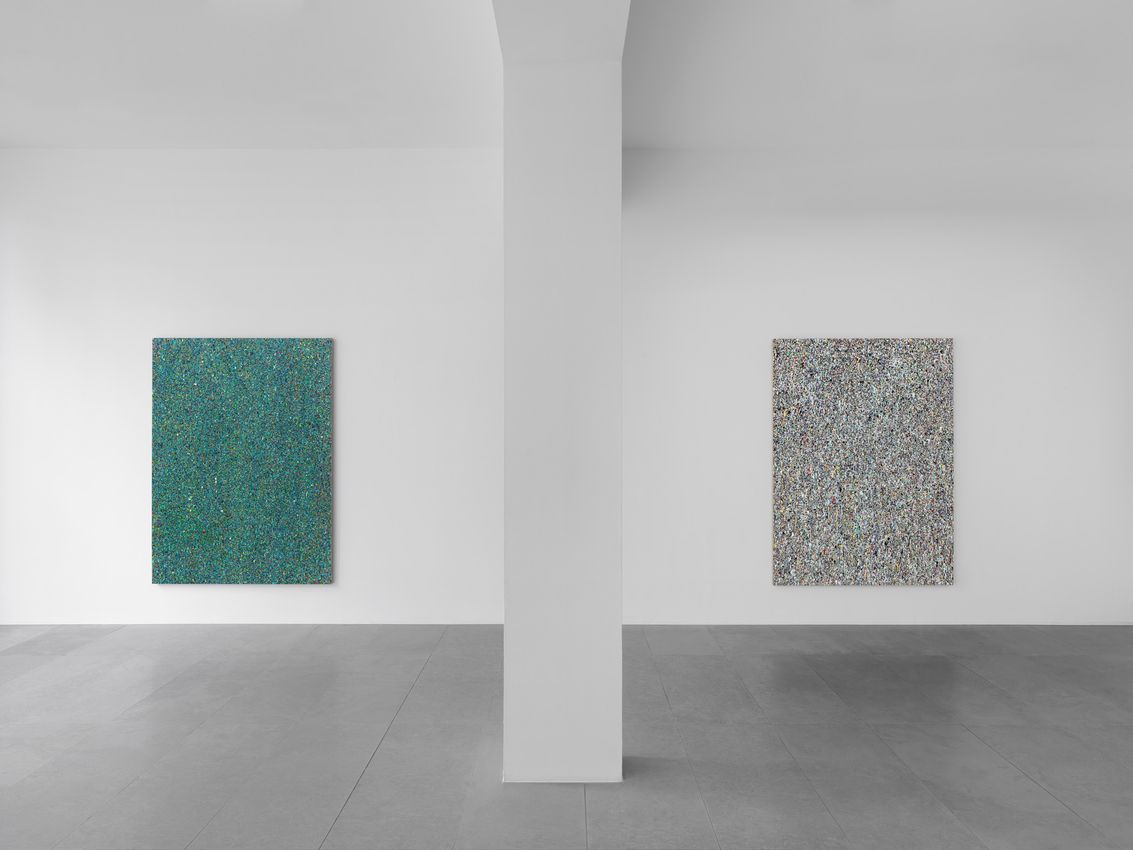
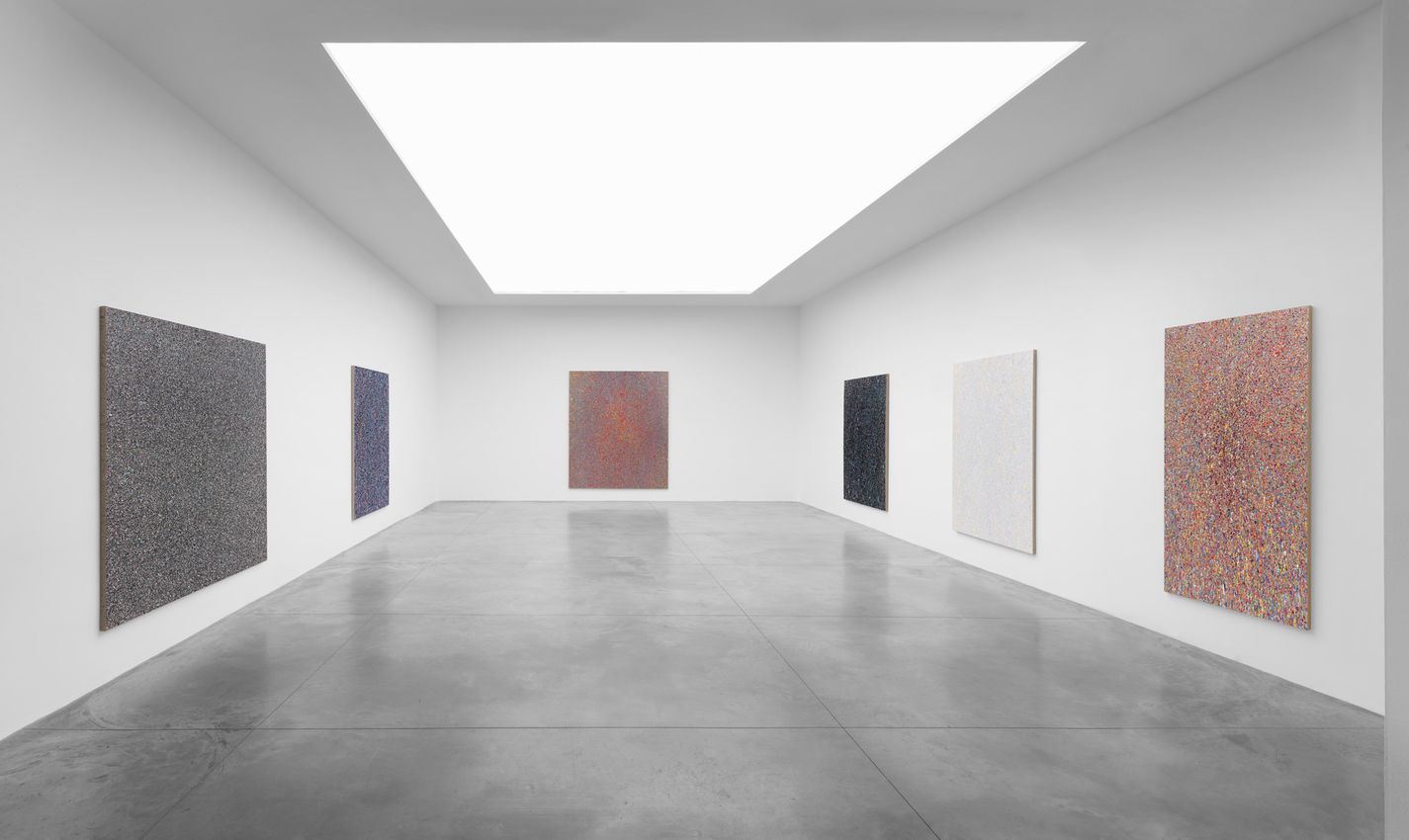
The Leftover Paint Abstractions are made by flicking drops of paint onto raw, stretched linen canvas. In each work colour is the conspicuous element: when seen up-close, the details of drops can be seen, and the colour interaction is vibrant; when viewed from afar the drops of paint blend into fields of colour thanks to optical mixing. The splatters look randomly distributed, yet every painting attests to a breadth of decision-making that the artist engaged in. Movement and gravity can be sensed, too, but differently than in the work of Jackson Pollock — an instant art historical association. Pollock’s work was floor-based; he lopped the paint splatters downwards, as he moved his body around the canvas. Jonathan Horowitz considers his paintings to be like mirrors, putting them upright, against the wall. He laterally flicks the paint onto the canvas. Now and then he rotates the painting. Some splatters drip downwards, lending the paintings a multi-directional drift. Horowitz thus literally tilts up a ubiquitous modernist reference, if not any laws of physics.

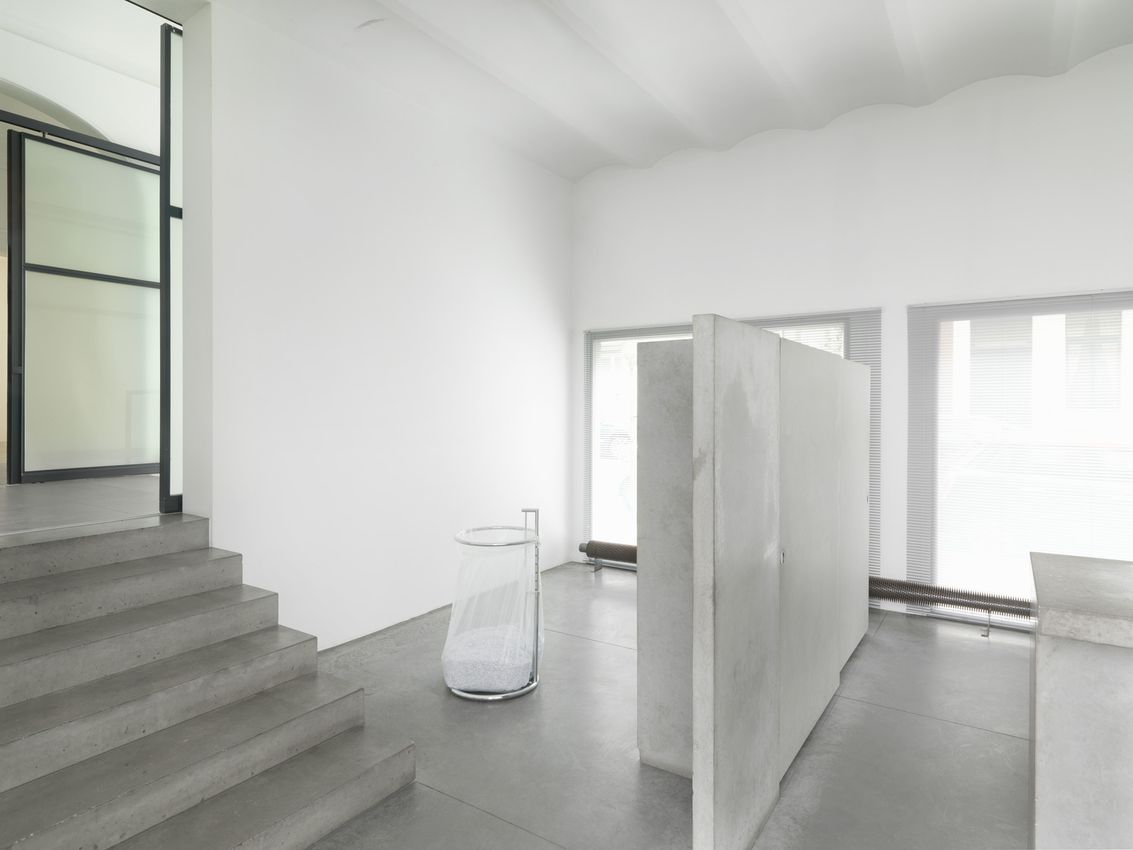
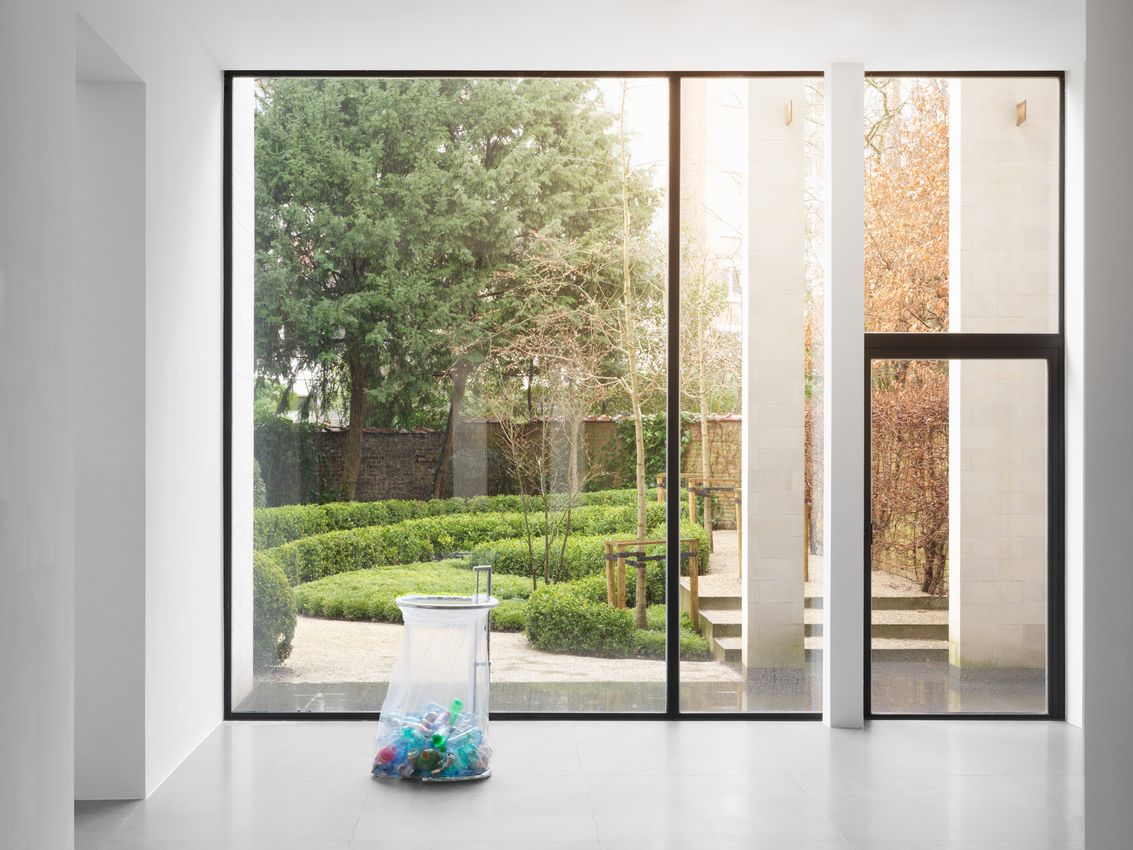
The issue of recycling is put at the centre of the room in the functional, readymade recycling sculpture that Horowitz made with a reproduction Eileen Gray side table and a clear plastic bag. Again, the artist directs the perspective in a new direction. The recycled element is placed in central view as part of an object of value. The side table further interests the artist as one of the few icons of modern design made by a woman.

The notion of recycling — with its urgent, political implications — is pertinent in the Leftover Paint Abstractions, too, but their inherent protest is indirect. The visual override the paintings provide instead allows the viewer a kind of abstracted solace. As Joshua Decter writes in his essay in the exhibition’s catalogue: “In today’s world, losing oneself in a painting might be a restorative experience. Losing oneself in a painting might even be a metapolitical act of defiance these days.” And, as the artist says in the interview with Simon Castets, the experience of viewing the paintings can be curiously intimate: “The effect is like a physiological transference of my subjectivity to the viewer.”

Jonathan Horowitz has previously used the logos of Pepsi and Coca Cola cans as a vehicle to discuss the binary system of U.S. politics; the Democrats use blue as their party colour, and the Republicans identify with red. On election night the map of the United States fills up as the results come in, state per state, with either colour. Horowitz commented on the binary system by making large formal abstractions using the two soda can motifs for colour. In the exhibition, the coke cans return, in a colour field Coke/Pepsi painting, only this time the cans are tiny. Their small scale and their random disposition, determined by an algorithm, result in a colour field that, on a superficial level is optically similar to the Leftover Paint Abstractions series, yet, being machine-generated, emanate sensations of choice or subjectivity.

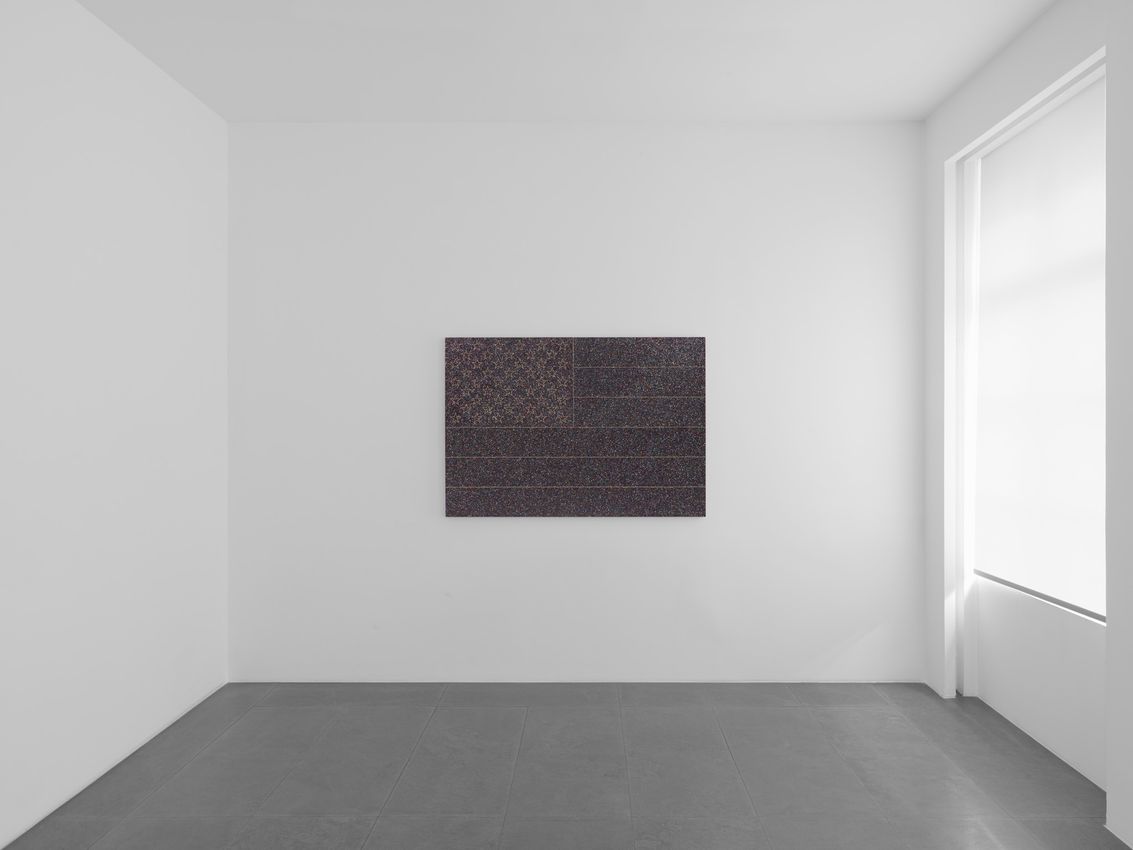
Three Leftover Glitter Abstractions blend together different hues of glitter. The artist describes what you get when you mix these shiny particles of colour as “a kind of iridescent mud.” Again, Horowitz folds the idea of recycling into the artworks’ form. He describes the paintings as “monochromish”, but in their composition they bear the clear traces of earlier works the artist executed in reference to (or in reverence of) other artists: a flag painting, reminiscent of the work of Jasper Johns, a larger work based on a Coke/Pepsi painting and an oval painting, just like the oval mirror painting he instructed his studio assistants to reiterate after a painting by Roy Lichtenstein, which, together, revealed each painter’s subjectivity.

Read More

Installation Views

About the Artist

New York-based Jonathan Horowitz works in video, sculpture, sound installation, painting and photography and is known for making work that critically examines some of the most controversial social and political issues of the day, including race, sexuality, celebrity, religion and consumerism. Born into the last generation to truly straddle both the analogue and digital eras, Horowitz regularly works with found footage and images, juxtaposing elements from film, television, advertising and the media to reveal connections and breakdowns between pre- and post-digital society and the overlapping modes of communication common to both. The themes of obsolescence and technology are also recurrent themes in his work. Often combining the imagery and insouciance of Pop Art with the critical rigour of Conceptualism, Horowitz’s work is frequently provocative and subversive, but rarely lacks poignancy and humour. Horowitz, who originally studied philosophy and film-making, is highly regarded for his acerbic and radical questioning of the value systems inherent within advertising, politics and the media to reveal larger, more uncomfortable truths about contemporary society.

View Artist Profile

Also Exhibiting at Xavier Hufkens

About the Gallery
Xavier Hufkens is one of Europe’s leading galleries for contemporary art. Located in Brussels, the gallery maintains a diverse exhibition programme with solo exhibitions of the gallery artists as well as group exhibitions and special projects. The gallery deals in a distinctive combination of painting, drawing, sculpture, photography, video and installation-based work.

The origins of the gallery date back to 1987, when Xavier Hufkens opened a gallery space in an un-refurbished warehouse in the neighbourhood of the South Station (Midi) in Brussels. During the early years, the focus of the gallery was upon mid-career and emerging artists and the gallery is known for having introduced some of the most influential contemporary artists to Brussels at a time when they were still relatively unknown. British sculptor Antony Gormley, who is still affiliated with the gallery, Felix Gonzalez-Torres and Rosemarie Trockel all showed in Belgium for the first time with Xavier Hufkens (Gormley in 1987; Gonzalez-Torres in 1991 and Trockel in 1993).

In 1992, the gallery moved to a 19th-century townhouse at 6 rue Saint-Georges, close to the Avenue Louise. Completely renovated by Belgian architects Paul Robbrecht, Hilde Daem and Marie-José Van Hee, the house quickly gained a reputation for being not just one of the most beautiful contemporary art spaces in the Belgian capital, but also one of the most interesting. The expanded exhibition programme coincided with the additional representation of a number of established artists from Belgium and abroad, including Richard Artschwager, Thierry De Cordier and Jan Vercruysse. In 1997, Hufkens expanded the gallery further by annexing the adjacent building and a number of new artists joined the gallery, including Louise Bourgeois, Roni Horn and Thomas Houseago.

A second space in the same street, at 107 rue Saint-Georges, opened in spring 2013. Located in the Galerie Rivoli, a mixed-use commercial development from the 1970s, the new gallery space was designed by Swiss architect Harry Gugger, who was previously in partnership with Herzog and De Meuron. Slegten & Toegemann, Brussels, managed the project. A third space opened in spring 2020, located at 44 Rue Van Eyck, designed by architect Bernard Dubois.

An eclectic but very clear vision underpins all of the gallery’s activities: ‘The definition of the gallery was established from the start. The common thread, then and now, is quality over and above everything else, which I find more intellectually challenging than a forced definition. From the early days I juxtaposed established artists such as Michelangelo Pistoletto with someone like Felix Gonzalez-Torres when he was totally unknown. Today I still mix my work: I have no problem showing Malcolm Morley … alongside Robert Ryman, or Willem de Kooning.’ [Xavier Hufkens in The Art Newspaper, Issue 220, January 2011, published online: 20 January 2011]

Xavier Hufkens represents some thirty artists from different generations. He was part of the six-member selection committee for Art Basel during seven years and also participates in up to five international Arts Fairs annually. The gallery has partnerships with the estates of Louise Bourgeois, Willem de Kooning, Robert Mapplethorpe and Alice Neel.
View Gallery Profile
Address
6 rue St-Georges
St-Jorisstraat
Brussels
Belgium
Opening Hours
Tuesday – Saturday
11am – 6pm
(1)
Brussels 6 rue St-Georges
Xavier Hufkens
6 rue St-Georges, St-Jorisstraat, Brussels, Belgium

Opening hours
Tuesday – Saturday
11am – 6pm
The art world in focus