



Press Release

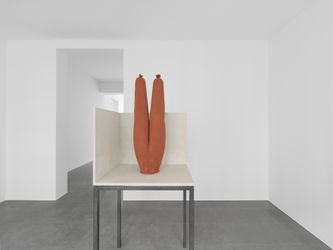
Xavier Hufkens is delighted to present Michel François’ fifth exhibition with the gallery. François will be the last artist to exhibit in the gallery’s location on 6 rue St-Georges, before the building undergoes a major refurbishment this year. Well-known for his interventionist approach to exhibition making, François’ works can be read as a poignant meditation on the architectural destruction that will precede the rebuilding.

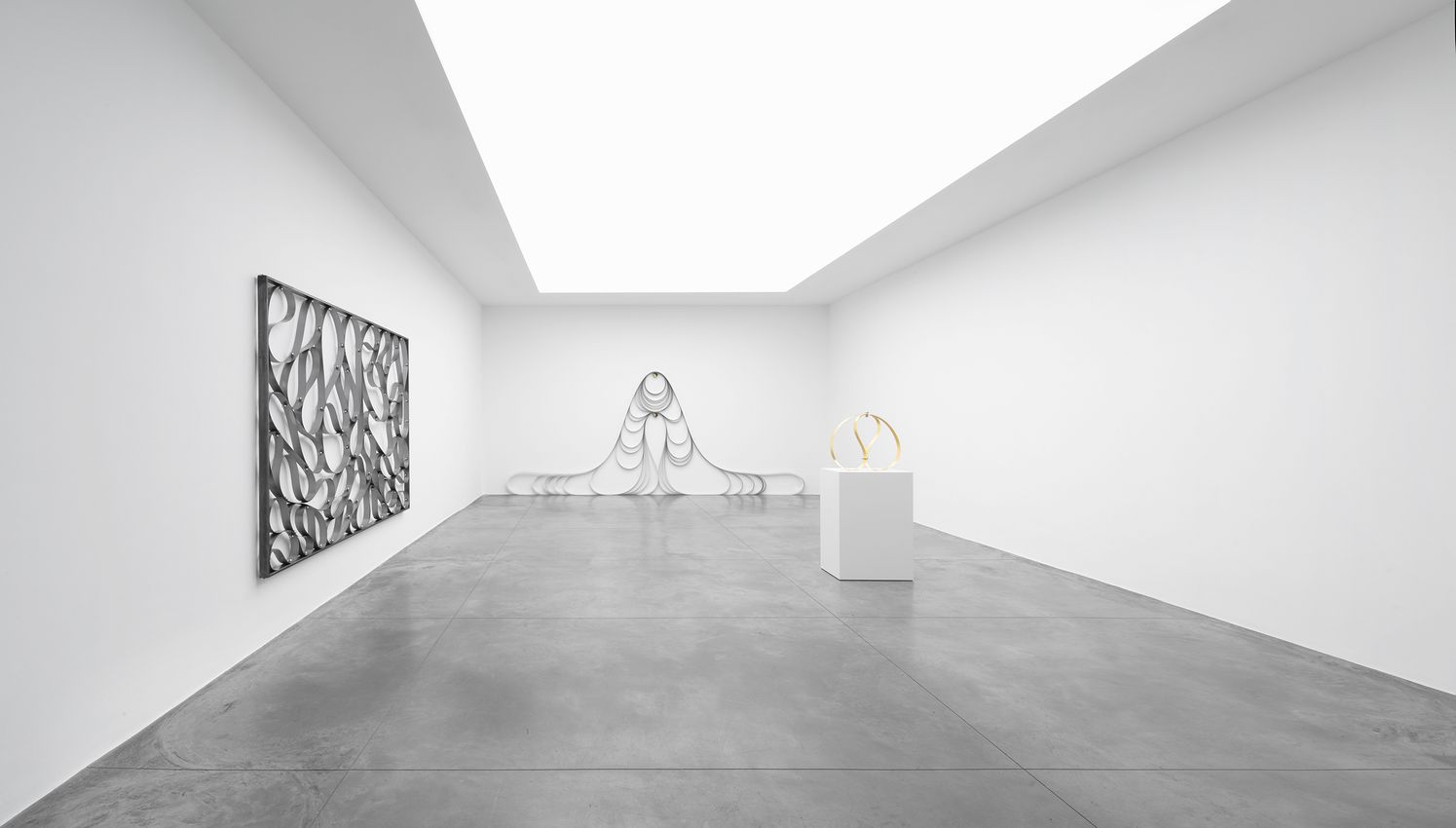
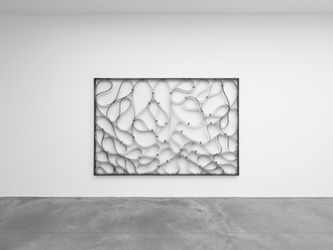
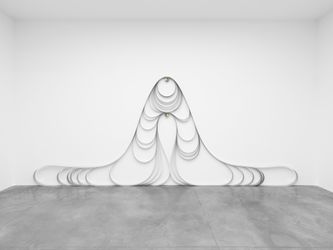
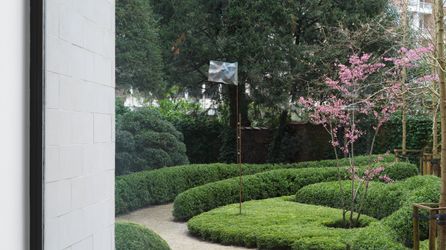
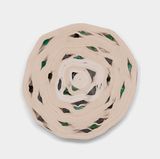
In the first room, the artist presents work from a new series of wall-mounted sculptures. From afar, it appears as though a sea of loops and curves has been sketched directly on the wall; as spontaneous as a doodle. Closer inspection reveals it to be a three-dimensional work in metal. The curvilinear ‘drawing’ is created from a single 95-metre-long ribbon of rolled steel. Yet, for all its linear grace, the metal possesses a powerful tensile strength and will instantly recoil unless firmly secured. François loops the ribbon across the frame, securing it at strategic points with strong magnets. As is typical of his work, the sculpture is the unpredictable result of a predetermined process. With great economy of means, he literally takes a ‘line for a walk’, without knowing in advance how the finished object will ultimately look. In this sense, the artist surrenders to the process and his material to create a piece that is as much about control (physically mastering the volatile, unpredictable steel), as it is about letting go (the material has a life of its own). The geometry of the frame precisely accords with the symmetry of the architecture, while the chaotic and almost irrepressible energy of the lyrical, free-flowing lines puncture the formal order. The wall is pierced with steel tubes, over which the sculpture is draped as if it had grown over organically. The steel-lined holes open up the room to the outside, a transparency that interrupts the protective gap between private and public.

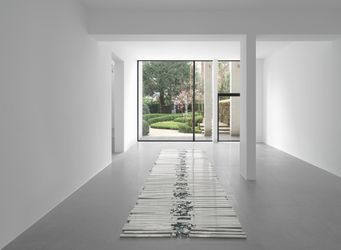
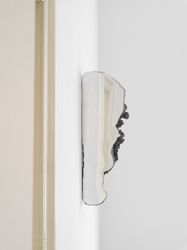
Like the steel ribbon drawings, the perfectly aligned silver glass tubes as presented in the garden room also play on the notions of chance and risk. An evolution of earlier sculptures, an action is repeated: the artist walked across the line of neon lights, crushing them underfoot. The work is premised on the artist’s physical intervention: a fractured line traced down the middle, like a pathway. Poetically, the mirrored tubes reflect the surroundings in various atmospheric conditions, capturing ever-shifting yet broken images of the white walls, glass windows, blue sky and bright green foliage of the garden. The neon lights or the mirrored tubes exemplify a theme that runs throughout Michel François’ oeuvre, namely his desire to divert clearly identifiable forms from our everyday lives—typically objects that are discarded and regarded as worthless—and to reframe them as artworks that point to alternative and potential realities. In this case, the push and pull between creativity and destruction, perfection and imperfection and, in a possible allusion to wider environmental concerns, the broken images of the natural world reflected in obsolete man-made goods. The result of trampling on the tubes can never be known in advance.

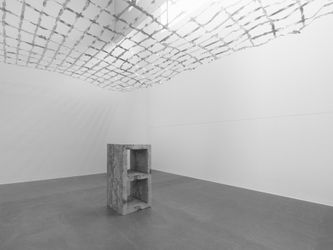
In the adjoining double-height room, François exhibits a metal lattice that is suspended from the ceiling in a horizontal position, so that it floats in mid-air. The work is made from three aluminium offcuts: the seemingly redundant grids that are left behind after a more valuable commodity—rectangular plates—have been punched from metal sheets. These offcuts have been bent, twisted and augmented with layers of glistening aluminium leaf. Images of intersecting horizontal and vertical lines—grids, nets, lattices, masonry walls, cages—reappear throughout François’ oeuvre. These works allude, in an oblique way, to current political realities surrounding borders that, for all their semblance of solidity and rigidity, are permeable structures through which both goods and people filter in both directions. For many, a border becomes a place to be reached at all costs, an object of desire in its own right, something infinitely precious—with the silver leaf in François’ work pointing to this inflated value.

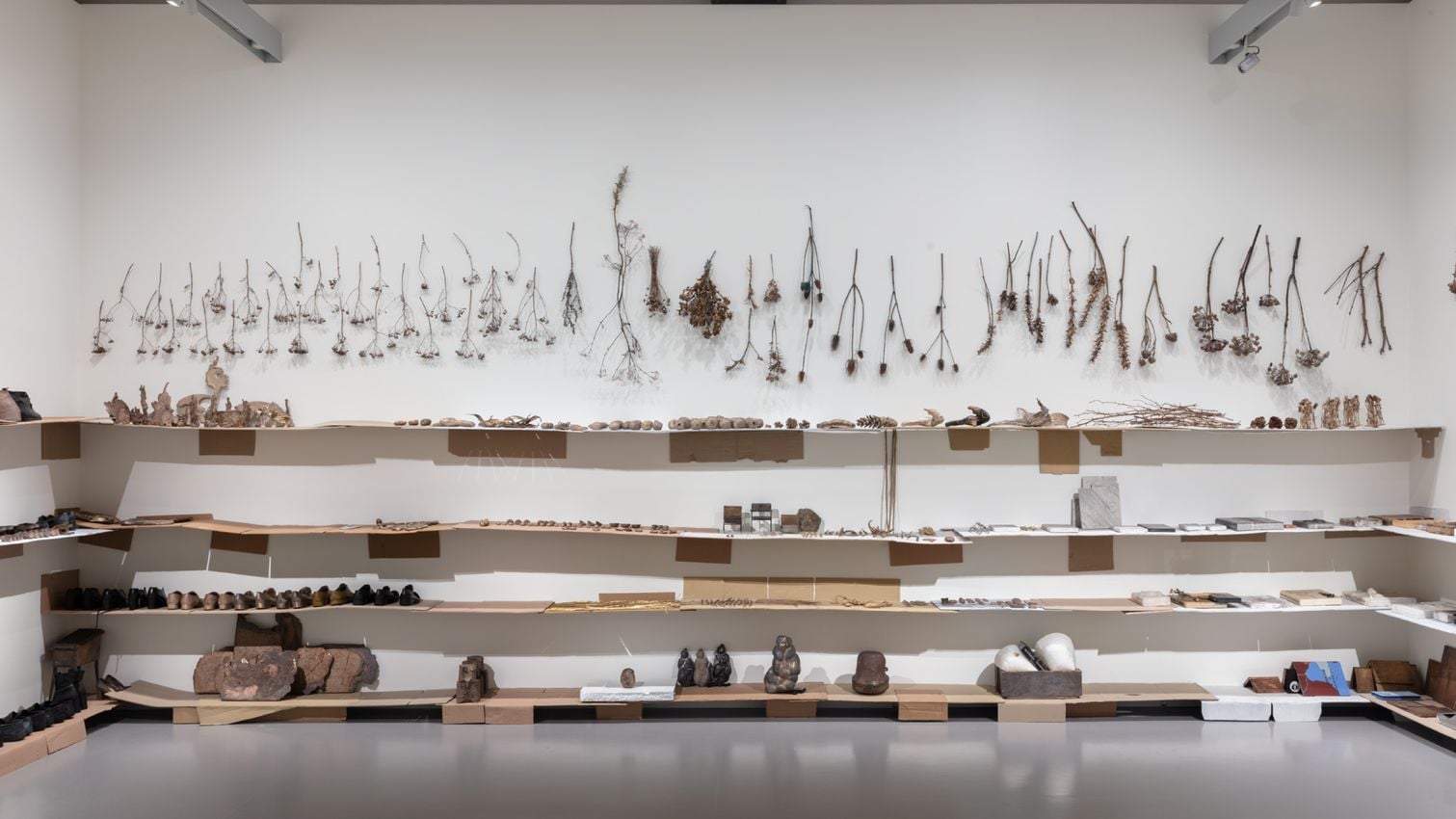
Including those not discussed here, the works in this exhibition engage, both metaphorically and materially, with the conditions of their setting. François has said that he thinks of his works as remnants, and that they have a limitless capacity for self-recycling. In the present exhibition, they dialogue with a space on the cusp of renovation, actuating a process of chaos, clearing and renewal.

Michel François (b. 1956, Saint-Trond, Belgium) lives and works in Brussels. He represented Belgium at the Venice Biennale with Ann Veronica Janssens in 1999 and his work was included in Documenta 9 (1992). BOZAR, Brussels, plans a large solo exhibition in 2022. Other museum exhibitions include Nineteen thousand posters. 1994-2016, Mac’s Grand Hornu (2011) and Frac île- de-France (2016); Pièce à conviction, Middelheim Museum, Antwerp (2016); Pieces of Evidence, Ikon Gallery, Birmingham (2013); Plans d’évasion, SMAK, Ghent and Iac Vileurbanne (2009-2010); Salon Intermédiaire, Centre Pompidou, Paris (2002); La Plante en nous, Haus der Kunst, Munich (2000); Kunsthalle Bern (2000).

Read More

Installation Views

About the Artist

Michel François is a conceptual artist and makes sculptures, videos, photographs, printed matter (posters and newspapers), paintings and installations. He claims no signature style but creates a web of shifting connections between his works and in each different exhibition. The titles of his solo exhibitions often point to his interest in contemporary reality, offices, domestic environments, surveillance, psychology and the police state. To cite just a few: State of Being, Urban Placarding, Expanded Bureau, Déjà vu, Theatre of Operations and Pieces of Evidence. The meanings in his works accumulate over time and vary according to their disposition in space, or the context. In a manner similar to that of the Arte Povera artists, François uses great economy of means to transform seemingly uncomplicated objects and materials, or traces of past events, into deeply resonant carriers of meaning. His work can be seen as exploration of cause and effect, and the ways in which simple gestures can change the status of an object or have important consequences. A number of recent sculptural works, without immediately revealing their origins or the way they were made, invite the viewer to consider the degree to which the hand of the artist, or chance, played a role in their formation. His lace-like wall sculptures, for example, are the result of the thermic shock provoked by pouring molten bronze onto a cold floor. He also collects drawings and transforms them into sculptures known as Scribbles.

View Artist Profile

Also Exhibiting at Xavier Hufkens

About the Gallery
Xavier Hufkens is one of Europe’s leading galleries for contemporary art. Located in Brussels, the gallery maintains a diverse exhibition programme with solo exhibitions of the gallery artists as well as group exhibitions and special projects. The gallery deals in a distinctive combination of painting, drawing, sculpture, photography, video and installation-based work.

The origins of the gallery date back to 1987, when Xavier Hufkens opened a gallery space in an un-refurbished warehouse in the neighbourhood of the South Station (Midi) in Brussels. During the early years, the focus of the gallery was upon mid-career and emerging artists and the gallery is known for having introduced some of the most influential contemporary artists to Brussels at a time when they were still relatively unknown. British sculptor Antony Gormley, who is still affiliated with the gallery, Felix Gonzalez-Torres and Rosemarie Trockel all showed in Belgium for the first time with Xavier Hufkens (Gormley in 1987; Gonzalez-Torres in 1991 and Trockel in 1993).

In 1992, the gallery moved to a 19th-century townhouse at 6 rue Saint-Georges, close to the Avenue Louise. Completely renovated by Belgian architects Paul Robbrecht, Hilde Daem and Marie-José Van Hee, the house quickly gained a reputation for being not just one of the most beautiful contemporary art spaces in the Belgian capital, but also one of the most interesting. The expanded exhibition programme coincided with the additional representation of a number of established artists from Belgium and abroad, including Richard Artschwager, Thierry De Cordier and Jan Vercruysse. In 1997, Hufkens expanded the gallery further by annexing the adjacent building and a number of new artists joined the gallery, including Louise Bourgeois, Roni Horn and Thomas Houseago.

A second space in the same street, at 107 rue Saint-Georges, opened in spring 2013. Located in the Galerie Rivoli, a mixed-use commercial development from the 1970s, the new gallery space was designed by Swiss architect Harry Gugger, who was previously in partnership with Herzog and De Meuron. Slegten & Toegemann, Brussels, managed the project. A third space opened in spring 2020, located at 44 Rue Van Eyck, designed by architect Bernard Dubois.

An eclectic but very clear vision underpins all of the gallery’s activities: ‘The definition of the gallery was established from the start. The common thread, then and now, is quality over and above everything else, which I find more intellectually challenging than a forced definition. From the early days I juxtaposed established artists such as Michelangelo Pistoletto with someone like Felix Gonzalez-Torres when he was totally unknown. Today I still mix my work: I have no problem showing Malcolm Morley … alongside Robert Ryman, or Willem de Kooning.’ [Xavier Hufkens in The Art Newspaper, Issue 220, January 2011, published online: 20 January 2011]

Xavier Hufkens represents some thirty artists from different generations. He was part of the six-member selection committee for Art Basel during seven years and also participates in up to five international Arts Fairs annually. The gallery has partnerships with the estates of Louise Bourgeois, Willem de Kooning, Robert Mapplethorpe and Alice Neel.
View Gallery Profile
Address
6 rue St-Georges
St-Jorisstraat
Brussels
Belgium
Opening Hours
Tuesday – Saturday
11am – 6pm
(1)
Brussels 6 rue St-Georges
Xavier Hufkens
6 rue St-Georges, St-Jorisstraat, Brussels, Belgium

Opening hours
Tuesday – Saturday
11am – 6pm
The art world in focus
