Press Release

Xavier Hufkens is pleased to present an exhibition on photography in the work of Belgian artist Michel François (b. 1956). The selection surveys the artist’s diverse and compelling encounters with the medium since the early 1990s. Among others, François’ photographs have been included in the following institutional exhibitions: Danser brut, BOZAR, Brussels, Belgium (2020); dix-neuf mille affiches. 1996-2016, Frac île-de-France, Rentilly, France (2016); 45.000 affiches (1994/2011), Mac’s Grand Hornu, Hornu, Belgium (2011); Plans d’évasion, SMAK, Ghent, Belgium (2009); Horror vacui, Belgian Pavillion, 48th Venice Biennale, Italy (1999). A major survey exhibition of François’ work will open at BOZAR in Brussels in spring 2023.

Much has been written about photography as a medium, but how to approach the photographs of an artist who subverts a signature style? How to define photographs within the practice of an artist internationally acclaimed for his personal universe and conceptual poetry that has found expression in such diverse media as sculpture, video, photography, printed matter, painting, and installation work? Rather than resort to familiar theories on photography, an intimate anthology offers solace here.

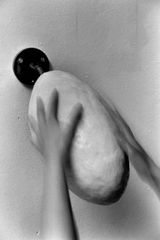
Since 1988, François has been making photographs at unbroken intervals, casually yet systematically, a selection of which are gathered here. The earliest photo in this selection, Savon Mâle, dates from 1991: it captures an anonymous touch, a tactile encounter between a child’s hands and a nostalgic ball of soap on a bar, a porte savon in French. The scent of rose, lavender, lemon or olive is offered as an invitation to the sensitive viewer. It is a striking image in our present post-Covid moment. Automated sanitisation stations and pocket-sized disinfectants are familiar to us all, connoting collective safety and control in the new every day.

Perhaps even more remarkable is the time of its creation. In 1991, the Internet became known to the public through HTML and the WWW project. Anyone with a computer and a connection could access it. Meanwhile, the digital image became an inherent part of our global reality, entity, and identity. In 2003, the science-fiction writer William Gibson used the word ‘atemporality’ to describe this hybridity: since the inception of the Internet, all eras seem to exist simultaneously. With each photographic capture, François injects, within the non-stop flow of digital images and physical detachment, a sensual counterpoint of pause and reflection. Savon Mâle, like its companion Savon Femelle (1991), occupies a middle ground between the timeless and the temporary.

The most recent photo in this exhibition, Mud Volcano (2022) was created in Baku, Azerbaijan during the installation of François’ exhibition Panopticon at the YARAT Contemporary Art Space. Here we see a close-up of a local natural phenomenon: bubbles of bursting gas in one of the many natural gas fields surrounding Baku. Seen against the background of the current war, the image—indirectly and without declamation—refers to global geopolitics and changing ecosystems. By emphasising singular moments of reality, François draws attention to the ways in which our society is determined, categorised, and understood. Through a precise use of intimacy and proximity, he reveals new meanings about a political era that is largely defined by detachment.

In the photo Film (2005), moonlight hits the car bonnets of a desolate residential area. Rather than autonomous images, François’ lens introduces authentic scenes. Imagining a before, a now and an after, each photograph elapses in time. The captured events are as generous as they are enigmatic, deliberately left undefined. This cinematic charge is perhaps best explained by the focus on what lies beneath the surface of the everyday. ‘Photography is for me the transcription of a form of identification or fusion with a moment of personal life, a block of sensation. (...) The subjects are often chosen for the vitality of the acts that they translate’,1 François explains.

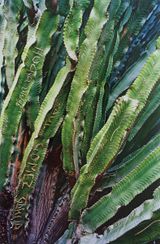
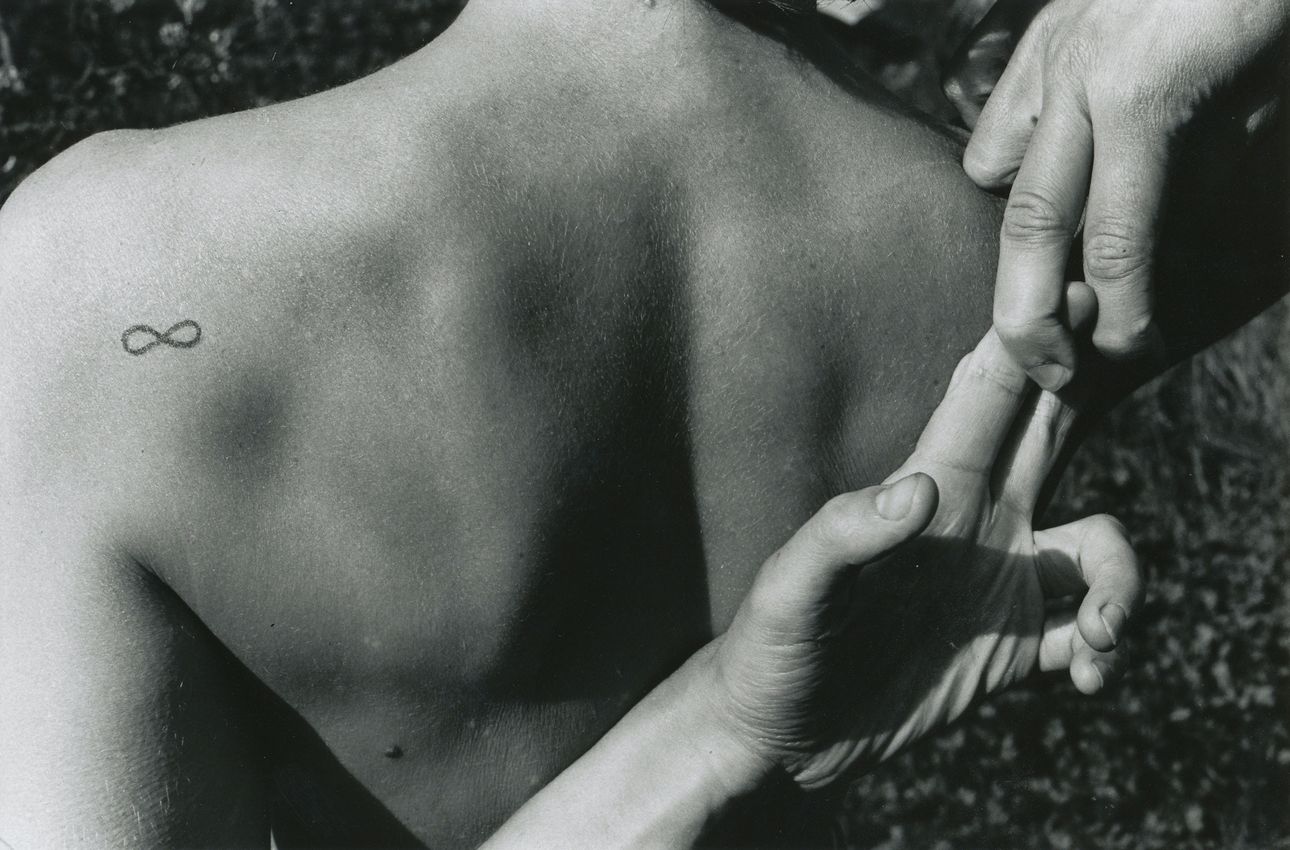
His is a humble and generous position, free of fixed definitions and always open to suggestion and synesthesia. The aspect of transformation is typical of a border. It is a physical and mental zone where one thing flows into another, a moment of in-betweenness, becoming and searching. A peripheral environment that embraces ambiguity and opacity. Although the scenes François portrays in his photography are extremely diverse, we could say that they all explore the boundary between nature-culture (culture as synonymous with human invention: money, tattoos, airports, residential areas). Look at Cactus Gravé (2001) where the skin of the plant bears traces of human incisions, or the soft stamps of Bébé Tampon (2003), or even the draped textile in Arbre India (2018) entwined, almost naturally, with the silhouette of a tree.

Abstract photographs such as Broken Neon (2002) or Froisser (2012)possess an incredibly strong plastic quality. They flirt with painting, sculpture, or installation art. It is therefore not surprising that François’ photographs frequently serve as preliminary sketches for later works in other media. The term prelude seems indeed appropriate here: an instrumental composition without a fixed form. Originally, it was a kind of improvisation, performed just before the real work. The photographs mentioned can be considered stand-alone works, but also, preludes to the sculptural works Néons brisés (Broken neon lights) (2003-14) and Bleu Ciel (Blue Sky) (2010).

Equally crucial is the fact that many of the photographs take their final form as posters. In 1994, François began to anonymously distribute these posters in public spaces. Each was printed on a fixed format of 120 x 180 cm. Since then, the posters (and thus the photographs) have been presented in exhibitions—often as stacks free for the taking—with the same standardised format. Narratives emerge through the juxtapositions occurring within a given ensemble. The choice of the poster as a carrier of the photograph is significant: captures from reality reappear in other realities. This format stimulates a string of associations. At the same time, it reinforces previously inherent dimensions of virtuosity and plasticity.

Looking at the photos, I can think of nothing but the thoughts of Simone Weil (1909-43), the French-Jewish mystic, philosopher, and political activist whose radicalism resonates greatly today. In her first publication, Gravity and Grace (1947), she pointed to, ‘attention as the rarest and purest form of generosity.’ ‘Beauty,’ she wrote, ‘captivates the flesh in order to obtain permission to pass right to the soul. Among other unions of contraries found in beauty there is that of the instantaneous and the eternal.’2

¹ Jean-Christophe Royoux, “Michel François: Forty-Nine Posters, 1994-2021,” in Michel François Photographe, 2011, p. 129

² Simone Weil, Gravity and Grace, English translation, Taylor & Francis Ltd, 2002, p. 148-49.

Read More
About the Artist

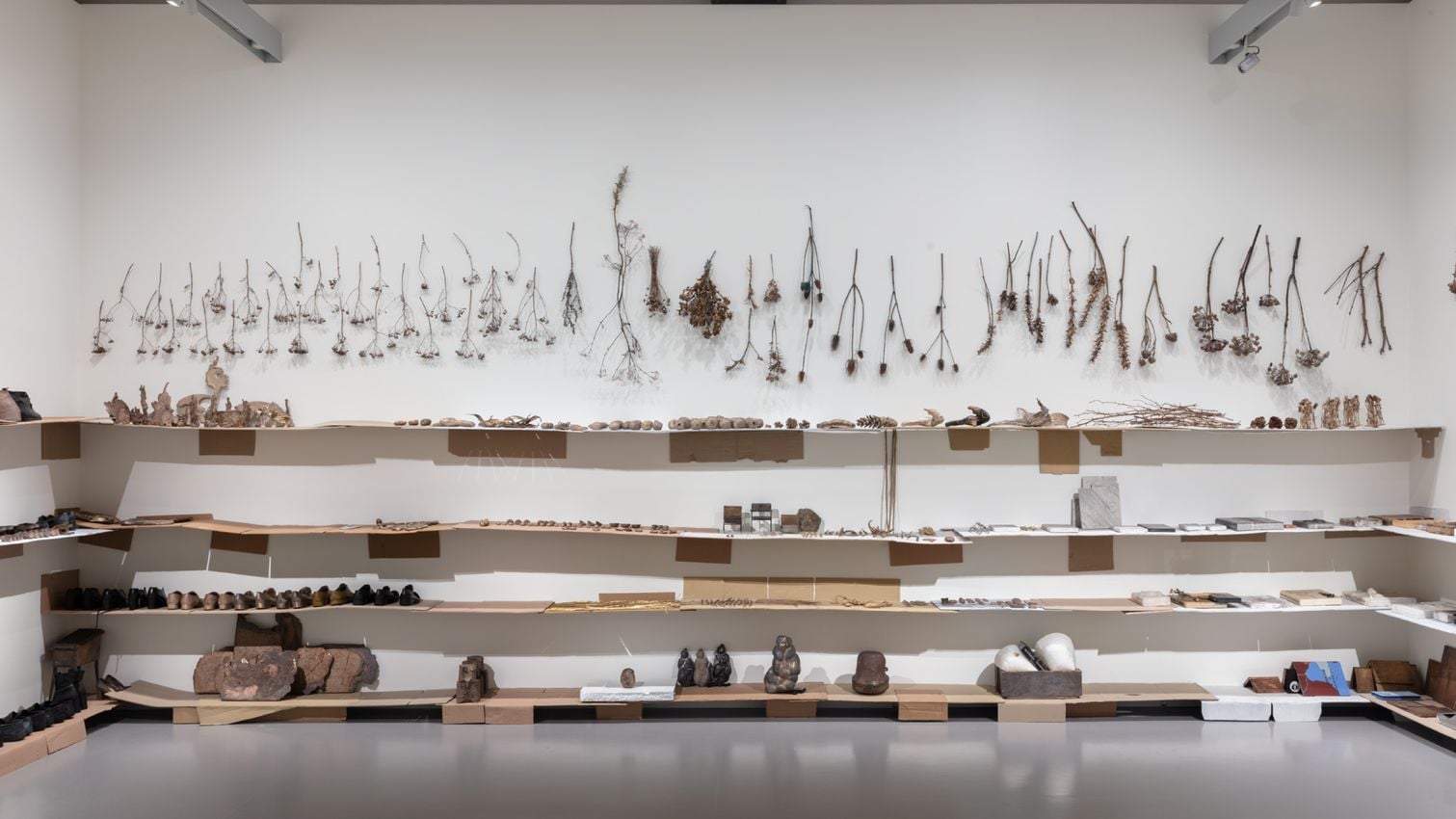
Michel François is a conceptual artist and makes sculptures, videos, photographs, printed matter (posters and newspapers), paintings and installations. He claims no signature style but creates a web of shifting connections between his works and in each different exhibition. The titles of his solo exhibitions often point to his interest in contemporary reality, offices, domestic environments, surveillance, psychology and the police state. To cite just a few: State of Being, Urban Placarding, Expanded Bureau, Déjà vu, Theatre of Operations and Pieces of Evidence. The meanings in his works accumulate over time and vary according to their disposition in space, or the context. In a manner similar to that of the Arte Povera artists, François uses great economy of means to transform seemingly uncomplicated objects and materials, or traces of past events, into deeply resonant carriers of meaning. His work can be seen as exploration of cause and effect, and the ways in which simple gestures can change the status of an object or have important consequences. A number of recent sculptural works, without immediately revealing their origins or the way they were made, invite the viewer to consider the degree to which the hand of the artist, or chance, played a role in their formation. His lace-like wall sculptures, for example, are the result of the thermic shock provoked by pouring molten bronze onto a cold floor. He also collects drawings and transforms them into sculptures known as Scribbles.

View Artist Profile

Also Exhibiting at Xavier Hufkens

About the Gallery
Xavier Hufkens is one of Europe’s leading galleries for contemporary art. Located in Brussels, the gallery maintains a diverse exhibition programme with solo exhibitions of the gallery artists as well as group exhibitions and special projects. The gallery deals in a distinctive combination of painting, drawing, sculpture, photography, video and installation-based work.

The origins of the gallery date back to 1987, when Xavier Hufkens opened a gallery space in an un-refurbished warehouse in the neighbourhood of the South Station (Midi) in Brussels. During the early years, the focus of the gallery was upon mid-career and emerging artists and the gallery is known for having introduced some of the most influential contemporary artists to Brussels at a time when they were still relatively unknown. British sculptor Antony Gormley, who is still affiliated with the gallery, Felix Gonzalez-Torres and Rosemarie Trockel all showed in Belgium for the first time with Xavier Hufkens (Gormley in 1987; Gonzalez-Torres in 1991 and Trockel in 1993).

In 1992, the gallery moved to a 19th-century townhouse at 6 rue Saint-Georges, close to the Avenue Louise. Completely renovated by Belgian architects Paul Robbrecht, Hilde Daem and Marie-José Van Hee, the house quickly gained a reputation for being not just one of the most beautiful contemporary art spaces in the Belgian capital, but also one of the most interesting. The expanded exhibition programme coincided with the additional representation of a number of established artists from Belgium and abroad, including Richard Artschwager, Thierry De Cordier and Jan Vercruysse. In 1997, Hufkens expanded the gallery further by annexing the adjacent building and a number of new artists joined the gallery, including Louise Bourgeois, Roni Horn and Thomas Houseago.

A second space in the same street, at 107 rue Saint-Georges, opened in spring 2013. Located in the Galerie Rivoli, a mixed-use commercial development from the 1970s, the new gallery space was designed by Swiss architect Harry Gugger, who was previously in partnership with Herzog and De Meuron. Slegten & Toegemann, Brussels, managed the project. A third space opened in spring 2020, located at 44 Rue Van Eyck, designed by architect Bernard Dubois.

An eclectic but very clear vision underpins all of the gallery’s activities: ‘The definition of the gallery was established from the start. The common thread, then and now, is quality over and above everything else, which I find more intellectually challenging than a forced definition. From the early days I juxtaposed established artists such as Michelangelo Pistoletto with someone like Felix Gonzalez-Torres when he was totally unknown. Today I still mix my work: I have no problem showing Malcolm Morley … alongside Robert Ryman, or Willem de Kooning.’ [Xavier Hufkens in The Art Newspaper, Issue 220, January 2011, published online: 20 January 2011]

Xavier Hufkens represents some thirty artists from different generations. He was part of the six-member selection committee for Art Basel during seven years and also participates in up to five international Arts Fairs annually. The gallery has partnerships with the estates of Louise Bourgeois, Willem de Kooning, Robert Mapplethorpe and Alice Neel.
View Gallery Profile
Address
6 rue St-Georges
St-Jorisstraat
Brussels
Belgium
Opening Hours
Tuesday – Saturday
11am – 6pm
(1)
Brussels 6 rue St-Georges
Xavier Hufkens
6 rue St-Georges, St-Jorisstraat, Brussels, Belgium

Opening hours
Tuesday – Saturday
11am – 6pm
The art world in focus