



Press Release

I’ve always privileged the way the work is experienced over its purely visual elements. (...) I’m always crafting experiences as much or more than I’m making “visual art.” — Evan Holloway

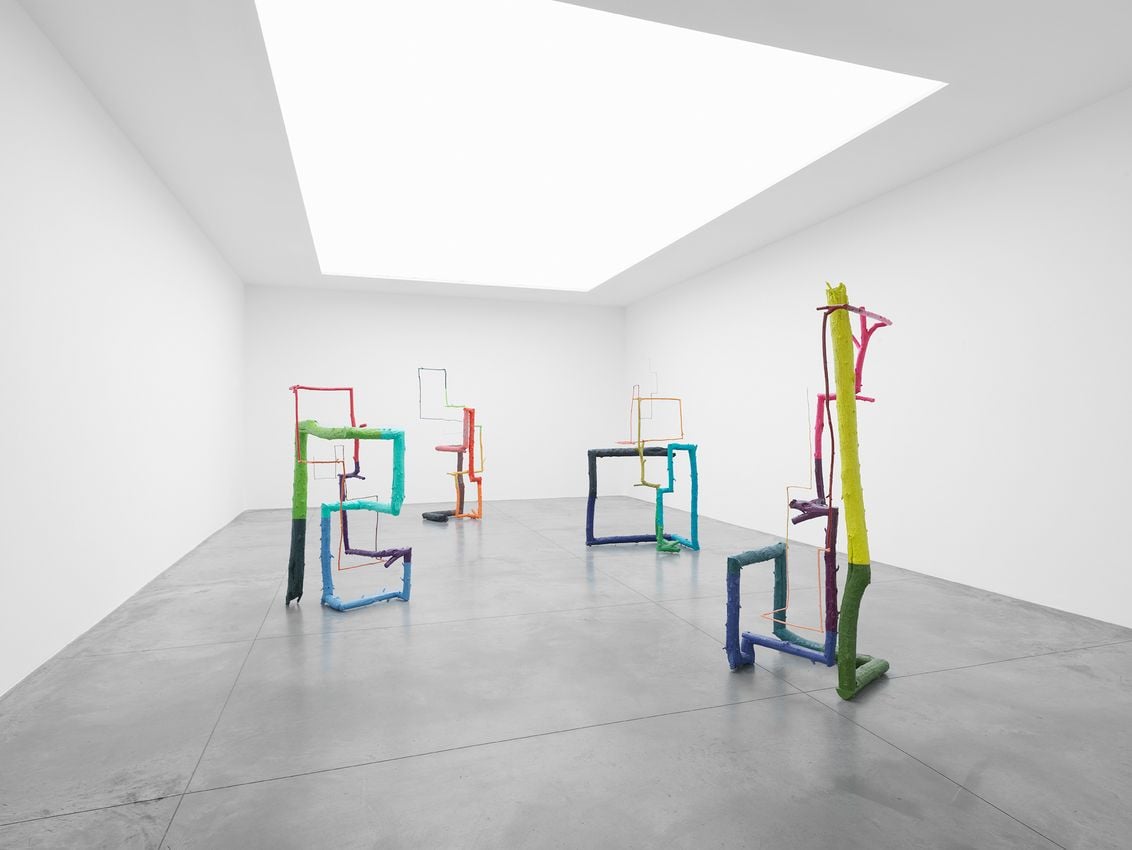
For his fifth exhibition at Xavier Hufkens, Los Angeles based artist Evan Holloway brings together new work in an extensive use of media, comprising ongoing series as well as more recent developments within his oeuvre. Drawing from his continuing interest in California’s contemporary culture and everyday objects—trees, plants, lamps, loops—Holloway’s sculptures are characterized by their formal experimentation and a love of craftsmanship. His work emphasises both qualities of individual human activity and the material experience: the way physical components are incorporated and assembled.

Although Holloway’s practice encompasses hybrid forms of sculpture, his interests have always been associated with the artistic heritage of the West Coast and build on the legacy of modernist and formalist sculptors such as Anthony Caro or Ibram Lassaw. This is manifested in Holloway’s tree sculptures, notably in his new single line trees, presented for the first time in this exhibition. Here, each bronze tree is recomposed to “grow” through only one limb, without any additional branches. The trees are multi-colored, and each color used, often tertiary, is preceded or followed by another color with which it shares a common hue conforming to color theories. If the branches were spread out into a single line, it would be apparent that they are methodical chromatic progressions. By contrast to organically occurring forms, these trees subject to human interference have been manipulated to reveal sharp angles, unpredictable colors and asymmetric shapes. The result is a seemingly off-beat relationship between form and color.

Another take on human manipulation of natural objects through art is apparent in his plant and lamp sculptures. The fabricated plants, such as Lactuca Serriola, are taken from the Southern Californian flora, and are paired with imitation growing-lamps looming overhead. Electrical light might be absent in the sculpture, yet the viewer’s understanding of the way plants and lamps interact results in the creation of an imaginary source of warmth and light. The idea of growth thus implied is enhanced by an impression of upward motion of the plants, visible for instance in Bitter Lettuce. These works can be understood not only as an assemblage of materials that is lifelike, but also as a spatial composition of objects and materials resembling the engagement with space of mid-twentieth century formalist sculptors.

Holloway’s head sculptures embody multi-colored heads with lighted noses blinking in a sequence of predetermined patterns. The heads are configured either stacked as “totems”, paired, or individually hanging upside down. Projecting a degree of empathy or antipathy, the viewer reacts to the noses blinking in an order of fixed patterns and attributes significance to the changes in the lights. The colored heads inevitably hint not only a notion of a mutual connection between the heads positioned in space but also suggest a hierarchal relationship within a community questioning who’s above and who’s below.

Recumbent form with incense is an allusion to the oft-repeated “modern” sculptural form, the Möbius loop. Because it contains a small incense stick, it is the smell that reaches the visitor before it sees the gigantic infinity symbol. When circling around the large metal work, scent and object coincide in one experience, the incense occupying a lot more space than its ponderous support. Rather than being a simple shape in space, the sculpture now expands beyond its conventional role and reveals its “meta” intention: it is a sculpture about sculpture. At the same time, as a result of the smoke and scent of the burning incenses, one can interpret this as related to post-war California’s infatuation with Eastern, esoteric mysticism and mind-altering substances—synthetic and otherwise.

Through their formal rearrangement, each work can be conceived as a conceptual product on its own, whilst intricately interweaving subtle remarks on modern sculpture’s tradition. Still, Holloway’s intention in creating an experience of purely visual elements is not by definition merely about the materiality of the work. What holds his attention just as much are hidden constructions, indicating that in his work the visible surface is just as relevant for its capacity to uncover an unseen structure of existence.

Evan Holloway (b. 1967, La Mirada, CA) lives and works in Los Angeles. His works feature in many public collections, including the Whitney Museum of Contemporary Art, Hammer Museum, LACMA, MCA, MOCA and the Smithsonian Hirshhorn Museum. Recent group exhibitions encompass Los Angeles - A Fiction at Astrup Fearnley Museet, Oslo, 2016-2017; Don’t Look Back: The 1990s at MOCA at The Geffen Contemporary at MOCA, Los Angeles, 2016, and Still Life: Capturing the Moment at Palm Springs Art Museum, Palm Desert, 2015-2016.

Read More

Installation Views

About the Artist

The sculptural work of Evan Holloway is based on his belief in the simple and fundamental transactions between people and objects. This also means that his sculptures are not just abstractions or decorations, but are to be understood as a commentary on contemporary society and its values. Evan Holloway uses the vocabulary of modern sculpture for rigorous formal experimentation and he constantly plays on allusions and materials. His questioning of perception and representation is also explored through his love of craftsmanship, and through his comments on ‘style’ or ‘taste’. His work is characterised by the playful use of colour and the introduction of human figures, mostly in the form of heads, masks or little creatures, and the mathematical, alphabetical and geometric systems that he uses to disrupt and re-order the associations typically attached to them.

View Artist Profile

Also Exhibiting at Xavier Hufkens

About the Gallery
Xavier Hufkens is one of Europe’s leading galleries for contemporary art. Located in Brussels, the gallery maintains a diverse exhibition programme with solo exhibitions of the gallery artists as well as group exhibitions and special projects. The gallery deals in a distinctive combination of painting, drawing, sculpture, photography, video and installation-based work.

The origins of the gallery date back to 1987, when Xavier Hufkens opened a gallery space in an un-refurbished warehouse in the neighbourhood of the South Station (Midi) in Brussels. During the early years, the focus of the gallery was upon mid-career and emerging artists and the gallery is known for having introduced some of the most influential contemporary artists to Brussels at a time when they were still relatively unknown. British sculptor Antony Gormley, who is still affiliated with the gallery, Felix Gonzalez-Torres and Rosemarie Trockel all showed in Belgium for the first time with Xavier Hufkens (Gormley in 1987; Gonzalez-Torres in 1991 and Trockel in 1993).

In 1992, the gallery moved to a 19th-century townhouse at 6 rue Saint-Georges, close to the Avenue Louise. Completely renovated by Belgian architects Paul Robbrecht, Hilde Daem and Marie-José Van Hee, the house quickly gained a reputation for being not just one of the most beautiful contemporary art spaces in the Belgian capital, but also one of the most interesting. The expanded exhibition programme coincided with the additional representation of a number of established artists from Belgium and abroad, including Richard Artschwager, Thierry De Cordier and Jan Vercruysse. In 1997, Hufkens expanded the gallery further by annexing the adjacent building and a number of new artists joined the gallery, including Louise Bourgeois, Roni Horn and Thomas Houseago.

A second space in the same street, at 107 rue Saint-Georges, opened in spring 2013. Located in the Galerie Rivoli, a mixed-use commercial development from the 1970s, the new gallery space was designed by Swiss architect Harry Gugger, who was previously in partnership with Herzog and De Meuron. Slegten & Toegemann, Brussels, managed the project. A third space opened in spring 2020, located at 44 Rue Van Eyck, designed by architect Bernard Dubois.

An eclectic but very clear vision underpins all of the gallery’s activities: ‘The definition of the gallery was established from the start. The common thread, then and now, is quality over and above everything else, which I find more intellectually challenging than a forced definition. From the early days I juxtaposed established artists such as Michelangelo Pistoletto with someone like Felix Gonzalez-Torres when he was totally unknown. Today I still mix my work: I have no problem showing Malcolm Morley … alongside Robert Ryman, or Willem de Kooning.’ [Xavier Hufkens in The Art Newspaper, Issue 220, January 2011, published online: 20 January 2011]

Xavier Hufkens represents some thirty artists from different generations. He was part of the six-member selection committee for Art Basel during seven years and also participates in up to five international Arts Fairs annually. The gallery has partnerships with the estates of Louise Bourgeois, Willem de Kooning, Robert Mapplethorpe and Alice Neel.
View Gallery Profile
Address
6 rue St-Georges
St-Jorisstraat
Brussels
Belgium
Opening Hours
Tuesday – Saturday
11am – 6pm
(1)
Brussels 6 rue St-Georges
Xavier Hufkens
6 rue St-Georges, St-Jorisstraat, Brussels, Belgium

Opening hours
Tuesday – Saturday
11am – 6pm
The art world in focus
