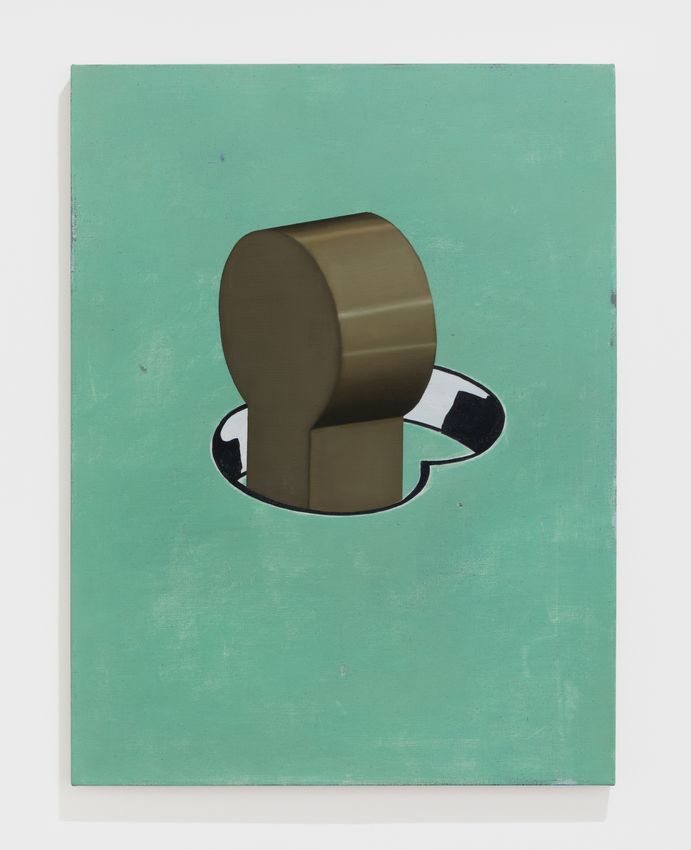
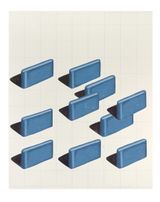
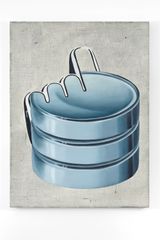
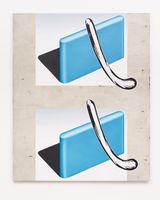
Anne Neukamp’s paintings hover on the edge of interpretation, utilising a chopped language of signs, logos, and images that echo their origins in our collective consciousness. Neukamp’s use of familiar signifiers invites us to contemplate the shifting associations of symbols passed down over decades, located in new contexts and combinations.
An Economy of Forms
Through calculated repetition, abstraction, and reconfiguration, Neukamp defamiliarises the icons of contemporary consumer life.
Typically, works take the form of large graphic symbols painted in outline, slipping in and out of monochromatic surfaces. These symbols are familiar, a lexicon of print characters and advertising shorthand, but amputated, blown-up, and abstracted into ambiguous pictorial mosaics. They range widely, from dashes, ampersands, quotation marks, and percent signs to envelopes, telephone receivers, stylised hands, and coins.
Neukamp’s works are painted in a combination of oils, egg tempera, and acrylic, offering various finishes that enable her to interweave multiple pictorial planes into a singular flat surface. Illusionistic objects are usually painted in oil, typographic elements in acrylic, and the scumbled grounds in tempera.
The efficiency of our communally abbreviated language is muddied by Neukamp in works like Notice (2017) and Brackets (2017). Contrary to its use in advertising, the fluid colour swatch in Notice doesn’t communicate information to manipulate or entice, but instead questions the method of its own transmission. Neukamp describes this usual purpose as ‘efficient and quickly recognizable, creating a closed circuit between intention and expectation.’ A form we might expect to see advertising makeup or paint is boxed off as a cut-out sample, pinned to the mottled grey ground by graphic paper clips. The image is severed from its usual straightforwardness, emptied of its information signalling. The paper clips are repeated in Brackets, now pinning a brochure-like rectangle with ambiguous coloured marks. Through repetition of motifs across works, Neukamp further distances her arsenal of signs from their origins, exposing their empty adaptability.
Digesting Images
Clearance (2019) features a widely used pictogram of a paper sheet with a folded corner. A fragment of an undefined character pokes behind and in front of the paper, with both sitting on a powdery, dry-brushed ground. It’s a sly reference to the image-making process, an empty picture that signals its own status as ‘abstract painting’.
Yet again, the same pictogram appears in Canapé (2019), multiplied in a stack with other scalloped, stamp-like rectangles. Neukamp’s titling can reveal the work’s play: a ‘canapé’ for efficient, neatly packaged consumption, and painting as a way to humorously question how we digest images. Communication and its condensation is the matter of Neukamp’s paintings, but it is in their entanglements that meaning is multiplied, forming hybrid connections between seemingly disparate modes.