





BERTRAND LAVIER
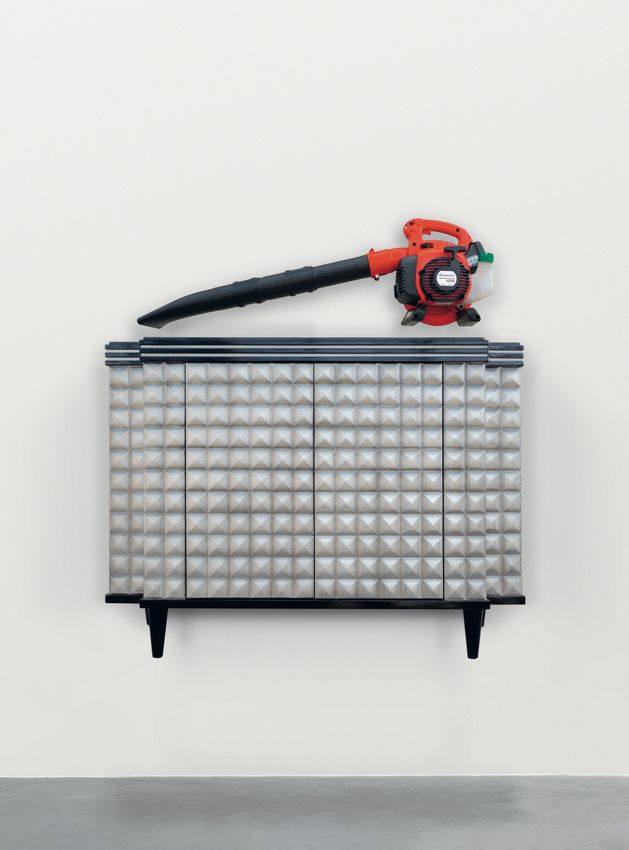
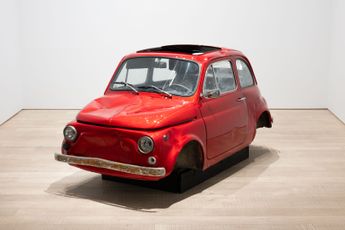
b. 1949, FranceAlthough French post-modern philosophers had a profound impact on American art during the 1980s, concepts such as simulacra and appropriation had less of an influence in their country of origin. The work of Bertrand Lavier, however, is an exception. Thanks to the heritage of Marcel Duchamp and the Nouveaux Réalistes, Lavier was able to give the art of the found object a typical French touch. Since the late 1960s, Lavier has reflected upon the relationship between painting and sculpture, representation and abstraction, life and art. An overriding characteristic of his work is its tongue in cheek attitude. In order to shape his ideas, Lavier developed a series of ‘demonstrations’: methods and strategies that enable him to question our intellectual baggage and to disrupt our most entrenched visual habits. His best-known intervention is to cover everyday objects with what he refers to as typical ‘Van Gogh-brushwork’. With this act, banal objects become artworks but, even more importantly, the object becomes a painted image of itself. Paradoxically, the representation of reality only occurs when the original object is hidden from view and completely disappears. Another ‘demonstration’ consists of combining two different objects in an absurd associative manner, such as a sculpture of Alexander Calder placed upon a radiator with an identical brand name, or La Bocca (Dali’s famous lip-shaped sofa) balanced upon a white freezer manufactured by Bosch.
Bertrand Lavier had a major retrospective at the Centre Pompidou, Paris, in 2012. Recent projects include En résonance avec la Biennale d’art Contemporain de Lyon at the Musée d’Art Moderne de St Etienne, France, 2011 and Afternoon, at Tsum, Moscow and the Hermes Museum in Seoul, Korea, 2010. In 2008, his work was shown at the Musée d’Orsay, Paris, in Musée Correspondances. Bertrand Lavier/Edouard Manet.
Betrand Lavier was born in Châtillon-sur-Seine, France, in 1949.
Courtesy Xavier Hufkens

Works at Xavier Hufkens









Recently Exhibited

Exhibiting Elsewhere

Works Elsewhere





Explore and Follow Artists Shaping Contemporary Art
A respected voice in contemporary art discourse.
Focusing on ambitious storytelling and insightful art-world commentary. Ocula Magazine publishes in-depth interviews, critical essays and timely analysis on the artists, exhibitions and ideas driving the global art world.
Learn more about Ocula Magazine
Showcasing the best of the art world.
Ocula partners with galleries from around the world to highlight their artists, artworks and exhibitions. Gallery membership is by application and invitation, with each member vetted by an independent panel.
Learn more about Ocula Membership
Specialises in the sale of major artworks.
Led by a team with deep ties to the world’s leading auction houses, galleries and collectors. Ocula’s advisory team offers bespoke services to high-net-worth clients from around the world who are looking to acquire the best of contemporary and modern art.
Learn more about our team and services