





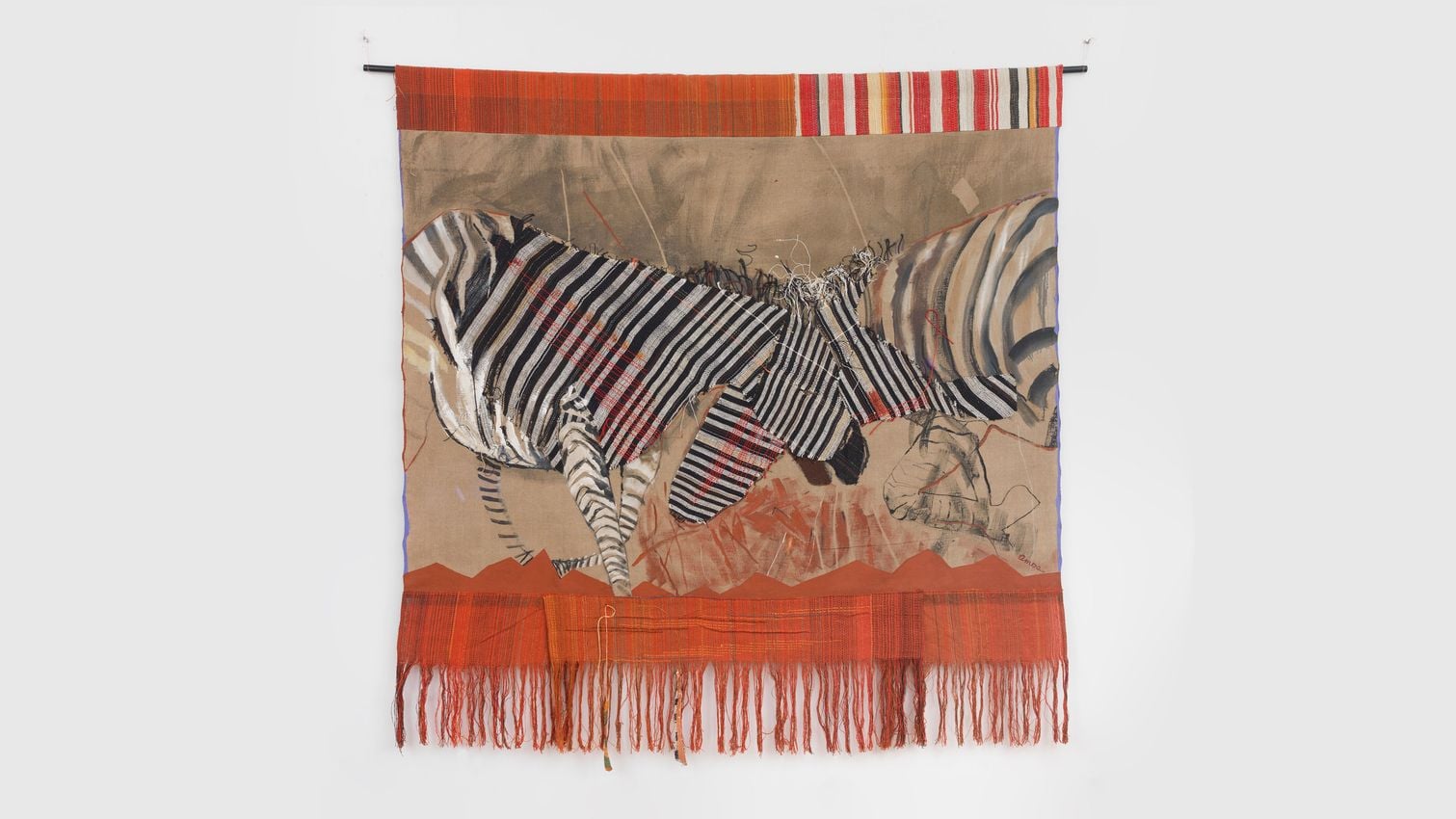
EMMA AMOS
1937-2020, United StatesEmma Amos was a pioneering American artist whose vibrant and deeply layered paintings, prints, and textiles challenged the conventions of contemporary art and the art world’s structures of power. As the only female member of the influential Spiral collective and a key participant in feminist art movements, Amos’s career stands as a testament to her commitment to interrogating race, gender, and privilege through art. Her bold, expressive use of colour and mixed media, as seen in major retrospectives such as Emma Amos: Color Odyssey at the Georgia Museum of Art, has established her as a vital figure in 20th- and 21st-century art.
Early Years
Emma Amos was born in Atlanta, Georgia, in 1937, where her parents owned a drugstore. She began painting and drawing at the age of six and attended segregated public schools before entering Antioch College in Ohio at sixteen. Amos spent a year abroad at the London Central School of Art, studying painting, printmaking, and weaving, and later earned a diploma in etching from the same institution in 1959. After her first solo exhibition in Atlanta in 1960, Amos moved to New York, where she worked as a designer and weaver, and pursued a master’s degree in art education at New York University.
Emma Amos Artworks
Emma Amos’s practice is defined by her innovative combination of painting, printmaking, and textiles, often integrating African fabrics, weaving, and collage into large-scale, unstretched canvases. Her art explores the intersection of race, gender, class, and privilege, using expressive colour and layered materials to create visual tapestries that question the norms of Western art and society.
Early Work and Spiral Collective (1960s)
In the 1960s, Amos’s paintings depicted scenes of Black middle-class domestic life, while her involvement with the Spiral collective—alongside Romare Bearden and Norman Lewis—marked her as the youngest and only female member of this historic group. Her early works, influenced by Abstract Expressionism and Colour Field painting, began to incorporate themes of identity and representation.
Experimentation and Feminist Engagement (1970s–1980s)
Amos’s practice evolved to include weaving, quilting, and illustration, notably for Sesame Street Magazine, as she balanced motherhood and art. She became active in feminist groups such as the Heresies Collective and Guerrilla Girls, deepening her engagement with issues of race and gender in art. Her Athletes and Animals series from the 1980s juxtaposed Black athletes with wild animals, addressing stereotypes and perceptions of power.
Mature Work and Major Series (1990s–2020)
In her later decades, Amos’s work grew increasingly complex, with series such as Falling exploring personal and societal anxieties, erasure, and the Black experience through dynamic, abstracted figures and layered symbolism. Her signature technique of bordering paintings with African textiles and integrating multiple media became central to her visual language.
Select Public Commissions, Awards and Other Accolades
- Ralph David Abernathy Memorial, Ralph David Abernathy Memorial Park, Atlanta, Georgia
- Larry D. and Brenda A. Thompson Award, Georgia Museum of Art (2016)
- Board of Governors, Skowhegan School of Painting & Sculpture
- Professor II and Department Chair, Mason Gross School of the Arts, Rutgers University
Exhibitions
Emma Amos has been the subject of numerous solo and group exhibitions at major institutions.
Solo Exhibitions
- Emma Amos: Color Odyssey, Georgia Museum of Art, Athens, travelling to Philadelphia Museum of Art and Munson-Williams-Proctor Arts Institute (2021)
- Black Bodies, RYAN LEE, New York (2017)
- True Colors: Paintings of the 1980s, RYAN LEE, New York (2016)
- Emma Amos: Paintings and Works on Paper, Herndon Galleries, Antioch University, Ohio (2004)
Group Exhibitions
- Soul of a Nation: Art ivn the Age of Black Power, Tate Modern, London; Crystal Bridges Museum of American Art, Bentonville; Brooklyn Museum, New York; The Broad, Los Angeles (2017–2020)
- We Wanted a Revolution: Black Radical Women 1965–1985, Brooklyn Museum; ICA Boston; California African American Museum, Los Angeles
- Spilling Over: Painting Color in the 1960s, Whitney Museum of American Art, New York
- With Pleasure: Pattern and Decoration in American Art 1972–1985, Museum of Contemporary Art, Los Angeles; Hessel Museum of Art, Bard College
Emma Amos FAQs
Where can I see Emma Amos’s artworks?
Emma Amos’s works are held in the collections of major museums including the Museum of Modern Art, Whitney Museum of American Art, Brooklyn Museum, Crystal Bridges Museum of American Art, and Cleveland Museum of Art. Her art is also regularly featured in travelling exhibitions and retrospectives at institutions such as the Georgia Museum of Art and the Philadelphia Museum of Art.
What are the main themes in Emma Amos’s art?
Emma Amos’s artwork explores the intersections of race, gender, class, and privilege, often challenging the conventions of the Western art canon and advocating for greater representation of Black women in contemporary art.
What techniques did Emma Amos use in her artworks?
Amos was known for her mixed-media approach, combining painting, printmaking, weaving, and collage. She frequently bordered her paintings with African textiles and used materials such as acrylic, etching, silkscreen, and photo transfer.
What was Emma Amos’s role in the Spiral collective?
Emma Amos was the youngest and only female member of Spiral, a historic collective of Black artists formed in 1964 to address issues of civil rights and representation in the art world.
Did Emma Amos receive recognition during her lifetime?
While Amos faced barriers due to her race and gender, her critical recognition grew significantly in the 2010s, culminating in major retrospectives and acquisitions by leading museums.
Are there any random and interesting facts about Emma Amos?
Emma Amos illustrated for Sesame Street Magazine and co-hosted the craft show Show of Hands for WGBH-TV in Boston. She was also a professor and department chair at Rutgers University, influencing generations of artists.
How do you pronounce Emma Amos’s name?
Emma Amos is pronounced ‘EM-uh AY-moss’.
Ocula | 2025


Explore and Follow Artists Shaping Contemporary Art
A respected voice in contemporary art discourse.
Focusing on ambitious storytelling and insightful art-world commentary. Ocula Magazine publishes in-depth interviews, critical essays and timely analysis on the artists, exhibitions and ideas driving the global art world.
Learn more about Ocula Magazine
Showcasing the best of the art world.
Ocula partners with galleries from around the world to highlight their artists, artworks and exhibitions. Gallery membership is by application and invitation, with each member vetted by an independent panel.
Learn more about Ocula Membership
Specialises in the sale of major artworks.
Led by a team with deep ties to the world’s leading auction houses, galleries and collectors. Ocula’s advisory team offers bespoke services to high-net-worth clients from around the world who are looking to acquire the best of contemporary and modern art.
Learn more about our team and services