





ERNA ROSENSTEIN
1913-2004, UkraineErna Rosenstein was a pioneering Polish artist and poet whose six-decade career, marked by survival, trauma, and resilience, made her one of the most compelling figures of the European avant-garde.
A Holocaust survivor and a founding member of the Kraków Group, Rosenstein’s art is celebrated for its unique blend of Surrealism, abstraction, and autobiographical storytelling—a practice that not only rewrote her own postwar trauma but also expanded the boundaries of contemporary art. In 2021, her first major solo exhibition outside Poland, Once Upon a Time at Hauser & Wirth, New York, introduced international audiences to her visionary oeuvre.
Early Years
Erna Rosenstein was born into a Jewish family in Lviv (then Lwów, Austria-Hungary; now Ukraine) and raised in Kraków. Defying her family’s wish for her to pursue law, she studied art at the Wiener Frauen Akademie in Vienna (1932–1934) and the Academy of Fine Arts in Kraków (1934–1937). As a student, Rosenstein became active in leftist politics and was closely associated with the first Kraków Group, a circle of avant-garde artists including Tadeusz Kantor and Jadwiga Maziarska.
Her formative years included a transformative visit to Paris in 1937–1938, where she encountered the Exposition Internationale du Surréalisme and the infamous Degenerate Art Exhibition in Berlin—experiences that profoundly shaped her artistic outlook.
Erna Rosenstein Artworks
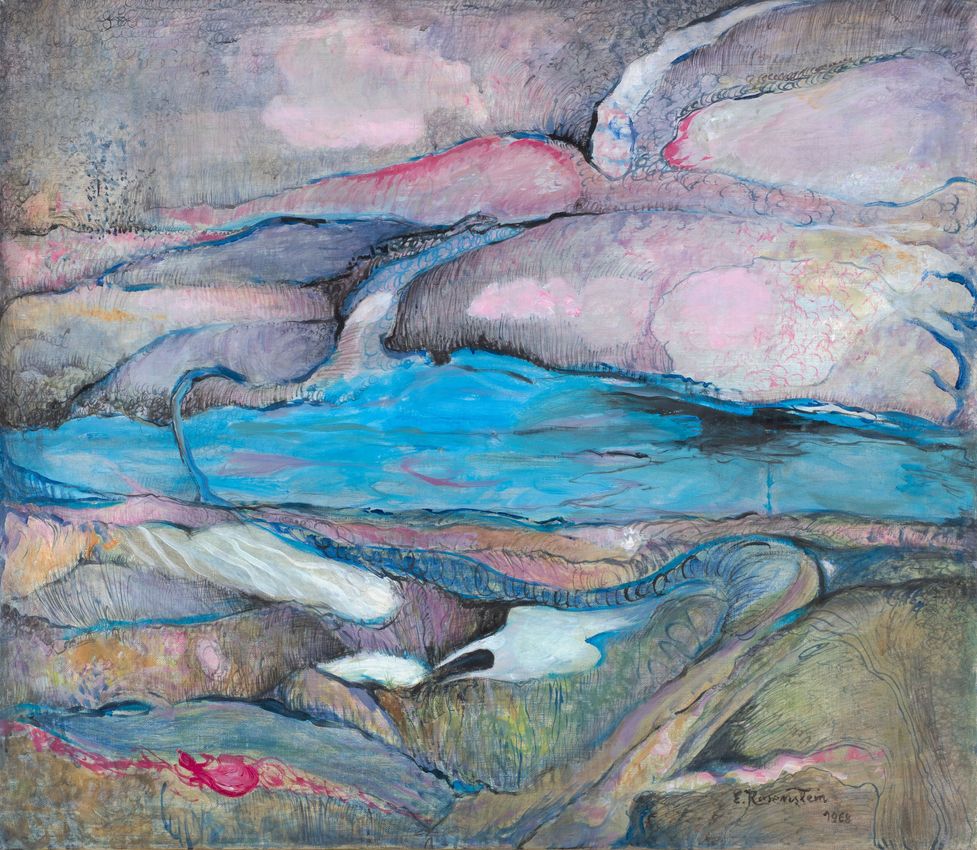
Rosenstein’s art is defined by an oscillation between biomorphic abstraction and autobiographical figuration, often filtered through the allegorical and fantastical. Her paintings, drawings, assemblages, and poetry grapple with memory, trauma, and longing, using paint, ink, and found materials to evoke a world tinged with enchantment and fairytale.
Early and Postwar Works
Rosenstein’s prewar works were lost during the Holocaust, but after surviving the war—during which her parents were murdered and she lived under false identities—she resumed painting in 1945. Her early postwar works, such as Extermination Train (1947–48) and Screens (1951), confront the horrors of the Holocaust and personal loss through emotionally charged imagery and surreal motifs.
The 1950s–1970s: Abstraction and Assemblage
During the Socialist Realist period (1949–1955), Rosenstein withdrew from official artistic life, working outside the mainstream and developing her own language of abstraction and memory. In the 1950s, she began incorporating everyday objects and remnants into her work, creating assemblages and ‘memory holders’ that blurred the line between art and life. Her paintings from this era, such as Poświata (Afterglow) (1968) and Kwiaty piekła (Hell Flowers) (1968), are noted for their vivid colours, biomorphic forms, and dreamlike landscapes.
Later Years and Legacy
Rosenstein continued to experiment with materials and forms well into the 1980s, producing untitled assemblage sculptures and artist books. She published seven volumes of poetry, including Ślad (Trace) (1972) and Spoza granic mowy (From Beyond the Edges of Speech) (1976). Her work, once marginalised, is now recognised as central to both Polish and global Surrealism, and her influence resonates in contemporary art today.
Select Awards and Accolades
- Cyprian Kamil Norwid Art Critics Award (1976)
- Jan Cybis Prize, Poland’s highest artistic honour (1996)
Exhibitions
Erna Rosenstein has been the subject of both solo and group exhibitions at major institutions.
Solo Exhibitions
- Erna Rosenstein: Aubrey Williams. Ziemia otworzy usta, Museum of Art in Łódź (2022–2023)
- Erna Rosenstein, Hauser & Wirth, Zurich (2022–2023)
- Erna Rosenstein: Once Upon a Time, Hauser & Wirth, New York (2021)
- Erna Rosenstein, Zachęta National Gallery of Art, Warsaw (1967)
Group Exhibitions
- Action, Gesture, Paint: Women Artists and Global Abstraction 1940–1970, Whitechapel Gallery, London (2023)
- Surrealism Beyond Borders, Metropolitan Museum of Art, New York, and Tate Modern, London (2021–2022)
- documenta 14, Athens and Kassel (2017)
- Unorthodox, The Jewish Museum, New York (2016)
Erna Rosenstein FAQs
Where can I see Erna Rosenstein’s artworks?
Erna Rosenstein’s artworks are held in major public and private collections, including the National Museums in Warsaw, Wrocław, and Kraków, the Muzeum Sztuki in Łódź, and the Art Institute of Chicago. Internationally, her works have been exhibited at Hauser & Wirth (New York and Zurich), Whitechapel Gallery (London), and The Jewish Museum (New York).
What are the main themes in Erna Rosenstein’s art?
Erna Rosenstein’s art explores memory, trauma, loss, and survival, often drawing on her experiences during the Holocaust and postwar Poland. Her works are known for their surreal, allegorical imagery and innovative use of materials.
How did Erna Rosenstein survive the Holocaust?
Erna Rosenstein survived the Holocaust by living under false identities and constantly moving. Her parents were murdered during their escape from Warsaw in 1942, an event that deeply influenced her art and poetry.
Is Erna Rosenstein also known for her writing?
Yes, Erna Rosenstein published seven volumes of poetry and was regarded as an important literary figure in addition to her visual art practice.
Are there any interesting facts about Erna Rosenstein?
Erna Rosenstein’s brother, Paul N. Rosenstein-Rodan, was a noted economist who coined the term “underdeveloped countries.” She was married to the renowned Polish-Jewish literary critic Artur Sandauer.
How do you pronounce Erna Rosenstein’s name?
Rosenstein is pronounced ‘r-OH-z-uh-n-s-t-EE-n’.
Ocula | 2025


Explore and Follow Artists Shaping Contemporary Art
A respected voice in contemporary art discourse.
Focusing on ambitious storytelling and insightful art-world commentary. Ocula Magazine publishes in-depth interviews, critical essays and timely analysis on the artists, exhibitions and ideas driving the global art world.
Learn more about Ocula Magazine
Showcasing the best of the art world.
Ocula partners with galleries from around the world to highlight their artists, artworks and exhibitions. Gallery membership is by application and invitation, with each member vetted by an independent panel.
Learn more about Ocula Membership
Specialises in the sale of major artworks.
Led by a team with deep ties to the world’s leading auction houses, galleries and collectors. Ocula’s advisory team offers bespoke services to high-net-worth clients from around the world who are looking to acquire the best of contemporary and modern art.
Learn more about our team and services