





EVELYN TAOCHENG WANG
b. 1981, ChinaThrough painting, drawing, illustration, calligraphy and video, Evelyn Taocheng Wang’s artistic practice addresses themes from feminism to colonialism via queer theory and traditional Chinese art. Her witty work asks viewers to address cultural questions and reconsider what shapes our perceptions.
Early Years
Evelyn Taocheng Wang was born in Chengdu in 1981. Learning about European modernism and Soviet realism in high school, she went on to study landscape painting, Chinese classical literature and calligraphy at Nanjing Normal University, graduating in 2006. She left China for Germany in 2007, where Monika Baer advised her to enrol at the Städelschule in Frankfurt. Following this, she moved to Amsterdam and became a resident at De Ateliers. She has always looked outside the traditional ways of understanding art. She has said: “As students, we visited museums and copied paintings, but I struggled with the fact that everyone could interpret artworks differently.”
Evelyn Taocheng Wang: Artworks
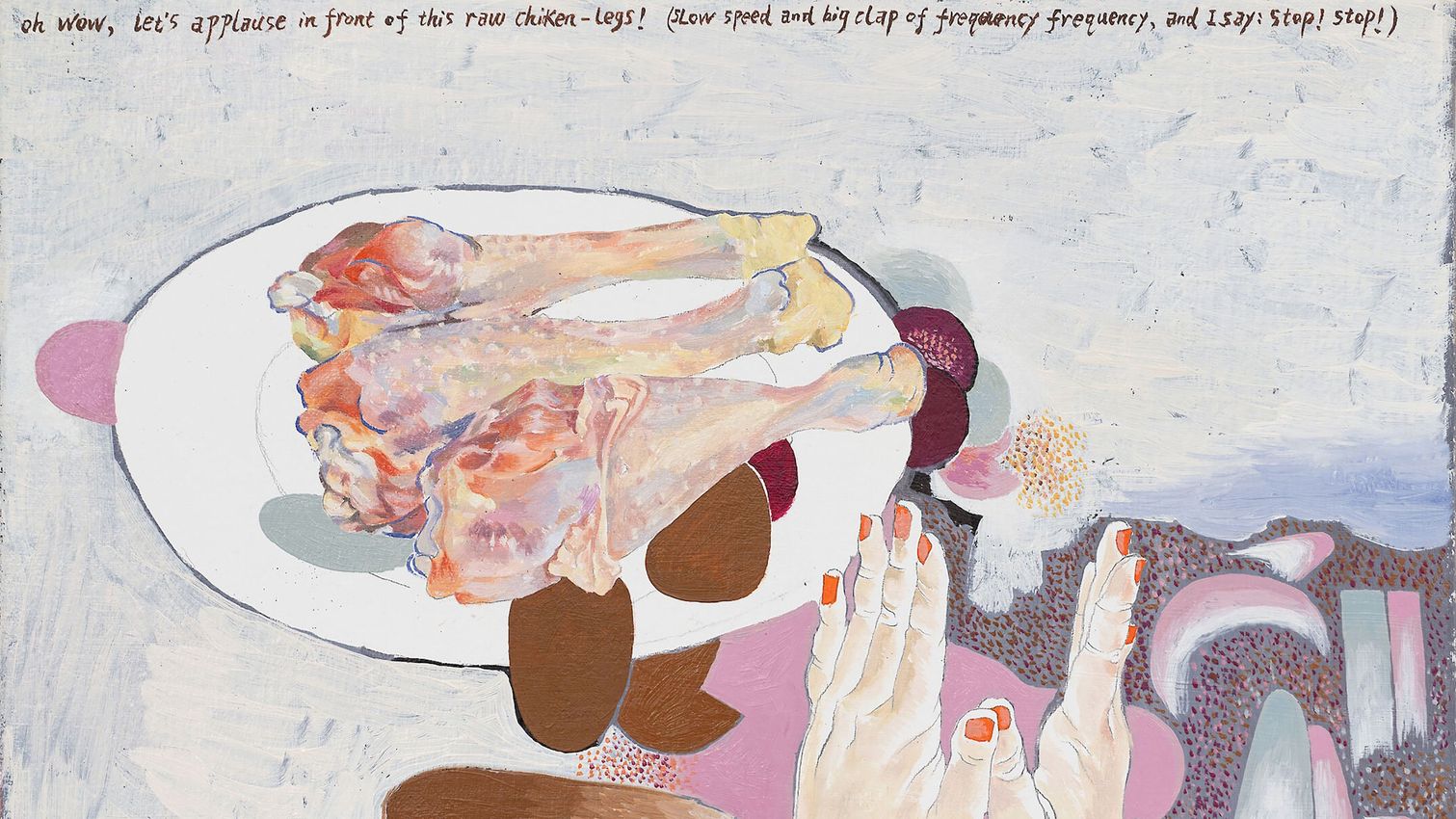
Notions of authenticity and identity lie at the heart of Wang’s work. As a China-born, German- and Dutch-educated artist, living in the Netherlands, she can see identity as a multi-layered idea. She also addresses questions about the consequences of globalisation and migration. Her work blends the written word (often in English) with muted backgrounds and line drawings, as well as textiles and found objects, creating pieces that radiate emotion. In artworks that reference European art history alongside her lived experience having relocated to the Netherlands, humour is a key element of Wang’s practice, and she often considers cultural assimilation, expressions of gender identity and personal appearance.
- Wit comes to the fore in the eight-metre-long Booklet of Bachmann Lost Leather Shoulder Bag Refund (2020), based on a real story of Wang leaving a handbag in a German café, only for an upstanding citizen to hand it in to the police. When Wang was reunited with the bag, she also received a five-page crime report—she collaged the report and a photo of the handbag on to a rice paper scroll that also features a scene of sheep grazing.
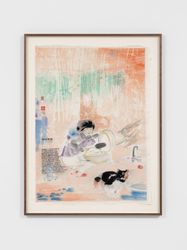
- Using ink, pigment, mineral colour and glue, Hygiene Me (2021) features a woman scrubbing a lavatory, interspersed with a cat, and various other receptacles for water. The drawn elements of the piece seem simultaneously to attract the viewer and disappear into the background.
- Influences from Wang’s German education are present in her work. For example, 2026’s Frog Princess Checks her Smartphone in Front of the Window of August Macke’s Hat Shop begins with a recreation of Macke’s 1914 painting but adds in a Frog Princess in the corner, creating discussion around modern deepfakes and questioning what we know to be real.
Evelyn Taocheng Wang: Awards
- Dorothea von Stetten Prize (2016)
- Dolf Henkes Award (2018)
- ABN Amro Art Prize (2019)
- 2025 Wolfgang Hahn Prize (2025)
Evelyn Taocheng Wang: Exhibitions
Select Solo Exhibitions
- Sweet Landscape, Museion, Bolzano (2026)
- Friendship, Museum Ludwig, Cologne (2025)
- Between the Shadow and the Highlight (with Xinyi Cheng), Antenna Space, Beijing (two-person exhibition) (2025)
- Spreading Elegance, Galerie Fons Welters, Amsterdam (2025)
- Patternmaster, Carlos/Ishikawa, London (2024)
- An Organic Day, Kayokoyuki, Tokyo (2024)
- Het Licht is Rond (The Light is Round), Dordrechts Museum (2023)
- An Equivocal Contrast, Rockbund Art Museum, Shanghai (2023)
- Horizons, Museum for East Asian Arts, Cologne (2022)
- Norwegian Music in Dutch Windows, Kayokoyuki, Tokyo (2022)
- Reflection Paper, Galerie Fons Welters, Amsterdam (2021)
- Heart of Eyeshadows, Antenna Space, Shanghai (2021) *Sour Gnossiennes, Museum Abteiberg, Mönchengladbach (2020)
- When I sought her along the river, she stood in the middle of the water, Kevin Space, Vienna (2020)
- Spreading Elegance, FRAC Champagne-Ardenne, Reims (2019)
- No Blood in the Afternoon, Carlos/Ishikawa, London (2019)
- What is he afraid of?, KW Institute for Contemporary Art, Berlin and Company, New York City (2018)
- For An Embarrassed Person It is Always Very Difficult To Avoid Embarrassing Things, Carlos/Ishikawa, London (2017)
- Heatweave Wrinkle, Château Shatto, Los Angeles (2017) A Home Made Travel MV Series, Galerie Fons Welters, Amsterdam (2015)
- Someone who lives in great comfort is completely enjoying it but still prays for even more fortune, Johan Berggren Gallery, Malmö (2014)
- Action...Cut!, Jakarta Yuz Museum, Jakarta (2013)
- What is Revealed by the Tide, OV Gallery, Shanghai (2012)
- Private Party, Vierter Stock Galerie, Berlin (2008)
Select Group Exhibitions
- Vies miniscules (Tiny lives), Panthéon, Paris (2026)
- The Architect and The Housewife: Cleaning the House, Building the Future, Groninger Museum (2026)
- House of Nisaba: New Stories of Painting, Moderna Museet, Stockholm (2026) *Skincare, Antenna Space, Shanghai (2025)
- 1985–2025, Galerie Fons Welters, Amsterdam (2025)
- Foreigners Everywhere, 60th Venice Biennale (2024)
- One And All: New Artistic Styles of Contemporary Painting, The National Art Museum of China (NAMOC), Beijing (2024)
- Horizons: Is there anybody out there?, Antenna Space, Shanghai (2023)
- Linhas Tortas, Mendes Wood DM, São Paulo (2023)
- Note to Self, Gallery Sofie Van de Velde, Antwerp (2022)
- Fashion Show: Clothing, Art and Activism, The Glucksman, Cork (2022)
- It’s Just a Phase, Kjøpmannsgata Ung Kunst (KUK), Trondheim (2021)
- Shaking the Habitual, Huidenclub, Rotterdam (2021)
- Frequencies of Tradition, Times Museum, Guangzhou (2020)
- In my room, Antenna Space, Shanghai (2019)
- PSST... A Play on Gossip, Fondazione Giuliani, Rome (2018)
- Manifesta 11, Zurich (2016)
- Offspring 2014, De Ateliers, Amsterdam (2014)
- Winter Screening, Almanac Projects, London (2013)
- Art Taipei 2012, Taipei World Trade Centre (2012)
- Learning from the Literati 2, OV Gallery, Shanghai (2011)
- Absolute Distance, White Space Gallery, Beijing (2010)
Further Reading
- Evelyn Taochen Wang’s Instagram
- Artist profile at Carlos/Ishikawa
- Spotlight from Ocula magazine before the 2024 Venice Biennale
- Interview ahead of 2026’s Sweet Landscape exhibition
Evelyn Taocheng Wang FAQs
Why did Evelyn Taochen Wang work in a massage parlour?
Wang worked in a massage parlour in Amsterdam’s red light district in order to finance her education. She kept diaries about the experience that inspired the 2015 series Massage Near Me. Her witty yet unsettling drawings include A Hong Kong-Dutch Client Licking My Arm During the Massage Treatment (2015) and __Excuse Me! You Are Not a Real Lady!_ (2015).
Who are Evelyn Taocheng Wang’s influences?
Wang is an admirer of the Canadian American painter Agnes Martin, who used grids as the basis of many of her abstract works. Wang also uses abstract grids, on to which she adds still life (for example, 2022’s Flat Peach and Imitation of Agnes Martin). Wang has said that Martin’s work reminds her “that a painting can be created with different layers and illuminate each of them” and that it inspires her to mix her oil thinly.
Does Evelyn Taocheng Wang paint Dutch Windows?
Yes, Wang has painted a series of Dutch Windows, beginning in 2020. Dutch windows don’t often feature curtains, and Wang’s monochromatic multi-layered images portray a blend of traditional architecture and the way that light plays on the surfaces of buildings.
Ocula


Representative Artworks
View story




Explore and Follow Artists Shaping Contemporary Art
A respected voice in contemporary art discourse.
Focusing on ambitious storytelling and insightful art-world commentary. Ocula Magazine publishes in-depth interviews, critical essays and timely analysis on the artists, exhibitions and ideas driving the global art world.
Learn more about Ocula Magazine
Showcasing the best of the art world.
Ocula partners with galleries from around the world to highlight their artists, artworks and exhibitions. Gallery membership is by application and invitation, with each member vetted by an independent panel.
Learn more about Ocula Membership
Specialises in the sale of major artworks.
Led by a team with deep ties to the world’s leading auction houses, galleries and collectors. Ocula’s advisory team offers bespoke services to high-net-worth clients from around the world who are looking to acquire the best of contemporary and modern art.
Learn more about our team and services