






GRIM PARK
b. 1987, South KoreaKorean artist Grim Park transforms traditions of Korean Buddhist painting into daring statements on identity, queerness, and society.
Early Years
Born in Seoul in 1987, Grim Park studied taenghwa (Buddhist hanging painting) in the traditional apprentice system for three years before enrolling at Dongguk University in 2012. There, the artist continued his studies of taenghwa and traditional Korean painting such as damchae, which involves layering pigments upon pigments on delicate silk. Park’s experience with the conservatism of the genre sharpened his resolve to address personal and social narratives through his art, most notably those arising from his identity as a gay man in South Korea.
Grim Park Artworks
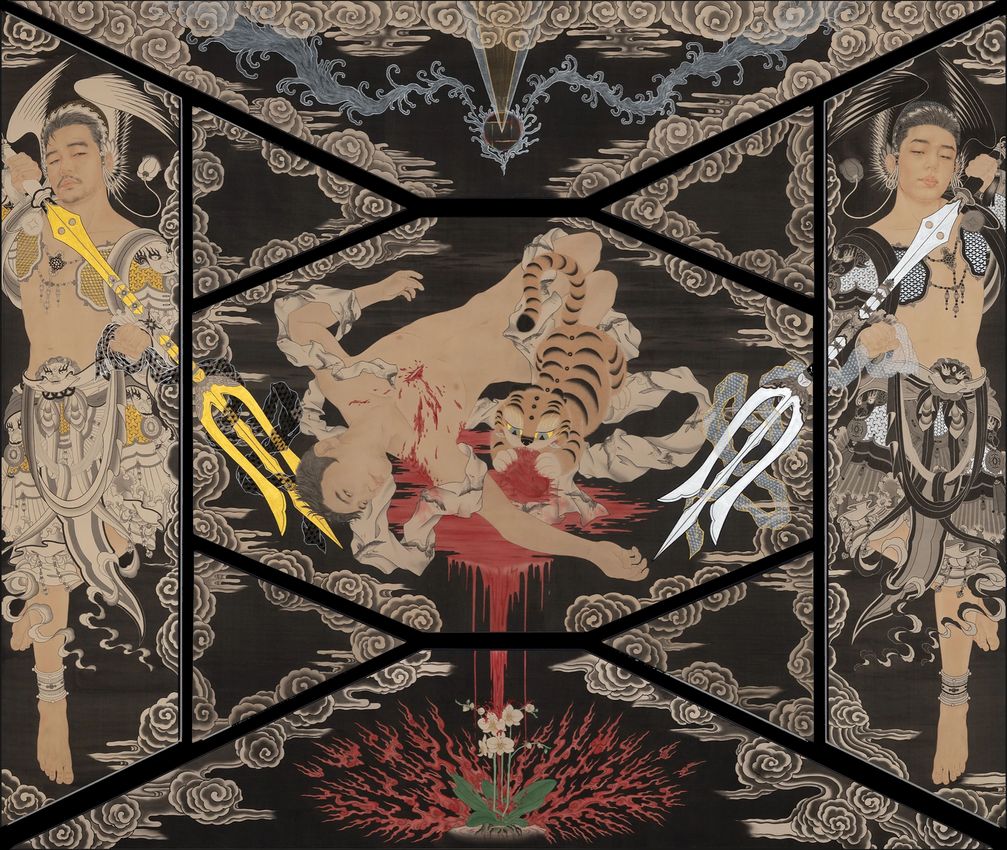
Grim Park’s artworks combine elements of traditional Buddhist painting with fresh narratives encompassing contemporary art, queerness, and self-invention. His practice interrogates dichotomies between tradition and transformation, notably fusing luminous techniques from Goryeo- and Joseon-period paintings with candid explorations of identity.
‘Hwarangdo’: Flowering Knights
Park’s early ‘Hwarangdo’ series (2015–2018) draws from the Silla-era elite known for youth and beauty, depicting modern queer men as Buddhist deities and guardians. Works like I SLAY (2016) and Dirty? Beauty!? (2018) present sensual, empowered male figures, subtly challenging societal constraints. In a radical gesture, the series was first exhibited in 2018 at Beobryeonsa, a Buddhist temple in Seoul.
The Tiger Persona
The tiger, a central figure in Park’s work, symbolises reincarnation and personal transformation. In the ‘Shimhodo’ series (2018–ongoing), the tiger emerges as Park’s alter ego, navigating themes of self-acceptance in the face of societal and personal pressures—a motif continued in series such as ‘Zero-Cogitation-Samadhi Continuum’, ‘The Tiger of Perfect Wisdom’, and ‘X-Tail/Tale’ (all 2022).
Beauty Rituals as Holy Relics
From 2022, Park began painting beauty tools—lipstick, cushions, nail polish—as if they were sacred relics, reimagining everyday items as symbols of personal and spiritual change. Each object is rendered with reverence for both its contemporary context and its transformative power.
Select Awards and Accolades
- Finalist, 22nd SONGEUN Art Award (2022)
- Absolut Vodka Artist Award Winner, Korea (2022)
- Special Selection, Sorable Art Award (2016)
Exhibitions
Grim Park has been the subject of both solo and group exhibitions at leading institutions.
Solo Exhibitions
- Hwarangdo: a crowd of beautiful men Bulil Museum, Seoul (2018)
Group Exhibitions
- PANORAMA, SONGEUN, Seoul (2023)
- Redrawn World: Break and Continuity of Korean Painting, Ilmin Museum of Art, Seoul (2022)
- Flags, Doosan Art Centre, Seoul (2019)
- By Light, By Wind, Bulil Museum, Seoul (2018)
- ASYAAF, DDP Design Plaza, Seoul (2016)
Website and Instagram
Grim Park’s website can be found here, and Grim Park’s Instagram can be found here.
Grim Park FAQs
Where can I see Grim Park’s works in person?
Grim Park’s works have been exhibited in Seoul’s institutions such as the Bulil Museum, Doosan Art Center, Ilmin Museum of Art, and SONGEUN. Park’s works are also regularly exhibited at their representing gallery, THEO.
What is the significance of the tiger in Grim Park’s artworks?
The tiger serves as Grim Park’s artistic persona, symbolising his journey of self-transformation and spiritual awakening. This motif is central to his series such as ‘Shimhodo’ (2018–ongoing), representing the process of inward and outward change.
How does Grim Park blend tradition with contemporary ideas in his art?
Grim Park applies Buddhist silk-painting techniques—with meticulous use of pigments and elegant linework—to explore queer identity, self-acceptance, and social critique, merging heritage with the urgent issues of the present day.
How do you pronounce Grim Park’s name?
The name ‘Grim’ is pronounced as ‘Guh-reem’ (ɡɯːrim), reflecting the Korean word for ‘picture’ or ‘painting’. ‘Park’ is pronounced as ‘Pahk’ (not ‘Park’ as in the English word for green space).
Why did Grim Park change his legal name?
In 2017, Grim Park legally changed his first name to ‘Grim’ as a symbolic act of becoming a professional contemporary artist, embracing the identity he expresses through his works
Ocula | 2025




Explore and Follow Artists Shaping Contemporary Art
A respected voice in contemporary art discourse.
Focusing on ambitious storytelling and insightful art-world commentary. Ocula Magazine publishes in-depth interviews, critical essays and timely analysis on the artists, exhibitions and ideas driving the global art world.
Learn more about Ocula Magazine
Showcasing the best of the art world.
Ocula partners with galleries from around the world to highlight their artists, artworks and exhibitions. Gallery membership is by application and invitation, with each member vetted by an independent panel.
Learn more about Ocula Membership
Specialises in the sale of major artworks.
Led by a team with deep ties to the world’s leading auction houses, galleries and collectors. Ocula’s advisory team offers bespoke services to high-net-worth clients from around the world who are looking to acquire the best of contemporary and modern art.
Learn more about our team and services