





HELEN MARDEN
b. 1941, United StatesHelen Marden is an American contemporary artist known for her radiant, improvisational abstractions that merge painting with unconventional materials, reflecting a decades-long commitment to colour, texture, and spontaneous mark-making.
Early Years
Born in Pittsburgh in 1941, Marden studied at Pennsylvania State University and later earned her MFA at Yale School of Art, where she was influenced by leading figures of postwar American art. In the 1960s, she became embedded in the New York art scene and moved within the orbits of artists such as Brice Marden (her former husband), Robert Rauschenberg, and Dorothea Rockburne.
While closely associated with Minimalism and Abstract Expressionism through proximity, Marden’s artistic voice has remained distinct. Her early works already showed a fascination with the sensual and the material, an interest she would pursue through pigment, resin, shells, and found objects. Today, she lives and works between New York and Hydra, Greece.
Artworks
Marden’s artworks are characterised by a gestural richness and layered, tactile surfaces. Fusing materials and methods, her practice defies categorisation and aligns with both contemporary art’s material experimentation and a painter’s instinct for colour and space.
Pigment and Resin Abstractions
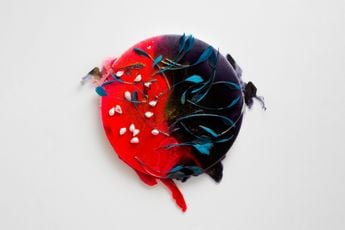
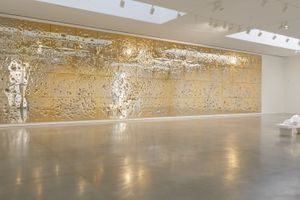
In the late 1980s, Marden began experimenting with pouring pigmented resin onto panels and canvas—an innovation that would become a signature aspect of her practice. These luminous surfaces suspended organic and inorganic materials alike, from seashells and pebbles to sequins and sand, creating layered compositions that recall tide pools or geological formations.
Marden’s use of resin was both formal and symbolic: it allowed for depth, reflection, and a sense of time captured mid-flow. Works like Untitled (Blue Resin) evoke an underwater world where painterly gestures float amidst captured detritus, collapsing distinctions between painting and sculpture, surface and depth. This body of work aligns her with a lineage of American artists exploring materiality—yet her sensibility remains more intuitive than analytical, anchored in sensory experience rather than systems or theory.
Colour and Chance
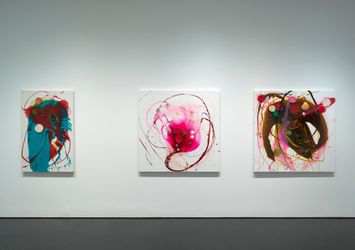
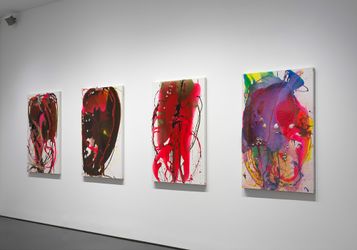
As her career progressed into the 2000s and 2010s, Marden embraced an increasingly improvisational approach to colour and gesture. Her palette intensified—lush crimsons, tropical greens, iridescent golds—and the compositions grew more rhythmically disordered, giving way to vibrant pictorial fields suggestive of maps, constellations, or aquatic topographies.
Rather than working from sketches or plans, she lets the materials guide her process, creating artworks that evolve organically. This method, which incorporates both chance and control, has led to comparisons with action painting and lyrical abstraction, though her works remain distinct for their earthy, oceanic resonance. Red Map, for instance, is less a schematic than a sensual terrain—dense, dripping, alive with painterly momentum.
Material Intuition
Throughout her practice, Marden has returned to the idea that materials carry both metaphorical and physical weight. Her inclusion of found objects—shells, mica flakes, bits of glass—not only breaks the two-dimensional plane of the canvas but also introduces personal and geographic specificity into her paintings. These elements are not merely decorative: they serve as compositional anchors, tactile interruptions, and narrative fragments.
The works become layered palimpsests where memory, travel, and place are embedded in the surface. In this way, Marden’s paintings speak to the tradition of assemblage while remaining resolutely painterly. She merges the handmade with the ephemeral, inviting viewers to both look and feel, to consider how art might hold the residue of experience without turning illustrative. Her material vocabulary situates her in dialogue with contemporary artists exploring hybridity and process in painting today.
Exhibitions
Helen Marden has been the subject of both solo exhibitions and group exhibitions at important institutions and galleries. A selection of important exhibitions are provided below.
Solo Exhibitions
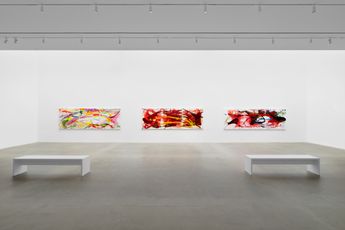
- The Grief Paintings, Gagosian, Park & 75, New York (2024)
- Helen Marden: Bitter Light a Year, Gagosian, 976 Madison Avenue, New York (2021)
- Helen Marden: Tivoli, Gagosian, 976 Madison Avenue, New York (2019)
- Helen Marden, Thomas Healy Gallery, New York (1998)
- Helen Marden, TennisportArts, Long Island City, NY (1993)
Group Exhibitions
- The Warp of Time, Old Carpet Factory, Hydra, Greece (2024)
- Travel Diaries, Musée Mohammed VI d’art moderne et contemporain, Rabat (2024)
- Painting: Now and Forever, Pat Hearn Gallery and Matthew Marks Gallery, New York (1998)
- 1995 Biennial Exhibition, Whitney Museum of American Art, New York (1995)
- Who Chooses Who. New Museum of Contemporary Art, New York (1994)
Critical Reception
Helen Marden’s work has been profiled in respected art publications including Artsy, Galerie Magazine, The New York Times, In a 2024 Conversation in Ocula Magazine, Marden said: ‘In those days, Brice was the art heavyweight. And I had the kids. Finally, I thought, ‘I don’t care. I’m just going to work. If I can keep the kids breathing, I can work.’
Helen Marden FAQs
What influences Helen Marden’s art?
Helen Marden’s art is deeply influenced by her surroundings, especially the natural environments of Hydra, Greece, and Tivoli, New York. Her paintings absorb elements from the landscapes around her—sunlight, sea, earth, flora—and she incorporates shells, stones, and pigments that recall these settings. Equally influential are the sensuous legacies of Abstract Expressionism and artists like Joan Mitchell and Cy Twombly. Marden works intuitively, often letting materials lead her, making chance, colour, and physical texture integral to her contemporary art practice.
What is Helen Marden’s connection to Hydra and Tivoli?
Helen Marden divides her time between Hydra, a Greek island in the Aegean Sea, and Tivoli, a hamlet in upstate New York. Both locations profoundly inform her art. Hydra, with its luminous seascapes, natural detritus, and vibrant Mediterranean colours, directly inspires her palette and materials—she often collects shells and stones from the island’s shores. Tivoli offers a different rhythm, surrounded by forest and seasonal change. These contrasting geographies shape the tone, material presence, and emotional atmosphere of her abstract artworks.
Did Helen Marden ever collaborate with her husband Brice Marden?
While Helen Marden and Brice Marden were married and shared studios during key phases of their careers, they maintained distinct artistic practices and did not formally collaborate on artworks. Helen developed her own visual language, marked by vivid colours, embedded materials, and a gestural approach distinct from Brice’s minimalism. However, their proximity did foster a shared sensitivity to surface, structure, and art history. Their mutual influence is most visible in sensibility rather than style—two divergent paths shaped by dialogue, not collaboration.
Ocula | 2025
Explore Helen Marden's Exhibitions




Representative Artworks






Explore and Follow Artists Shaping Contemporary Art
A respected voice in contemporary art discourse.
Focusing on ambitious storytelling and insightful art-world commentary. Ocula Magazine publishes in-depth interviews, critical essays and timely analysis on the artists, exhibitions and ideas driving the global art world.
Learn more about Ocula Magazine
Showcasing the best of the art world.
Ocula partners with galleries from around the world to highlight their artists, artworks and exhibitions. Gallery membership is by application and invitation, with each member vetted by an independent panel.
Learn more about Ocula Membership
Specialises in the sale of major artworks.
Led by a team with deep ties to the world’s leading auction houses, galleries and collectors. Ocula’s advisory team offers bespoke services to high-net-worth clients from around the world who are looking to acquire the best of contemporary and modern art.
Learn more about our team and services