





HENRY 'MZILI' MUJUNGA
b. 1971, UgandaHenry Mzili Mujunga’s (b. 1971, Uganda) practice is grounded in Indigenous Expressionism, a conceptual framework he coined in 2001 in response to the Eurocentric categories often imposed on African artists. For Mzili, the “indigenous” is not defined by geography alone, but by an internal point of origin – the personal lens through which one sees and interprets the world, shaped by culture, upbringing, history, and lived experience.
Rooted in Pan-African dialogue and artistic exchange, Indigenous Expressionism emerged most decisively from the transformative 2001 workshop in Bagamoyo. It became a declaration of artistic self-definition: rather than conforming to inherited Western art historical labels, Mzili proposed a framework that centers the artist’s own viewpoint, allowing freedom across style, medium, and form. Both an intellectual foundation and a quiet act of resistance, Indigenous Expressionism asserts the legitimacy of African perspectives within global artistic discourse.
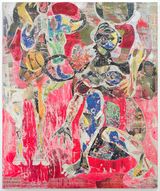
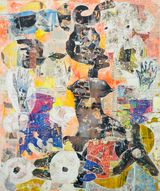
Mzili’s recent works mark a return to his roots as a printmaker. After nearly a decade focused predominantly on painting, he now brings painting and printmaking together in fresh, experimental ways. This body of work is driven by an intense engagement with material and process; by allowing these elements to lead, Mzili accesses the subconscious in search of spiritual and sensual nourishment.
His career spanning over nearly three decades, Henry Mzili Mujunga has established himself as a leading voice in contemporary East African art, with a practice grounded in academic training at Makerere University and international engagement and exchange. His work has been presented in major solo exhibitions at Afriart Gallery and shown widely across Africa, Europe, and the United States, including at Norval Foundation (South Africa), OSTRALE (Germany), Art Basel Miami Beach, and Art X Lagos. Mzili’s practice extends beyond the studio into curatorial work, mentorship, public art, and performance, reflecting a long-standing commitment to critical discourse, artistic experimentation, and the development of Uganda’s contemporary art ecosystem.
Courtesy Afriart Gallery, Kampala.




Explore and Follow Artists Shaping Contemporary Art
A respected voice in contemporary art discourse.
Focusing on ambitious storytelling and insightful art-world commentary. Ocula Magazine publishes in-depth interviews, critical essays and timely analysis on the artists, exhibitions and ideas driving the global art world.
Learn more about Ocula Magazine
Showcasing the best of the art world.
Ocula partners with galleries from around the world to highlight their artists, artworks and exhibitions. Gallery membership is by application and invitation, with each member vetted by an independent panel.
Learn more about Ocula Membership
Specialises in the sale of major artworks.
Led by a team with deep ties to the world’s leading auction houses, galleries and collectors. Ocula’s advisory team offers bespoke services to high-net-worth clients from around the world who are looking to acquire the best of contemporary and modern art.
Learn more about our team and services