It was during this time that she became involved in the Situationist International, a leftist movement whose practice was meant to disrupt the consumerist mind of society. After leaving the group in 1962, de Jong began The Situationist Times in protest to the exclusion of artists by the extreme Situationists, led by Guy Debord. The English-language magazine covered a broad range of topics and was published six times between 1962 and 1967.
The publication reflects the artist’s interest in history, literature, philosophy, and other areas of knowledge that ultimately inform her varied artistic style across her decades-spanning career. Specific issues were dedicated to de Jong’s fascination with topology, which, for her, embodied a type of controlled chaos. She viewed topologies as alternative forms of knowledge that functioned with, and not in opposition to, paradoxes and confusion. This is reflective in her paintings, which she uses to explore contradictions, boundaries, and misunderstandings.
Paintings
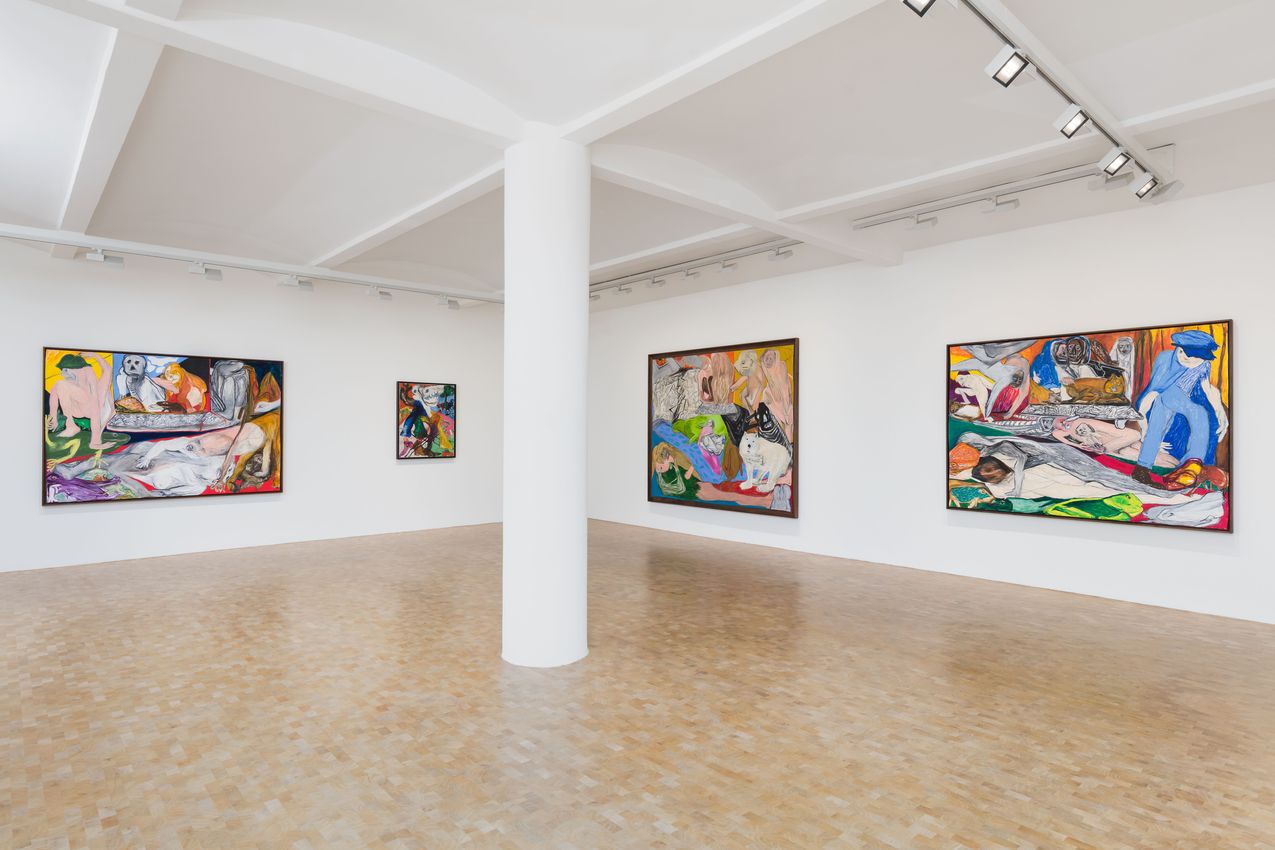
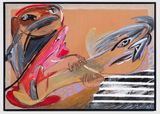
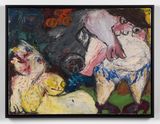
De Jong’s paintings from the early 1960s showcase a highly gestural style, defined by swathes of colour and heavy applications of paint. People, animals, and skeletons began to emerge from the canvas, combined with symbolic pictorial elements. Her artworks show influence from CoBrA, with their violent brushwork, vivid colours, and distorted figures, while also drawing elements from cinema, advertising, and popular culture.
The ‘Kroniek van Amsterdam’ series
During the 1970s, de Jong developed a comic book-like style that consisted of a work set up as a diptych in a suitcase. Measuring 50 by 50 centimetres, the artworks could be closed and carried anywhere. Text, handwritten in English, was inscribed on the left-hand side, while a painted image was situated on the other. These works, titled the ‘Kroniek van Amsterdam’ series, piece together seemingly mundane people and situations into a fragmented narrative.
Later Artwork
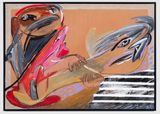
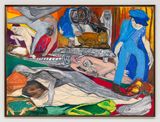
Later paintings show de Jong’s departure from a specific movement, as her colour palette grew lighter and she developed a balance between the playful and the absurd; realism and expressionism; figuration and abstraction. Her experimentation with the application of paint and continued interest in abstract, figural, and animal motifs show influence from artists such as Jean Dubuffet, Wassily Kandinsky, and Vieira da Silva.
Since the 2010s, de Jong’s work has been inspired by old potatoes she found in the cellar of her house in France, which she uses to create installations, photographs, and paintings. She has returned to a dynamic expressionist state that recalls her works from the 1960s.